





AV Insider is our new series of interviews with influential people inside the AV industry. From execs to the people behind the technology, every Friday we'll bring you a new perspective on world of TV and audio.
Every year, there are innovations in the world of TV panels, ranging from OLED upgrades to next-gen RGB-backlit sets. The smart TV platforms get just a ton of upgrades too, but these don’t generally get as much attention — or as much innovation.
Some brands are adding new ‘AI’ features for picture and sound enhancement, but the core of the operating system (OS) in the TV stays similar each year.
I recently spoke to Balaji Krishnan, founder and CEO of Displace, a US-based TV manufacturer with a couple of groundbreaking launches under its belt — and what stands out is that its TVs are wireless, capable of fixing themselves to the wall and running from batteries. It launched an OLED you could mount anywhere first, and then followed up with a smaller 27-inch TV that again can be stuck anywhere.
Displace's most recent launch is the Pro TV 2, an OLED which features the Displace OS, the company’s own smart TV platform. I discussed with Balaji what he sees as the future of TV, as a relatively new company in the space.
‘More than a display’

“If you want to move the needle in this TV market, you have to go beyond a display product”, Balaji says when I ask him about his thoughts on the current TV market. “If you look at all the screens we have at home, the biggest screen is the TV”.
But Balaji thinks TVs need to get smarter. “Ironically, it’s the dumbest screen we all have at home. My watch screen is a smarter product”.
While smart TVs do provide access to streaming apps and some are starting to introduce more ‘AI-based’ smart features for content recommendation and picture and sound enhancement, Balaji believes the smart TV platforms in these TVs are lacking. “The smart TVs these companies sell don’t work well in terms of software. The user experience sucks”.
Balaji sees it that people are using their TVs purely to stream video content and even then they would rather go for a streaming device such as Roku Stick, Apple TV or Fire Stick, as they provide a better user experience than the TV’s own software.
So, what does Balaji feel needs to happen in order for TVs to ‘get smarter’? This is where Displace OS and the ‘native AI’ of the Pro TV 2 come into play, in his view. Displace OS is a browser-based platform and the goal on Displace’s part is inter-connectivity with other devices. “We built a browser-based operating system because that is where you connect a lot of your day-to-day activities, be it your email, your Amazon commerce, anything to do with the internet.”
In a style out of the likes of Blade Runner or Minority Report, Balaji believes the TV can become the main hub of the home, citing it as the “consolidation of all your activities”.
While brands such as LG with its webOS platform and Samsung’s own Tizen platform are starting to include more ‘daily activity’ based apps and home pages, they’re by no means comprehensive.
So, what does Displace OS and the Pro TV 2 think it should offer that these other companies’ software doesn’t? I briefly mentioned it above: native AI.
AI on TVs
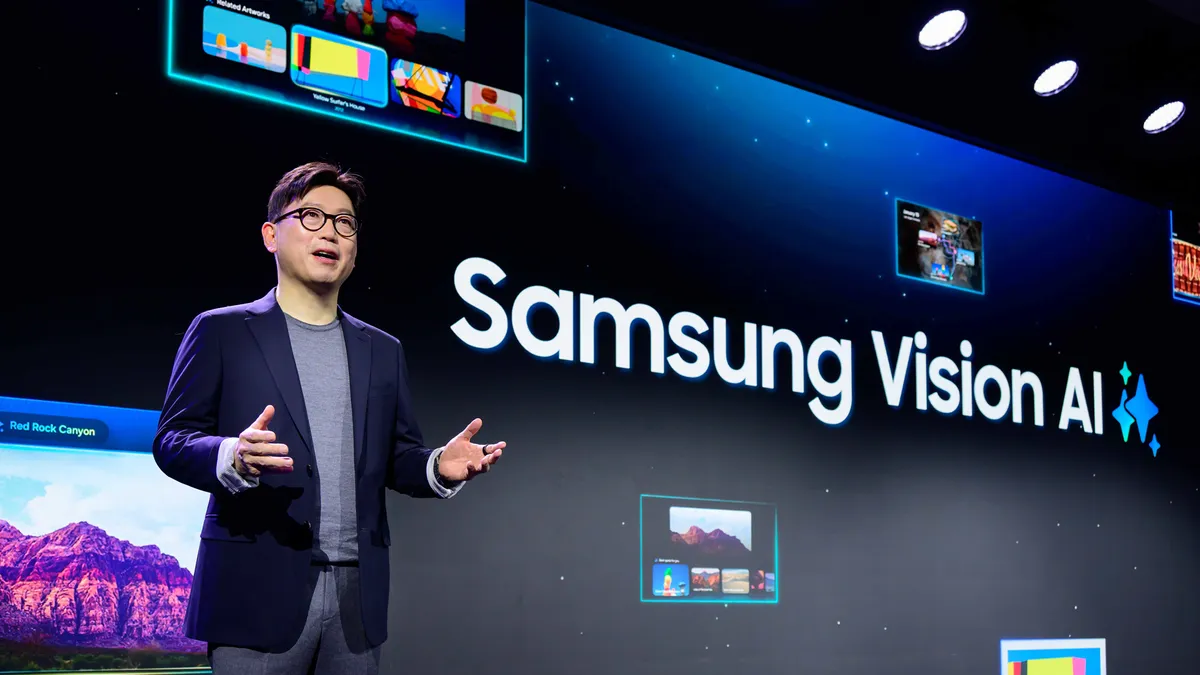
If you’ve been following TVs for a few years now, you’ll have noticed AI has really crept its way into the lexicon. LG, responsible for delivering some of the best OLED TVs on the market, has AI processors and AI features such as AI Picture Wizard, AI Search and so on. Samsung has rebranded its TV lineup as ‘Vision AI TVs’, with a focus on AI-based picture features.
I asked Balaji if these AI features are really ‘AI’ in the current sense of the word — as I haven’t seen these features as really being 'AI in the sense we mean it in world with ChatGPT and Google Gemini — and he agreed. “You walk down the aisle of these TVs at CES — Hisense, TCL, everyone was saying AI TV. All these AI technologies that they call AI, to your point, it is not AI. They just do better contrast, better picture quality, depending upon the ambient lighting and all that stuff, but that's not AI per se, it's more like, you know, optimization of your picture quality.”
So, what does Displace 2.0 and the Displace Pro TV 2 offer in terms of AI? Some of the headline features include pause-to-shop, which detects products on screen when content is paused and finds purchasing options “aligned with a user’s preferences."
There’s also gesture control, live conversational search where a user could ask for a specific scene, and even a personalized news agent where users can select a text based source, such as TechRadar, and Pro TV 2 will generate video news channels based on the chosen source.
While this all sounds like more advanced use of AI capabilities, some of its also sounds pretty dystopian. I naturally had to ask Balaji about security. For all these customized and personalized touches that Pro TV 2’s AI brings, you’d think there’d need to be a lot of data collected. But, the Pro TV 2 is advertised as a "privacy-first AI TV".
“It should not be sending any of your personal information to the cloud, so that is why we built NPUs inside the TV," sas Balaji. "But it has to access the internet to bring internet data that is personalized for you based on your personal information.”
“I wouldn't feel comfortable connecting my Amazon account with a third-party cloud provider where they can actually get all my data and then use it for other purposes”, Balaji says, by way of explanation on his "privacy-first" with the Pro TV 2 and Displace OS.
Post purchase and ads
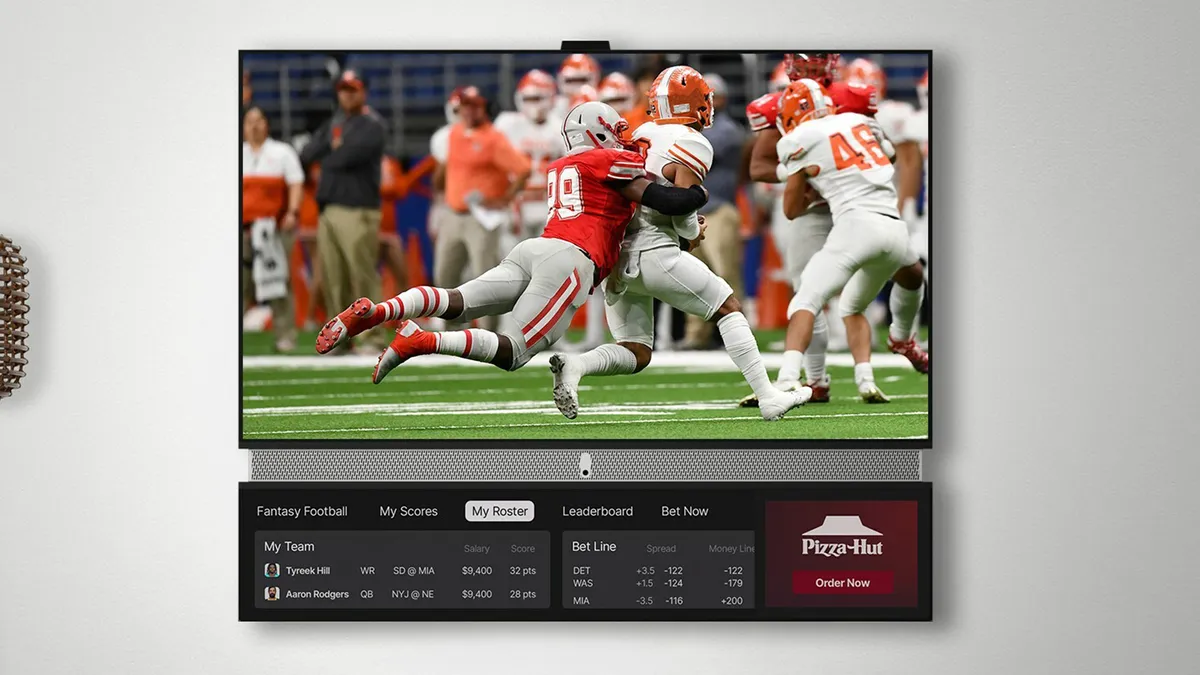
Advertising is always a much-discussed topic when it comes to TV. Most brands will have some sort of ads in their smart TV platform, most often on the home screen. More and more are starting to implement ads in a TV’s screensaver mode, such as Roku and LG.
To Balaji, this seems like a company’s attempt at monetizing after purchase. “I see this to be a more desperate measure for the TV companies to monetize. They have been trying to monetize in various different ways, they were not succeeding, and the only way that they could monetize now is through ads and selling data”.
In fact, Balaji discussed the company Telly, which sells a 55-inch LCD TV for $200. In exchange for this ridiculously low price, there is a constant banner of ads at the bottom of the screen. And again, that means giving over data. “Would you be willing to compromise your privacy for $200?”, Balaji says. “I would not do it, but apparently they are getting into that direction.”
Balaji believes that the hardware side of the business just doesn’t make money, hence why companies have gone down this route. “I think all these things are happening because they think hardware is a low-margin business, so they have to make money beyond hardware, and the only easy path that they can see is to collect data and sell data, which I think is not good for this ecosystem.”
Post-purchase monetization, via pause-to-shop and other features, and the evolution of the TV as ‘just a screen’ seems to be at the core of Displace’s thinking, which Balaji calls “a significant shift from the traditional, legacy way of thinking about TV”.
It will be interesting to see if other brands adopt this way of thinking, or whether the money from data and ads is just too tempting to let go. And, while we’re seeing brands like LG adopt AI into its TVs in other ways, such as content discovery, it’ll be interesting to see if it gets used with this post-purchase monetization in mind — Balaji makes the case that it's the better monetization option, but I wonder if everyone will see it as the better option.
Thinking of buying a new TV?
Try our TV size and model finder! You tell it how far you sit from your TV, we'll tell you what size to buy based on viewing angle advice from image quality experts, and we'll recommend our three top TVs at that size for different prices.
Follow TechRadar on Google News and add us as a preferred source to get our expert news, reviews, and opinion in your feeds. Make sure to click the Follow button!
And of course, you can also follow TechRadar on YouTube and TikTok for news, reviews, unboxings in video form, and get regular updates from us on WhatsApp too.
