


The TechRadar team has been reviewing and testing camera equipment since Sony mirrorless cameras were a thing – and we've checked out a whole host of Sony E-mount lenses, too. There are a lot of these lenses to pore over, however, from wide-angle primes to super-telephoto zooms, available for both APS-C and full-frame Sony cameras, which is why we've put together this guide. It's designed to help you find the best E-mount lens for your shooting style (and your budget).
No one lens can cover every scenario. That said, we think the Sony FE 16-35mm F2.8 GM II is a fantastic piece of E-mount glass. It’s relatively compact, focuses reliably, and delivers excellent detail across the frame. Sony’s catalog also includes several prime options, such as the FE 50mm F1.4 GM, a premium nifty fifty that shoots sharp and fast.
We've put each of the lenses featured in this guide through a rigorous testing process, covering all focal lengths. Our team combines the techy specs with our real-world shooting experience to evaluate and compare glass, and ultimately recommend the best lenses that tick all the important boxes. Think build quality and optical performance.
For clarity, I've divided the list into three main sections: wide, standard, and telephoto. You'll also find gems from Sigma and Viltrox in our rankings, because no other lens mount has been so widely adopted by third parties.

I'm TechRadar's Cameras Editor, with more than 15 years' experience in the photo industry, during which time I've shot with kit from the biggest camera manufacturers – including a lot of the best Sony lenses. That gives me a unique picture of what makes a great Sony lens. Many Sony cameras are sold with kit zoom lenses, which are useful for getting started, but I believe that more experienced photographers should look to additional lenses, in order to expand their photography and achieve better results in different situations.
Why you can trust TechRadar
Together, our team has reviewed hundreds of lenses over the years and, when testing the best Sony lenses, we take our evaluation process seriously. Every time we review a lens, we spend a significant amount of hands-on time with it to ensure that we've understood the benefits and drawbacks of each model for different types of photographer. We test each lens with one of the best Sony cameras and, where relevant, try to use it with both a full-frame and an APS-C model.
☑️ 100s of lenses reviewed
☑️ 15 years of product testing
☑️ Over 16,000 products reviewed in total
☑️ Nearly 200,000 hours testing tech
Our testing process goes beyond controlled conditions. We think a lot about the real-world situations where most Sony users will shoot with their lenses. We take each lens out into the field and put it through several different scenarios and environments. These can range from landscapes and portraits to busy streets by day and night. This approach allows me to assess the practical performance of a given lens, including features such as image stabilization – and how suitable it is for different styles of photography.
⭣ Read more
During these tests, we'll consider several factors. A key one is autofocus performance, particularly when reviewing lenses aimed at action or street photography. We test both the speed and accuracy of the lens in various lighting conditions, as well as listening for the volume of its motor.
We also consider the build quality and ergonomics of every lens, for both durability and usability. We assess the barrel's feel and whether it seems rugged enough for the scenarios where the lens will be used. We also consider handling, including the placement of controls and focus rings, both for new and experienced users.
When it comes to assessing the images shot on test, there are a few factors we look out for. We start by evaluating the overall quality, looking particularly at sharpness and contrast. For lenses with a wider aperture, we'll look for smooth bokeh in defocused areas. We also keep a careful eye out for any optical imperfections that can reduce image quality, including distortion, fringing and chromatic aberrations.
From the result of all these tests, we'll form an assessment of a lens’ suitability for different types of photography. We'll also consider its strengths and weaknesses against those of alternative lenses, including similarly priced options from Sony and other manufacturers, as well as more expensive glass in the same category. The result determines whether or not we recommend it as one of the best Sony lenses.
Meet the team
Collectively, our team of reviewers has amassed over a hundred years of camera experience and testing, covering all of the latest and greatest cameras in the last 20 years.

For more than a decade, Chris has been finding and featuring the best kit you can carry. When he's not writing about his favourite things for Stuff, you'll find Chris field-testing the latest gear for TechRadar. From cameras to classic cars, he appreciates anything that gets better with age.

James Abbott is a professional photographer and freelance photography journalist. He contributes articles about photography, cameras and drones to a wide range of magazines and websites where he applies a wealth of experience to testing the latest photographic tech. He's one of our top go-to drone experts.

Mark is TechRadar's Senior news editor and has been a technology journalist since 2004. Formerly Trusted Reviews and TechRadar's cameras editor, Mark has tested cameras over many years from all of the leading brands.

Amy has been writing about cameras, photography and associated tech since 2009. Amy was once part of the photography testing team for Future Publishing working across TechRadar, Digital Camera, PhotoPlus, N Photo and Photography Week.
Today's best Sony standard lenses
Why you can trust TechRadar We spend hours testing every product or service we review, so you can be sure you're buying the best. Find out more about how we test.
Below you'll find full write-ups for each of the best Sony standard lenses in our list. We've tested each one extensively, so you can be sure that our recommendations can be trusted.
The best standard prime Sony lens


Sony FE 50mm F1.4 GM sample images


✅ You would like a high-quality 50mm prime: this is no mere nifty fifty, but a premium optic with fast, accurate and near-silent autofocus.
✅ You need a take-everywhere lens: At just 18.3oz / 516g, this is a great lens to have attached to your camera most of the time.
❌ You’re on a budget: At $1299 / £1500 / AU$2599, this lens has a professional price tag that may be difficult to justify for some enthusiasts. A great alternative is the Sigma 50mm F1.4 DG DN | Art, which is almost half the price.
❌ You prefer the versatility of zooms: Want to carry fewer lenses when out shooting? A versatile zoom like the 24-70mm F2.8 GM could be a better bet.
Traditionally, nifty fifties are inexpensive, compact and capable of producing great images. This 50mm prime does the second two fantastically: in our review, we described it as “an exquisite lens”, praising its excellent quality at all apertures, as well as its tidy, lightweight design. What’s more, its autofocus is rapid, accurate and operates almost silently, making it just as versatile for video as it is for stills. Shooting wide open, we found bokeh pleasing as well.
The downside is that you’ll need to part with a significant amount of money to buy one. The price is firmly in professional territory, making it a less accessible option for many enthusiasts. And if you are willing to make such a significant investment in a 50mm prime, you might want to look further upwards towards the even faster Sony FE 50mm f/1.2. Still, if you want a high-quality prime lens that’s built well and sized to take anywhere, there’s no denying that the Sony FE 50mm f/1.4 is a fantastic piece of glass.
- Read our in-depth Sony FE 50mm F1.4 GM review
The best Sony prime lens for portraits


Sony FE 85mm F1.4 GM II sample images


✅ You want the best Sony 85mm lens there is: The original FE 85mm F1.4 G Master was good, and there are excellent, affordable third-party options from Sigma and Viltrox, but overall Sony's version II is the pick of the bunch.
✅ You’re trying to keep the weight down: The Mark II is 20% smaller than the original 85mm lens, but even better optically.
❌ Your budget is feeling the squeeze: Heart set on an 85mm lens? The Sigma 85mm f/1.4 DG HSM Art and Viltrox 85mm F1.4 Pro are stellar, affordable alternatives.
❌ You already have the original FE 85mm F1.4 GM: Yes, the lens is pretty exceptional and an upgrade in many ways, but the original is still a solid pick.
The original Sony FE 85mm F1.4 GM was already one of our favorite lenses for shooting portraits on an E-mount camera. The sequel is better in almost every way: its new dual linear motor autofocus system proved faster and more responsive in our review, while improved optics delivered an upgrade to both resolution and aberration control. Despite this added complexity, the lens is actually slimmer and lighter than the original. It’s still a relatively large lens, but it also handles superbly, with two useful function buttons and a de-clickable aperture ring.
Perfectionists might wish for a maximum aperture of f/1.2 instead of f/1.4, but based on our experiences, the GM II performs spectacularly. Edge-to-edge sharpness is superlative, with barely any noticeable difference in detail between f/1.4 and f/8. There is some cats-eye bokeh near the frame edges, but we didn’t encounter any bokeh fringing whatsoever. There are cheaper alternatives, such as the Sigma 85mm f/1.4 DG HSM Art, but if budget isn’t an issue, this is comfortably the best Sony 85mm lens money can buy.
The best Sony zoom lens for video


Sony FE 20-70mm F4 G sample images


✅ You need a small, lightweight zoom: small, lightweight, and with a useful standard zoom range wider than most 20mm settings.
✅ You need a travel lens: If you're a travel photographer and are after a versatile hybrid lens, the 20-70mm can easily cover video, landscapes, portraits, and many subjects in between.
❌ You want a pro-standard zoom: Optically, the Sony FE 24-70mm F2.8 GM II is a better lens, even if it's not quite as wide, plus it costs much more.
❌ You need a particularly wide-angle zoom: It's wider than most standard zooms, but the Sony FE 16-35mm F4 ZA OSS is even wider.
If you’re looking for a compact everyday lens with a versatile focal range, this 20-70mm glass is a great fit for Sony’s full-frame mirrorless cameras. Besides a useful zoom range, its constant f/4 maximum aperture makes it a flexible option for a spectrum of subjects and scenarios. At 488g, it’s easy to carry all day, while its dimensions proved conveniently portable during our tests. Quiet motors are a win for video – even if they're not completely silent – as is the aperture ring, which can de-click for smooth adjustment.
While it can go wider than most standard zooms, we did encounter distortion at the wide end of the focal range. If you shoot with an APS-C model, the effective range of 35-105mm also means you’ll lose the wide-angle appeal. Still, it produces beautifully sharp images throughout the aperture range and can’t be faulted on detail. International price disparities mean it’s not the cheapest in every region, but if you can look past the optical distortion, it’s a respectable lightweight lens that can cover the majority of photography situations.
- Read our in-depth Sony FE 20-70mm F4 G review
The best Sony standard zoom lens


Sony FE 28-70mm F2 GM sample images


✅ You want top quality at every focal length: Sony has made very few optical compromises – detail is pin-sharp at the center across the zoom range, while lens distortions are practically non-existent.
✅ You want a prime-quality zoom: The Sony FE 28-70mm F2 GM is a dream one-stop shop, with the optical quality and bright f/2 aperture of a prime lens, with the versatility of a zoom.
❌ You need a wide-angle zoom lens: Most pro standard zooms start at 24mm, but Sony has sacrificed 4mm in favor of a constant f/2 maximum aperture. If you're unlikely to make use of f/2 a lot, then look to a 24-70mm instead.
❌ You shoot at a specific focal length: It has the quality of a prime, but it also has the price and size of several primes combined. So, if you only plan to shoot at a specific focal length, be it 50mm, you can get an even faster aperture for less.
This might just be the ultimate standard zoom lens, combining prime-level performance with real versatility. Its constant f/2 maximum aperture (a full stop faster than typical f/2.8 alternatives) delivers exceptional low-light capability and beautiful bokeh across the entire zoom range.
Optically, the G Master glass is superb: pin-sharp detail at every focal length; minimal vignetting or chromatic aberrations; and strong contrast throughout. Four XD linear motors provide rapid, whisper-quiet autofocus that locks onto subjects with laser precision, making it surprisingly effective for action photography.
Despite its fast optics, Sony's kept it remarkably compact, especially compared to Canon's equivalent, and at 918g it balances well on full-frame bodies without feeling overly front-heavy. The robust build features comprehensive weather seals and tactile controls, including customizable buttons and torque/click switches for zoom and aperture rings.
The main drawbacks are no lens-based stabilization (though fast shutter speeds at f/2 compensate) and a 28mm starting point rather than the usual 24mm. And it's undeniably expensive. However, for professionals needing one lens that truly does it all. From low-light events to portraits, this could replace several primes in your kit.
- Read our in-depth Sony FE 28-70mm F2 GM review
Today's best Sony wide angle lenses
Below you'll find full write-ups for each of the best Sony wide-angle lenses in our list. We've tested each one extensively, so you can be sure that our recommendations can be trusted.
The best Sony wide-angle zoom lens


Sony FE 16-35mm F2.8 GM II sample images


✅ You're a pro events photographer or filmmaker: A wide-angle zoom gets you into tight spaces and can fit large groups of people / sweeping scenery.
✅ You'll carry the lens all day: A smaller size and weight are benefits over the original lens, and every saving helps if you have a packed kit bag and lug gear around all day.
❌ You don't need f/2.8: Sony's FE PZ 16-35mm f/4 G lens is much smaller, lighter, and cost-effective.
❌ You shoot at one focal length: Most people shoot at either extreme of a zoom lens's focal length. So, if you tend to shoot at 35mm more, perhaps the Sony FE 35mm f/1.4 G Master lens is a better option.
A significant upgrade to one of Sony’s best wide-angle zoom lenses, the FE 16-35mm F2.8 GM II is an even better choice for serious photographers. At 547g, it’s some 20% lighter than before. We didn’t specifically notice the weight reduction in our review, but it certainly feels compact for a 16-35mm f/2.8 lens.
Another change is the new aperture ring, which has a 'clickless' switch for smooth shifts when shooting video. Closer focusing means you can also use it effectively for close-ups, as well as wide shots.
The original 16-35mm f/2.8 G Master delivered excellent quality, and this version is sharper still. Images are packed with crisp detail across the frame. We were also impressed with focusing: by the end of our tests, we simply trusted it to work. If you don’t need to shoot at f/2.8, you’ll find better value from the Sony FE PZ 16-35mm f/4 G lens. Similarly, if you’re a street photographer who mainly shoots at 35mm, the Sony FE 35mm f/1.4 G Master might make more sense. But if you want the versatility of 16-35mm and demand the absolute best detail possible, this is the lens for you.
- Read our in-depth Sony FE 16-35mm F2.8 GM II review
The best wide-angle Sony prime lens

Sony FE 24mm f/1.4 GM sample images


✅ 24mm is your jam: This is a niche lens, but if 24mm is your choice focal length, then there's no better alternative, even a zoom that covers 24mm such as a 24-70mm.
✅ You like wide angle portraiture: The focal length and maximum f/1.4 aperture are a dream combo for wide angle portraiture.
❌ You'd like a versatile wide-angle lens: Sony has a range of zoom lenses that cover the 24mm focal length, all of which will be more versatile overall, except for the compromise on aperture.
❌ You'd like an affordable wide angle prime: Sony's 24mm f/1.4 is superb, but there are also affordable alternatives with similar specs available.
Sony designed the FE 24mm f/1.4 GM around four key criteria: resolution, bokeh, speed, and a compact and lightweight design. Based on our review, it doesn't disappoint on any of those. Image quality proved stunning in testing, with excellent sharpness across the frame, while the 11-blade circular aperture rendered smooth, natural-looking bokeh.
We found focusing swift, thanks to the Direct Drive SSM (DDSSM). At only 445g, it also weighs in at quite a bit lighter than Canon's 24mm f/1.4 (650g), Nikon's 24mm f/1.4 (620g) and Sigma's 24mm f/1.4 (665g). Combine all of that with fantastic build quality, and you've got a Sony lens that should continue to deliver for several generations of full-frame Alpha cameras. The only real downside is its hefty price tag.
- Read our in-depth Sony FE 24mm f/1.4 GM review
The best wide-angle zoom for Sony APS-C cameras


Sigma 10-18mm f/2.8 DC DN | Contemporary sample images


✅ You want a tiny lens big on performance for your APS-C Sony:
It's hard to believe the optical quality, versatility, and handy constant f/2.8 aperture can be found in such a tiny lens.
✅ You also dabble with macro photography: A maximum 0.5x magnification is another string to the Sigma lens' bow.
❌ You want handy external controls for lens settings: Somewhat disconcertingly, there are no external controls, meaning adjustments to camera settings like focus mode are made in camera – which can be a time sink.
❌ You’re wanting a hybrid lens: Yes, it performs well for video, but the Sigma 10-18mm lacks the external controls that filmmakers rely on.
The 10-18mm F2.8 DC DN helps to cement Sigma’s reputation for top-quality third-party glass. Paired with a Sony APS-C camera like the A6700, it’s equally as useful for vloggers as it is for landscape photographers. In our review, we were impressed by its build quality and the usefulness of its ultra-wide field of view. We also noted that it compares in size to Sony’s 10-18mm f/4 lens, yet offers a constant f/2.8 aperture – which makes it great for working handheld in low light and capturing soft backgrounds.
Optically, this glass is sharp at any setting. With lens corrections disabled, we did notice significant vignetting and barrel distortion; but leave them enabled, and there are very few flaws to speak of. The minimum focus distance is also good for up to 0.5x magnification, which is plenty for proper close-up work, and we found pleasing bokeh when shooting at f/2.8.
Those who like direct controls will need to look elsewhere, as there are no external switches or buttons. But if you want a lightweight, streamlined ultra-wide, this is a lens we can confidently recommend.
- Read our in-depth Sigma 10-18mm F2.8 DC DN review
The best super wide-angle prime for Sony cameras


Sony FE 16mm F1.8 G sample images


✅ You shoot wide-angle in various light: With its fast f/1.8 maximum aperture, Sony’s super-wide prime has the light-gathering abilities to shoot sharp in dim conditions, such as for astrophotography.
✅ You want a lightweight wide-angle lens: This is no GM lens, and as such it weighs in at just 304g, making it a tidy choice for travelling.
❌ You need supreme optical quality: Center sharpness drops off in the corners when shooting at wide apertures, resulting in softness and a loss of detail.
❌ You want a versatile wide-angle zoom: The f/1.8 maximum aperture is a win, but the Sony FE 16-35mm F2.8 GM II zoom is a more flexible choice.
With bright optics and a tidy design, the Sony FE 16mm F1.8 G is a good choice if you want to cover wide angles in different lights. In testing, we found that its fast maximum aperture allowed it to shoot sharp even in dim conditions. It could also deliver soft backdrops and attractive bokeh with close subjects, which isn’t a given for wide-angle glass. Physically, we also found it an easy lens to wield. Its plastic build doesn’t feel exactly premium, but the pay-off is that it hits the scales at just 304g.
Optically, this isn’t a perfect lens. Sharpness is best at the center, with detail lost at the corners when shooting at wide apertures. That’s a result of distortion correction, which is required to fix significant barrel distortion. This is handled in-camera for JPEGs, but needs to be addressed in post for raw files, as well as some vignetting. Even so, we think this is a useful little lens, especially for vloggers: its focal length is ideal for self-shot videography, and there’s minimal focus breathing.
- Read our in-depth Sony FE 16mm F1.8 G review
The best Sony telephoto lenses for today
Below you'll find full write-ups for each of the best Sony telephoto lenses in our list. We've tested each one extensively, so you can be sure that our recommendations can be trusted.
The best Sony macro zoom lens


Sony FE 70-200mm F4 Macro G OSS II sample images


✅ You're into macro photography: A 70-200mm f/4 zoom lens with a 0.5x magnification? This is versatility in the highest form.
✅ You don't need f/2.8: Sony also produces a pricier 70-200mm F2.8 GM lens, which is more versatile in low light.
❌ You shoot a lot in low light: With a maximum f/4 aperture throughout the zoom range, you'll really be pushing your Sony camera's image quality limits in low light.
❌ You don't need all its features: it's small, sharp, and excellent for macro, but it is pricey for an f/4 zoom. If you can live with a simpler alternative, the first-gen model costs much less.
A decade after the original, the Sony FE 70-200mm F4 G OSS II represents a total redesign. Compared to the first iteration, it's smaller and lighter – a fact alone that would make it worth upgrading. In testing, we tried it with both the Sony A7C R and the crop-sensor A6700, both of which proved an excellent fit. But there’s more: the second edition is faster to focus and sharper, too. With a Sony full-frame body attached, it’s one of the most versatile lenses in this list.
In our review, we found it capable of rendering super-sharp detail with virtually no distortion. We found almost nothing in our sample images to pick fault with. It also delivers pleasant bokeh for an f/4 lens. Sure, the Sony FE 70-200mm F2.8 is better for bokeh and low light, but it’s also heavier and more expensive. What the F4 adds is class-leading macro focusing, with up to 0.5x magnification at any focal length. If you want a truly versatile, travel-friendly telephoto zoom and you’re happy to pay a premium for it, this is a winning combination.
- Read our in-depth Sony FE 70-200mm F4 G OSS II review
The best super telephoto zoom for Sony cameras


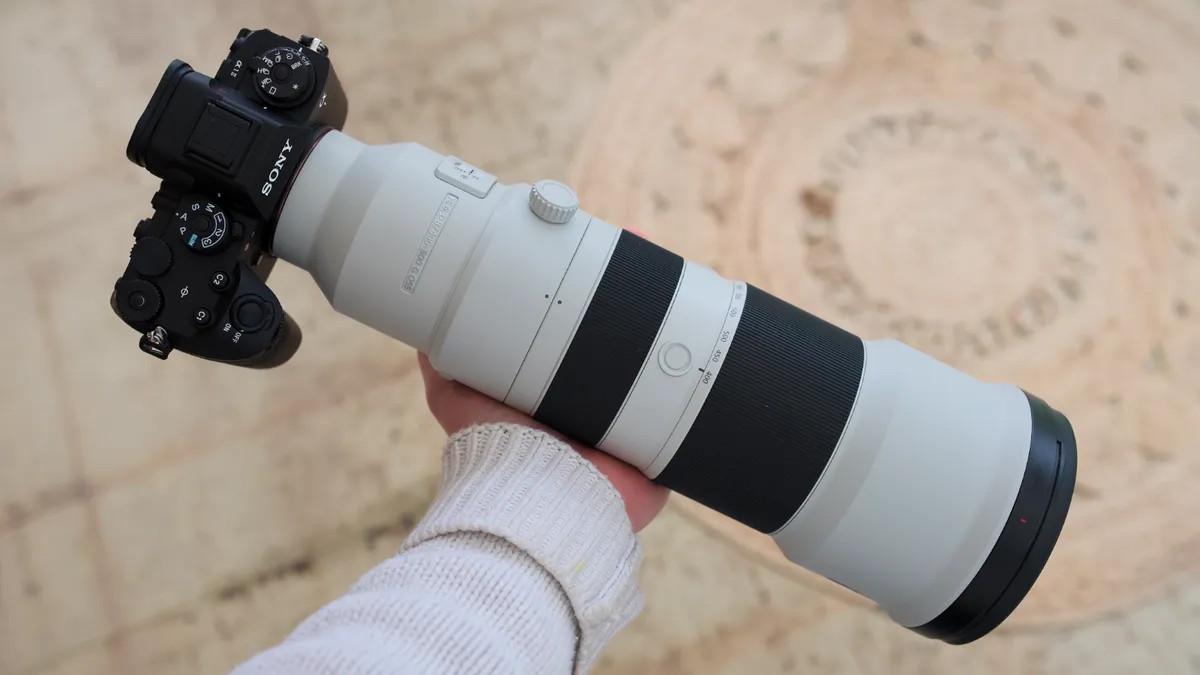


Sony FE 400-800mm F6.3-8 G OSS sample images


✅ You’re a birdlife photographer: The extreme reach of the lens is perfect for small wildlife such as birds.
✅ You shoot subjects from a long distance: Put simply, this is Sony’s longest telephoto zoom, which gets you significantly closer to the action.
❌ You’re a pro sports photographer: The max f/6.3-8 aperture is pretty slow, and the lens will struggle to keep up with fast-paced action in challenging light.
❌ You don’t want to visit the chiropractor: At 2.5kg, the 400- 800 mm lens is a large and heavy carry over long periods.
Offering the longest reach of any Sony telephoto zoom to date, the FE 400-800mm F6.3-8 G OSS is an impressive lens for wildlife photographers. We found it fairly hefty in testing, but several features help to make it manageable. One is internal zoom, which keeps the weight balance centered over the tripod foot. We also welcomed the tactile controls, short-throw zoom ring and customizable function buttons, all of which make this an easier lens to handle. It feels solidly assembled, too.
In performance terms, we found autofocus responsive on the FE 400-800mm F6.3-8 G OSS. We also recognized the usefulness of its ability to focus on subjects at a distance of 1.7m, particularly when shooting wild subjects. That said, the zoom range does come with some compromises: optically, it’s not as sharp as a telephoto prime, while the relatively slow maximum aperture isn’t ideal for sports photography.
Still, if you want a well-built, weather-sealed super telephoto zoom with decent sharpness, this one can cover a lot of bases.
- Read our in-depth Sony FE 400-800mm F6.3-8 G OSS review
The best Sony zoom lens for events


Sony FE 50-150mm F2 GM sample images


✅ You're an events photographer: I can't think of a better single lens for wedding event photography, with a 50-150mm zoom range, constant f/2 aperture, and prime-quality sharpness.
✅ You need a workhorse lens: This is a GM lens, with pro-quality build quality able to handle the rigors of professional use.
❌ You know your focal length: You're paying extra and carrying a heavier optic to effectively get several primes into one lens. If you stick to a specific focal length – buy that prime instead.
❌ You don't need f/2: Sony also produces superb f/2.8 and f/4 zooms with a similar focal range that are much smaller, lighter, and cheaper!
The groundbreaking FE 50-150mm f/2 GM is the world's first telephoto zoom able to maintain a constant f/2 maximum aperture, and we found it genuinely exceptional for events and sports photography.
While the unconventional focal range might raise eyebrows, after extended testing, we reckon it's more versatile than traditional 70-200mm alternatives. And when paired with high-resolution bodies like the A7R V, the potential for cropping down effectively extends the reach for grassroots sports coverage.
The f/2 aperture delivers spectacular bokeh, particularly at the telephoto end, with subject isolation to rival a prime lens. That extra stop over f/2.8 zooms provides crucial light-gathering ability for low-light situations like weddings and indoor events. Image quality is outstanding across the zoom range: consistently sharp; minimal vignetting; and easily corrected pincushion distortion. Four XD linear motors drive rapid, near-silent autofocus, while its professional build quality extends to comprehensive weather sealing.
Yes, it's seriously pricey, decidedly hefty at 1.34kg, and comes with a bag-stretching 102.8mm diameter. There's no optical stabilization either, though Sony's excellent IBIS compensates. But if you're a professional needing one lens capable of covering everything from portraits through to distant action, all with prime-level performance, this makes a compelling choice.
- Read our in-depth Sony FE 50-150mm F2 GM review
The best Sony macro prime lens


Sony FE 100mm f/2.8 Macro GM OSS sample images


✅ You want an upgrade from the Sony FE 90mm f/2.8 Macro G OSS: The new Sony FE 100mm f/2.8 Macro GM OSS has plentiful upgrades that make it the ultimate macro lens for Sony shooters.
✅ You need teleconverter compatibility: Unlike Sony's 10-year-old 90mm macro, the Sony FE 100mm f/2.8 Macro GM OSS has been designed to work with Sony's 1.4x and 2x teleconverters, effectively turning the lens into a 140mm f/3.5 or 200mm f/5.6, respectively.
❌ You're on a budget: This is one of the most expensive macro lenses on the market, so Sony's older FE 90mm f/2.8 Macro G OSS or third-party options will be a better choice for those on stricter budgets.
❌ You don't need the extra magnification: Sony's new macro lens can go to 1.4x magnification, but the old Sony FE 90mm macro can go to 1x magnification, which is still perfectly suitable for close life-size macro shots.
Sony's latest macro prime is the 100mm F2.8 Macro GM OSS, and it's in a different league to the 90mm F2.8 Macro G OSS, a long time favorite with macro photographers; its optical quality is improved, autofocus is 1.9x faster, optical stabilization is steadier, zoom is increased, it's now compatible with teleconverters and, most tellingly, its maximum magnification gets a boost.
Whereas the 90mm lens offers a 1:1 (1x) rendering of subjects, the new 100mm macro lens goes bigger than life size, with a 1.4x magnification. We paired the lens with the high-resolution A7R V for our review, and the combination proved formidable – with the tiniest of details rendered in incredible clarity. And the 100mm's attributes go beyond macro photography – this is an excellent product photography, still life, and flat lay lens, while its smooth bokeh characteristics make it a decent option for portrait photography too.
It might not be groundbreaking given that Canon launched such a lens years ago, and it is pretty pricey for a 100mm f2.8 macro lens. However, if you're a pro macro photographer who shoots with Sony, or if it's a serious hobby, then you won't find a better quality option, and that's why the five-star rating in our review was such an easy choice.
- Read our in-depth Sony FE 100mm F2.8 Macro GM OSS review
Also consider
With so many Sony lenses on the market, there was a lot of capable e-mount glass that didn't make the cut. Here are some honorable mentions that are also worth looking at:
Best standard zoom – Sigma 24-70mm f/2.8 DG DN Art: Half the price of Sony’s equivalent G Master glass, this Sigma zoom is impressive mechanically and optically. Autofocus is fast and quiet, while image quality is superb. The only negative is a bit of barrel distortion at the short end.
Best telephoto zoom – Sony FE 100-400mm F4.5-5.6 GM OSS: While 1,395g is hardly lightweight, this versatile zoom lens is relatively compact for a telephoto. It's well-built, handles well and balances fantastically with full-frame Sony bodies. Focusing is incredibly quiet and quick, plus optical performance is very good.
Best value portrait lens – Sony FE 85mm f/1.8: A chunky plastic lens with a relatively clean design, this is a great value option for portraiture if you can’t stretch to more exotic glass. Focusing is nice and brisk, plus it’s incredibly sharp at the centre of the frame.
Best super telephoto – Sony FE 200-600mm F5.6-6.3 G OSS: With a tough, weather-sealed construction, this super telephoto is ideal for everything from action sports to wildlife photography. Handling is excellent, autofocus super-fast and optical performance consistently outstanding.
Best for reportage – Sony Distagon T* FE 35mm F1.4 ZA: It’s pricey and heavy, but this f/1.4 Distagon lens offers a generous feature set, including an aperture ring with the option to select stepped or free rotation. Sharpness is exemplary across the entire frame.
Best macro prime – Sony FE 90mm F2.8 Macro G OSS: Quiet autofocus, quality glass, effective stabilization and excellent handling combine to make this an incredible lens for close focusing. Its 90mm focal length and f/2.8 aperture also make it useful as a short telephoto lens.
Best APS-C lens for beginners – Sony E 70-350mm F4.5-6.3 G OSS: An affordable mid-tier telephoto for Sony’s crop-sensor cameras, this is a versatile lens which delivers very good optical quality. At 625g, it doesn’t add too much heft to your kit bag, yet covers a very useful zoom range.
Third party alternatives
No other lens mount has such a wide choice of third-party lenses as Sony's E-mount, which is open to a wide range of brands. The likes of Sigma, Tamron, Viltrox and Laowa often release their lenses first for Sony cameras, and then sometimes make those lenses available for other lens mounts.
If Sony lens prices are out of your reach, then it's well worth looking out for cheaper alternatives, and we highly recommend any of those names just mentioned. Sigma has long been a leading lens maker for Sony E-mount, while Viltrox is another superb quality brand that has recently emerged – its prices are usually less than half of the price of the equivalent Sony lens.
Some of my favorite third-party Sony lenses include the Viltrox AF 16mm F1.8 and Viltrox AF 35mm F1.2 LAB for full-frame, the Sigma 17-40mm F1.8 (APS-C) and Sigma 135mm F1.4. Sigma in particular has a range of lenses that pretty much matches Sony in terms of choice, so if you spot a Sony lens you like the look of in this guide, chances are you'll find a similar Sigma alternative.
How to choose the best Sony lens

How to choose the best lens for Sony cameras
As you’ll see from the list above, the best Sony lenses fall into several categories. There are fast primes for street photography and fast primes for portraits; wide-angle zooms for landscapes and standard zooms for everyday shooting; telephotos for getting closer to the action and super telephotos for getting closer still.
Price
Arguably the most important factor when selecting a lens is your budget. In any category, from wide-angle to telephoto, there will be different grades of glass. You’ll usually find entry-level lenses, enthusiast options, all the way through to professional-grade kit. Which is right for you will depend on your skill level, but also on how much you’re happy to spend. The hardest question is for novices: beginner glass is the obvious choice, but spending more on a hobbyist lens will often give you more room to grow.
Purpose
Next you need to think about what you plan to shoot. Of course, one lens isn’t limited to one type of photography, but certain lenses are better suited to certain pursuits. Each genre demands different focal lengths and features from a lens. Portrait photographers typically prefer lenses with wide apertures that can produce a shallow depth of field, while landscape photographers might prioritize wider angles and overall sharpness.
If you’re into sports and wildlife, for example, you’ll probably want a telephoto like the Sony FE 100-400mm F4.5-5.6 GM OSS, which benefits from a long reach, excellent autofocus performance and a relatively low weight. Equally, if landscape photography is your genre, a wide-angle zoom like the Sony FE 16-35mm F2.8 GM II is an excellent choice. Or if you’re looking for a versatile nifty fifty prime that can cover everything from streets to portraits, the Sony FE 50mm F1.4 GM is a winning pick.
Prime or zoom
There are several technical and physical factors to consider when choosing your ideal Sony lens, some of which involve trade-offs. A fixed focal length usually comes with a wider maximum aperture, such as f/1.4, offering a shallow depth of field and better light-gathering abilities in dim conditions. Conversely, zoom glass usually has a narrower aperture, but gives you the flexibility to cover different focal lengths without changing lenses.
Speed and accuracy, as well as overall optical quality, are factors that you’ll find mentioned in all of our reviews above. These often improve as the cost increases, so the aim is to find a sweet spot between price and performance. You can read more about how we test these elements below.
Consider your Sony camera
Your camera body is also a crucial consideration. You need to think about how the weight and handling of a lens will marry with it: larger lenses tend to be heavier and more durable, but can make a compact body feel front-loaded. Just as important is sensor size. Not all lenses are compatible with both APS-C and full-frame sensors; those that are will have a different crop factor across the two. Confirm whether your camera has in-body image stabilization, too. If it doesn’t, you might want to consider a stabilized lens for sharper handheld shooting. And do check that your camera has a Sony E mount to work with the lenses above; otherwise, you might need an adapter.
- Best mirrorless camera
- Best entry-level mirrorless camera
- Mirrorless vs DSLR: 10 key differences
- Full-frame cameras: do you really need one?