


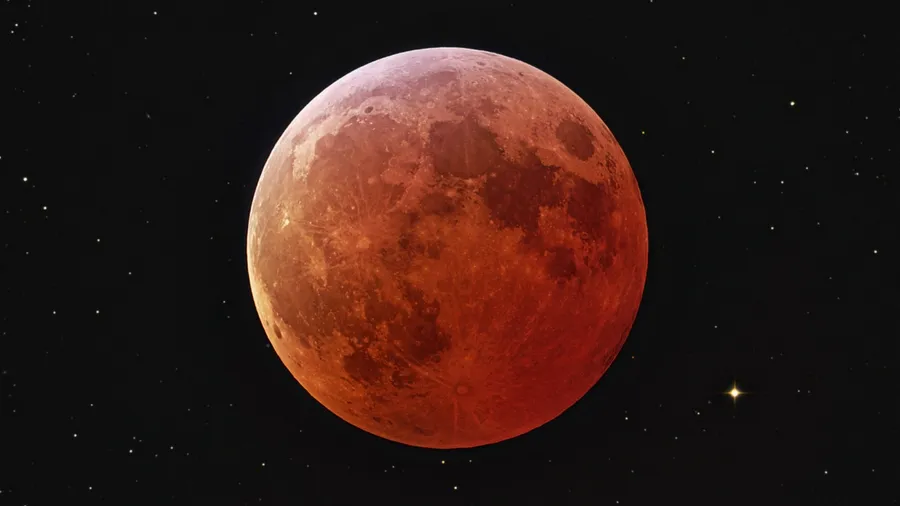
August's celestial wonders aren't done yet. Following the stunning total solar eclipse and the peak of the Perseid meteor shower a couple of weeks ago, we're set for another extraordinary show this week — a lunar eclipse.
On August 27-28, night sky observers in North America, South America, Europe, Africa and Western Asia are in for a treat, with a 96.2% lunar eclipse and 'blood moon' occurring.
It's not a total lunar eclipse — the next one of those takes place on December 31, 2028 (yes, new year's eve!) But for many, this week's eclipse will be the best until then, so it's well worth staying up late/getting up early for.
Here's exactly when and where the lunar eclipse can be seen — and my pro tips for capturing it with your camera of choice.
When and where to see the August lunar eclipse
The lunar eclipse can be seen on the night side of Earth, which on August 27-28 means that large portions of North America and South America, plus the western half of Europe and Africa, will enjoy the best of the eclipse — its maximum.
Further afield, viewers in eastern Europe and western parts of Asia will catch a glimpse of the eclipse — the penumbral and partial phase, but not the maximum 96.2% — while Australia won't see it at all. In total, 44.4% of the global population can catch a glimpse.
A large portion of the US is ideally placed to see the lunar eclipse, including Washington DC and New York, because it reaches its maximum at 12:12am ET time, and the moon will be relatively high in the night sky.

Across Europe, the maximum eclipse occurs at 6:12am (CEST), which is 5:12am BST. In cities including London, Paris and Madrid, the maximum eclipse is around one hour prior to sunrise and as the moon sets, meaning the moon will be very low in the sky — offering the prospect of superb photography opportunities.
Those timings are for the maximum eclipse, but the 'penumbral' eclipse begins almost three hours before, and ends almost three hours after. Even as much as 90 minutes before maximum, the moon will start turning red as it moves into a partial eclipse phase.
- The timeanddate.com website provides exact times, dates and places for every eclipse, including for August 27-28, wherever you are in the world. It's a comprehensive resource, also covering eclipse FAQs, such as what is a lunar eclipse is, why the color of the moon changes and more.

Planning your photos of the lunar eclipse
The full eclipse cycle will last for about five hours in total, but you don't need to be on the alert for all of it. Let's take New York city as an example.
There, the event kicks off with a penumbral eclipse at 21:23pm ET (August 27), but viewing starts to get interesting from 22:33pm when the partial eclipse begins. This is a good time to set up your camera gear, because the moon will begin to lose its brightness, and will start turning reddish at its edge.
You'll soon see the weird sight of a crescent moon with a blurry straight line between the bright and dark areas. That's the line of Earth's atmosphere being projected onto the lunar surface.

At 00:12am ET (August 28), the eclipse reaches it maximum, and the moon will be at a viewing altitude of 38.3 degrees, which is relatively high in the sky. At 96.2%, a sliver of bright area of the moon surface remains, but the rest should be a reddish color to the naked eye. This is the maximum phase, when you should takes lots of photos.
From then on, the bright area of the moon increases once more during the partial eclipse phase, which finishes at 1:51am ET, and the eclipse is fully finished at 3:02am. You may wish to stay up for the entirety in order to capture key phases of the eclipse — great for a montage — but the main activity will be in the hour around its maximum.
Meanwhile, in London the timings are less favorable, but the components for photography could be ideal. The penumbral eclipse begins at 2:23am BST (August 28), the partial eclipse begins at 3:33am, while the maximum eclipse is 5:12am, at which point the moon is close to the horizon, and it's approximately an hour before moonset/sunrise.
In the UK, you'll need a clear vantage point looking west to southwest to see the moon (and a dose of luck, if the forecast for cloud is accurate), and if you can plan to include landmarks/points of interest in the frame, it should make for dramatic images of the eclipse's maximum phase. The moon will have set below the horizon before the partial eclipse (after maximum) ends.

Camera gear for the lunar eclipse
So, how do you do photograph a lunar eclipse? The good news is that you don't need any filters, as you do with a total solar eclipse. The bad news is that since the moon is so small, you're going to need some magnification for the moon to fill most of the frame. That means either using a telephoto lens, whether that's on a DSLR or a mirrorless camera, or a superzoom compact/bridge camera. Taking decent photos of the moon with your phone is going to be a tougher challenge.
In terms of focal length, a 600mm-equivalent lens (25x zoom on a phone, approx) should fill most of the frame with the moon. You might want to use a slightly wider-angle lens to include landmarks in the frame.
On a smartphone, typically the best optical zoom reach you'll have is 5x. The quality of a digital zoom is poor, and only gets worse the more you zoom in. Some flagship devices such as the Oppo Find X9 Ultra have better telephoto reach — 10x in the case of that phone — and a teleconverter accessory to further extend the maximum reach. My advice for most people is to use a camera with a telephoto lens instead.
Whatever camera you opt for, I recommend attaching it to a sturdy tripod support — especially if you're capturing multiple phases of the eclipse with landmarks in the frame. A tripod minimizes camera shake for sharper shots, and delivers the continuity you need for capturing the phases. Alternatively, find a secure surface to rest your camera on. A self timer or a remote shutter further minimizes camera shake, while shooting in the RAW format rather than JPEG/HEIF gives you more flexibility for editing.

A lunar eclipse isn't easy to capture, but you will have plenty of time to play with various settings of your DSLR/ mirrorless/ superzoom compact camera. As well as a wide range of colors, lunar eclipses bring a lot of changes in brightness. Also bear in mind that when zoomed-in, the moon is a very fast-moving target (blame our rotating planet).
Consequently, I recommend setting the white balance manually — the Tungsten setting will maintain the color accuracy of the bright moon and rich blue of the night sky.
You'll also need a high shutter speed. So, as the moon dims in brightness, increase the ISO (try ISO 200 during the partial phase, and ISO 1600 during the maximum phase) and open the aperture (start at about f/11 and experiment).
However, it's not just about getting a sharp image, because during the partial eclipse, the moon will be part-bright and part-dim, so you have to make a choice about which side of the moon to expose for. The answer, of course, is to try both, many times over.
Take a spare battery out with you, make sure your memory card has plenty of space on it, and prepare for a marathon post-processing session. Most of all, cross your fingers for clear visibility — cloud cover puts paid to the best-laid plans!

Follow TechRadar on Google News and add us as a preferred source to get our expert news, reviews, and opinion in your feeds.
