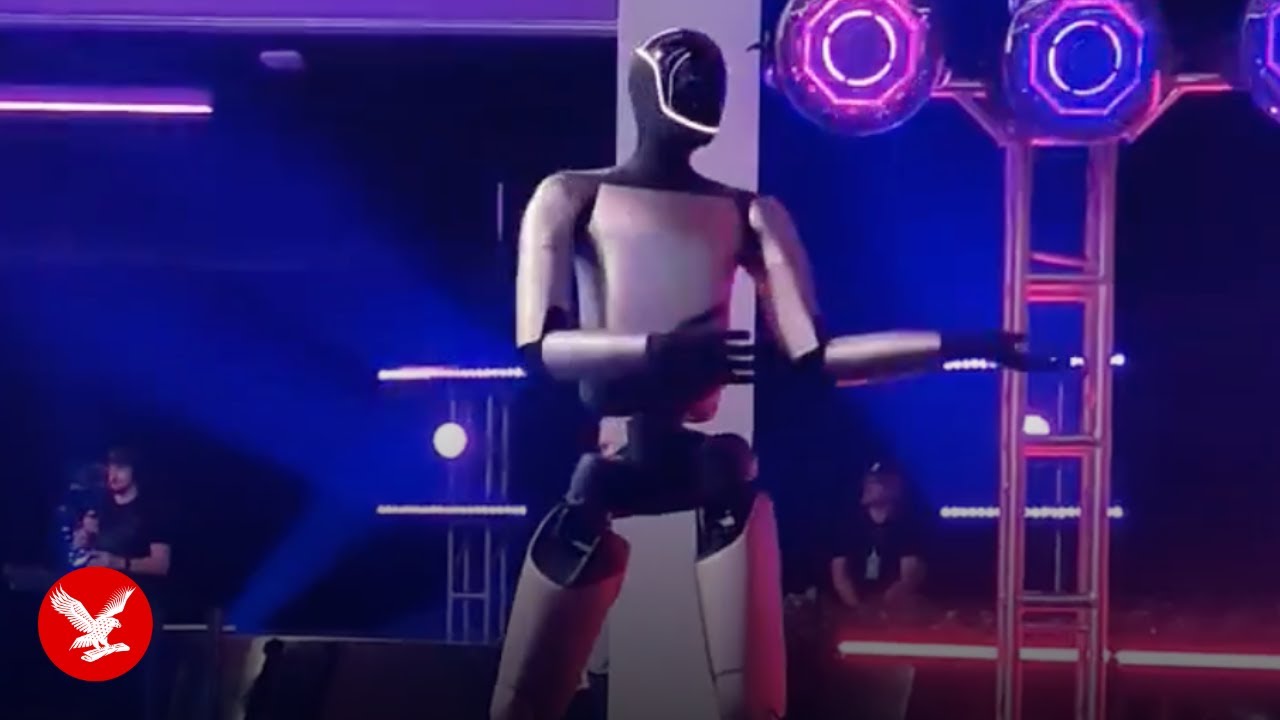
Lost among the shock news that Tesla would be shifting away from Model S and Model X production to building a million robots a year in its Fremont factory were the company's wild aspirations and promises for its upcoming Optimus 3 humanoid robot.
Built on the same Full Self Driving technology (FSD) you'd find in a Tesla Model 3 or Model Y EV, Tesla's Optimus robot has been on a development fast track for almost four years, quickly graduating from embarrassingly halting locomotion to impressive dance moves. Now, though, Elon Musk and Tesla are promising something more – and possibly more disturbing.
During an earnings call in which execs did their best to put a positive spin on declining sales and extreme EV competition in one of their biggest markets (China), Tesla robotics engineer, and the guy leading its AI efforts, Ashok Elluswamy, claimed, "Yeah, it’s an awesome robot that minimizes any differences... It looks like a human. People could be easily confused that it’s a human."
Entering the uncanny valley
Naturally, I have questions. Sure, there is a movement now among humanoid robotics engineers to make their robots look a little more lifelike, like the oddly feminized Xpeng robot, but no one would mistake it for a real woman. I'm struggling to imagine how someone might confuse the upcoming Optimus 3 with a person, especially if it still has that smooth, all-black featureless plastic face.
On the other hand, no one really wants an humanoid robot with an uncanny valley face walking around their living room.
This is a conversation, though, about more than looks. Musk also made some bold claims during the call, insisting that we're heading into an age of "amazing abundance" (a new company motto) and that AI and robotics would be the driving force behind us all having "a future of universal high income. Not universal basic income, but universal high income."
Tesla's plan to use its Freemont manufacturing facility to churn out one million Optimus robots a year could mean, in Musk's view, that “Everyone can have whatever they want, including great medical care.”
None of this seems remotely possible – certainly not based on Tesla's timeline of delivering Optimus 3 in March 2026 and consumer-grade robots at scale by 2027 or 2028, especially if they cost in the range of $30,000.
Will we all want one?
Musk's commitment to this idea is deep, and his comments during the earnings call – in which he claimed that his Optimus robot will be an economic force big enough to move the US GDP – align with statements he made at the Davos World Economic Forum a week or so ago.
There he told an audience: "I think everyone on earth is going to have one, to want one," adding that people will want his robots to watch over children, pets, and, yes, the elderly ("assuming it’s very safe").
People could be easily confused that it’s a human.
Ashok Elluswamy, Tesla AI Lead
Musk isn't wrong about the elder care crisis we're facing. The aging population is essentially outpacing the birthrate, and Musk noted in Davos that there are not enough young people to take care of the elderly.
Robots assisting in elder care isn't a new idea, nor is it unique to Musk and Tesla. It's been a topic of conversation for almost as long as I've covered robotics, and certainly humanoid robots.
Honda's long-term goal for its revolutionary ASIMO humanoid robot was elder care, but the car company eventually stopped pouring money into the ill-fated research project. Interestingly, another car company, Hyundai, is now at the forefront of humanoid robotics development with its significant Boston Dynamics Atlas funding.
I think everyone on earth is going to have one, to want one.
Elon Musk
The problem I see with Musk, Tesla, and Optimus 3 is that even with the rapid advances being made as a result of AI training, Musk's timeline is off.
Very little is known right now about how humans and humanoid robots will interact in real-world environments, and I would assume that years of testing will be required before we can safely leave any robot home alone with grandma. The technology for making these robots look and act human is still far from perfected.
And then there's the price – $30,000 is out of range for most people, while those wealthy enough to afford Optimus will likely treat it like a toy rather than a utility.
Humanoid robots will not become universal until they're $500 a piece and accept payment plans (I know some companies are looking at leases, but the monthly costs on those will be at least as much as luxury car payments).
The China factor

And then there's China. Even Musk admitted that while people often underestimate that nation, it may offer the toughest robot competition. On the other hand, Musk showed few doubts about his ability to beat the global superpower, saying "We think Optimus will be much more capable than any robot that we are aware of under development in China."
Musk pointed to the strides it's made in dexterity, real-world AI, and scaling. "Those are the three hardest problems by far for humanoid robots. I think Tesla is the only company that actually has all three of those components."
In the end, I think Musk and Elluswamy were blowing a little smoke for investors, trying to keep them excited as the company makes a massive shift away from EVs as the core business and to a future of AI and robotics.
Optimus 3 might be the shiny thing that Musk points to at future events and on future earnings calls, but it will be AI, and the promised Tesla AI chips, that will have the largest impact on their business, if not the world.
And if anyone mistakes Optimus 3 for a person, I'll eat my hat.
Follow TechRadar on Google News and add us as a preferred source to get our expert news, reviews, and opinion in your feeds. Make sure to click the Follow button!
And of course, you can also follow TechRadar on YouTube and TikTok for news, reviews, unboxings in video form, and get regular updates from us on WhatsApp too.