
 Become a TechRadar Insider





We've tested all of the best Sonos speakers over the years, with many of them featuring in our roundups of the best wireless speakers and best soundbars you can buy. Our guide below features only the best Sonos speakers and soundbars for different needs and budgets, based on our rigorous in-house testing methodology.
Sonos speakers still rank among the best Bluetooth speakers going. They're also some of the best-sounding wireless speakers, soundbars, and home audio systems. We test Sonos devices for a living, yes, but we genuinely feel like our sound setups aren't complete without at least one. We simply rate them that highly, and if it's your first time shopping for a Sonos product, we're confident you'll love what you hear.
What you need to know is this: all Sonos speakers are wireless and now, they're all compatible with each other, which makes them an easy choice for multi-room audio setups that avoid cables, whatever your budget. Also, while a Sonos soundbar on its own will upgrade your TV's audio, add the company's speakers and subwoofers (you can do it over time, this isn't a race) and you'll seriously up the immersive experience for movies, TV shows, sports broadcasts, and even gaming. So which ones should you buy? That's all in the guide below.

I've been testing and reporting on cutting-edge audio products since 2012, including many of the break-out wireless speaker systems over the last decade. I've tested nearly ever Sonos speaker over the the last few years, and have used all of Sonos' current soundbar range – and I had a Sonos surround system at home for several years. I've used my experience to put together this guide, working with our other AV editors and reviewers.
May 21, 2026
Refreshed the introduction and made sure all copy is up to date with the current year. We've added the Sonos Play to our 'best portable' category, and reworded some categories to be more immediately understandable.
The best Sonos speakers in 2026
Why you can trust TechRadar We spend hours testing every product or service we review, so you can be sure you're buying the best. Find out more about how we test.
Below you'll see our full write-ups for each of the best Sonos speakers in our list. We've tested each one extensively, so these recommendations are based on real-world experience.
The best for most people
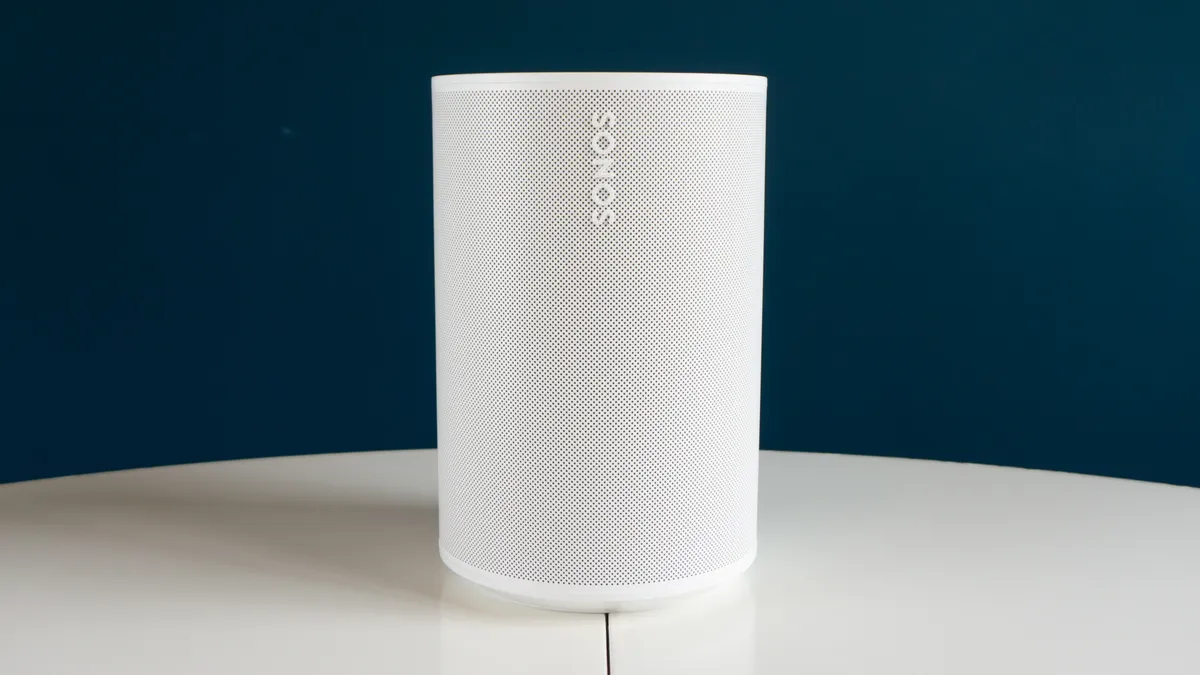


✅ You want big sound from a small speaker: It's loud, well-balanced and delivers impressive range and power for its size.
✅ You need flexible connectivity: It supports the Sonos app, AirPlay 2, Bluetooth and optional line-in – lots of ways to play your music.
❌ You want true stereo sound: Despite clever tweeter placement here, the stereo effect is subtle at best.
❌ You want a deft touch on bass: The bass isn’t overwhelming, but it’s the only place the soundstage feels less controlled.
While it's not the newest Sonos speaker on the block, the Sonos Era 100 is still an absolute stalwart in the home, and we still consider it the best all-rounder choice for most people. Rather than offering the best in spatial audio and immersive sound like the Era 300, the Era 100 is cheaper, smaller, and designed to replace the Sonos One – which was at the top of our list, but has been discontinued.
The Sonos One was such a fantastic speaker and the Era 100 has a lot to live up to. That's why it targets everything about the Sonos One that could do with an improvement. The Era 100 has a wider soundstage and more bass, which means a fuller dynamic range. It also adds Bluetooth, allowing you to play music to it from any wireless device and there's an adapter to add 3.5mm line-in, so you can connect to wired music sources.
These improvements are welcome, but if you already have a Sonos One, don't add up to being too much of an upgrade, so you should probably stick with the old speaker. But in the context of the current Sonos line-up, the surprisingly amount of power, the strong detail and clarity, and compact size make this a great choice for the vast majority of people.
Read our full Sonos Era 100 review
The best portable Sonos speaker


✅ You want something waterproof: This can be used even in places where getting wet is a risk – it can take being splashed or dunked (briefly).
✅ You want a sleek, portable speaker: It’s compact, stylish, and simple to use – perfect for on-the-go listening.
❌ You’re on a tight budget: At $299 / £299 / AU$499, it’s pricey for a portable, and there are cheaper non-Sonos alternatives.
The Sonos Play is the best portable Sonos speaker for most people, and boasts numerous improvements over the Sonos Roam 2 (our previous sitter of this category), namely in battery life, connectivity options, and IP67 waterproofing. It delivers powerful sound from a rugged design, with excellent connectivity features and a nice dose of smart home control.
Priced at $299 / £299 / AU$499, said improvements do come at a cost. It's a good $100 / £100 / AU$200 more expensive than the Roam 2 was. While you're absolutely getting a much higher-quality product for the price, we wouldn't blame you for wanting to seek out a cheaper, non-Sonos portable alternative.
If you are willing to take the plunge, though, you likely won't regret it. 24-hour battery life is a huge improvement here, and as mentioned, you're getting all the connectivity options you could possibly want. That includes Wi-Fi 6, Bluetooth 5.3, and good old USB-C. Oh, and it can coexist with any other Sonos devices you might have via the brand's multi-room control technology.
Obviously, the sound here isn't as good as Sonos' larger and more expensive speakers, but the Play nonetheless delivers punchy audio that betrays its relatively stout size. Bass is chunky, and you can expect decently well-rounded sound in any environment. We recommended raising the volume above 40%, though, for best results.
Read our full Sonos Play review
The best Sonos soundbar




✅ You need a compact choice: It can easily fit under most TVs on a cabinet or be mounted to a wall to keep your living room clutter-free.
✅ You want a broad-feeling sound: The audio feels bigger than the soundbar itself, and more expansive than you get from the cheaper Sonos Ray.
❌ You want the most immersive experience: There's no true Dolby Atmos here. The Sonos Arc Ultra is much more immersive, thanks to side- and up-firing speakers.
❌ You want the cheapest soundbar: The Sonos Ray offers really impactful sound for cheaper – though the Beam 2 does sound better.
If you're tight on space, the Sonos Beam (Gen 2) is the best soundbar you can buy from Sonos, as well as the best mid-range choice if you want to invest in a soundbar but not go as cheap as the Sonos Ray or as premium as the Arc.
Its compact size means it will easily slot beneath your TV, whether you pop it on a TV stand or mount it to your wall, and its sleek design means it won't look out of place with your decor.
It improves on the company’s original Sonos Beam soundbar with virtual Dolby Atmos, HDMI eARC compatibility, and a refreshed design.
While it doesn't have the upfiring tweeters necessary for 'true' Dolby Atmos (resulting in a sonic height less impressive than that of the Sonos Arc), the Sonos Beam (Gen 2) still boasts a wide soundstage and an immersive audio performance.
HDMI eARC compatibility allows for hi-res audio streaming, making it ideal for listening to music, too. For a small soundbar, it's got a surprisingly solid amount of bass to it, though it's far from having the same nuance and power that a subwoofer delivers – the soundbar can fill a surprisingly large space, but the bass is where you'll feel it lacking in energy a little.
Still, if you want super-clear, cinematic sound from a smaller soundbar, the Beam 2 is a superb choice, and handles music far better than most non-Sonos soundbars.
Read our full Sonos Beam (Gen 2) review
The best for spatial audio


✅ You want a powerful, feature-packed speaker: It supports Dolby Atmos, Hi-Res audio, AirPlay 2, Bluetooth, and more – all in one impressive package.
✅ You’re into spatial audio: It delivers the best Dolby Atmos and stereo sound we’ve heard from a single speaker.
❌ You’re chasing pure hi-fi: The Sonos Five still leads for audio purists after classic fidelity.
❌ You want subtle background sound: The Era 300 shines when it’s turned up, but it’s not ideal for low-volume listening.
The Sonos Era 300 was the first speaker from the company with Dolby Atmos support (although not the first soundbar, we’re looking at you Sonos Arc). It has up- and side-firing speakers, which create spatial audio.
This is a premium speaker through and through. At $449 / £449 / AU$749 it isn’t cheap, but during our testing we commented that we’ve tested more expensive wireless speakers, making the Era 300 good value in our books. This is largely down to the fact you get an array of drivers and processing skills.
In our Sonos Era 300 review we wrote: “it delivers more expansive sound than any one-box speaker I've heard to date – even with just stereo music, there's such a clear sense of left and right channels feeling separate and distinct.” This is why the Sonos Era 300 is our top pick if you’re look for immersive, spatial audio in a Sonos speaker design rather than a soundbar. The speaker doesn’t just offer fantastic height and a wide soundstage, but offers a rich, detailed and powerful sound.
Bluetooth works well and makes the Sonos Era 300 more accessible for more of your devices. There’s also Hi-Res support from compatible devices too, which is a welcome addition.
Read our full Sonos Era 300 review
The best Sonos speaker for hi-fi sound


✅ You have a turntable: It pairs beautifully with vinyl and can stream your records to other Sonos speakers.
✅ You want big sound: Expect expansive, room-filling audio and pure hi-fi power.
❌ You want Bluetooth: The Sonos Five doesn’t support it – it’s Wi-Fi only.
❌ You want voice control: No built-in mics means no Alexa, Google Assistant, or Sonos Voice.
When the Sonos Era 300 was first rumored to be coming soon, we assumed it would replace the Sonos Five. Now the Era 300 is out we know that isn't the case. The Sonos Five is still the biggest option from Sonos and one we'd suggest you consider if you're looking for hi-fi power over the Era 300's spatial audio precision.
It's a large and bulky speaker as far as Sonos tech goes. It doesn't support spatial audio but is designed for stereo output instead. It has a 3.5mm line-in and supports external devices, like turntables.
There's Apple AirPlay 2 with the Five, but no Bluetooth. You also won't find microphones or voice controls – but you can connect it up to another Sonos speaker with a mic and control it that way.
Sound-wise it gets loud, really loud, without going too bass-heavy. There's an impressive soundstage too and clear, defined vocals.
If you want the best speaker for your home, we'd recommend the newer Sonos Era 300 over the Sonos Five. It has Bluetooth connectivity, spatial audio and is smaller and lighter than the Five. But if spatial audio isn't a deal-breaker for you and you want loud, detailed and powerful sound, it's an older but good option.
Read our full Sonos Five review
Also consider these options

Best Sonos speakers: FAQ
How much do Sonos speakers cost?
Sonos speakers tend to be fairly priced and good value. However, Sonos does sometimes increase its prices and certainly isn't considered a budget brand. Here's how the prices of its best soundbars and speakers stack up:
Sonos Era 100: $199 / £199 / AU$319
Sonos Roam 2: $179 / £179 / AU$299
Sonos Play: $299 / £299 / AU$499
Sonos Beam (Gen 2): $499 / £449 / AU$799
Sonos Era 300: $449 / £449 / AU$749
Sonos Arc: $899 / £719 / AU$1,499 ($899, AU$1499)
Sonos Arc Ultra: $999 / £999 / AU$1, 799
Sonos Move 2: $449 / £449 / AU$799
Sonos Five: $549 / £549 / AU$899
Sonos Ray: $199 / £199 / AU$349
Do Sonos speakers get good deals?
Sonos speakers do go on sale. But predicting how much you’ll save isn’t always easy. Discounts vary between events like Black Friday and Prime Day, and different models get different treatment.
However, looking at past sales can give us a good idea of what to expect. This makes it easier to spot which deals are genuinely worth snapping up and which ones might not be as much of a bargain as they seem.
The Sonos Era 100 is currently priced at $199 / £199 / AU$319. However, during Prime Day deals, it was available in the UK sales for £170. It was also also discounted on Amazon in the US down to $179.
Similarly, the Sonos Roam 2 officially retails for $179 / £179 / AU$299, but during Prime Day it was reduced in some UK stores to £122. In the US, you could pick one up for as low as $143.
The Sonos Beam (Gen 2) is available for $499 / £449 / AU$799 right now. We hadn't seen it discounted before, but on Prime Day we reported that it dropped down to $369 in the US and £327 in the UK.
The Sonos Era 300 will currently set you back $449 / £449 / AU$749. However, during Prime Day deals earlier this year, it was reduced down by £100 in the UK. It got a discount almost as good in the US, where it was briefly available for $359.
The Sonos Arc Ultra is $999 / £999 / AU$1, 799 and we haven't seen many discounts on this one yet. But it did get a price drop in the UK and US around Prime Day, but only to $899 / £899.
In contrast, the older Sonos Arc is now often getting its price reduced to $599 in the US and £529 in the UK, since it seems to be getting phased out.
You can pick up the Sonos Move 2 for $449 / £449 / AU$799, but during Prime Day deals it was reduced down to £317 in the UK. It also got dropped down to $336 at Amazon, Sonos and Best Buy in the US.
The Sonos Ray is $199 / £199 / AU$349 right now, but it has been discounted during the Prime Day sales from £199 to £160.55, that's a really decent reduction so keep your eyes peeled for similar.
Does the Sonos app work well?
Generally speaking, the Sonos app is reliable these days. During our testing and when we review Sonos products we've always found it easy to navigate and it's packed with useful features.
For example, you can control playback, group or ungroup speakers, adjust EQ settings and stream from several music services all in one place.
That said, like most apps, some users do report glitches or connection issues, especially in larger multi-room setups. Or when switching between Wi-Fi and Bluetooth on portable models.
Back in 2024, Sonos users experienced widespread issues with the app. However, we reported that Sonos had fixed most of its app problems since then.
Now it seems it's back on form and one of the better audio apps out there, though other companies have caught up a lot. The app has also been regularly updated with new features and improvements, as well as more fixes.
How do Sonos speakers work?
Sonos speakers all work together within a wider ecosystem, and each device is controllable via the brand’s S2 app. The app lets you add and remove Sonos devices from your setup as you please, while making it easy to adjust your music playback and stream content from your phone.
This means you can make your wireless Sonos setup as big or as small as you want. Pretty much any configuration you can think of is possible, from multi-room audio systems with speakers built into your ceilings to modest home cinema solutions with soundbars and rear stereo speakers.
Which Sonos speaker should I buy?
If you're looking for an easy way to play your music, the Sonos One wireless speaker will do the job if you can find one. But it's now discontinued.
Those with audiophile tendencies may want to try the Sonos Amp with two stereo speakers (Sonos or otherwise) or the newer Sonos Era 100 and Sonos Era 300 with spatial audio.
For music on the go, check out the brand's portable Bluetooth speakers, the Sonos Move 2 and the Sonos Roam. Or, if you want to boost your home theater setup, the Sonos Arc, Sonos Beam (Gen 2) and Sonos Ray will sound far more powerful than your TV’s built-in speakers.
For a truly portable option, we can't recommend the Sonos Play enough. It fixes so many of the Sonos Roam 2's shortcomings with improved battery life and better connectivity options. It's on the pricier side, but we think it's worth its weight in gold.
From there, you could expand your system to include a couple of Sonos One SLs as rear speakers, and a Sonos Sub to emphasize the bass frequencies.
Can I use Sonos speakers with an Android device?
You can, but with most Sonos speakers you'll miss out on one of the Sonos ecosystem's best features: TruePlay. The room calibration feature tunes the sound of Sonos speakers to the dimensions of your room. With most Sonos speakers, it only works with iOS devices. You could always borrow a friend's iPhone to setup your new Sonos speaker, though.
This problem is also solved with the newer Sonos Era 100 and Era 300 speakers, which have TruePlay customization on the speakers themselves, so you don't need another device to set it up.
How we test Sonos speakers
We've tested a range of Sonos speakers over the years, so you can be sure that the models in this guide have been thoroughly vetted by the TechRadar team.
Testing how well a Sonos speaker works in the company's ecosystem is just as important as testing how it sounds, which is why we always test Sonos speakers within an existing setup. For instance, alongside a Sonos Arc and a Sonos Sub.
We use a number of audio sources and music genres during the testing process to build a full picture of a speaker's sound profile, from hi-res audio files to streaming Spotify over Bluetooth.
For portable speakers, like the Sonos Move 2 and Sonos Play, we also run down the battery life of these speakers to see if they match up to the manufacturer's claims, and use them in a range of environments to make sure they can withstand outdoor conditions.
