


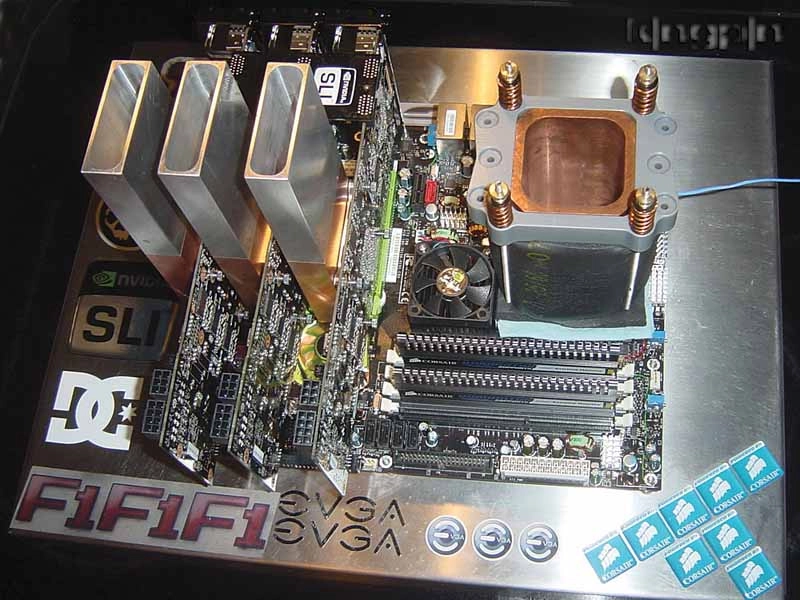
We're all overclockers now.
Having a go at super charging any chip of the last generation or so – and specifically Intel's Core 2 – has been been easy and safe endeavour.
So much so that if you're not running, for instance, a Q6600 at 3GHz or more, frankly you're not really getting your money's worth from the chip.
Don't kid yourself that adding 500MHz without so much as unscrewing the heatsink puts you in the big league, though. You're doing a smart thing, but you are not part of the elite cabal who get to call themselves veterans.
No, you're not made of the same crazed stuff that drives them to ever more ludicrous fleet feats or suffered financial hardship to raise your CPU speed. You've also probably never soldered anything to your mobo or kept dangerous industrial chemicals in the house. You, in short, are not worthy!
At the grassroots level, overclocking has a lot in common with MG Club membership or the kinds of man-in-ashed pastimes that involve swing lathes. It's born out of the same hackers' spirit of inquiry that makes one guy install Linux, fit their own kitchen or crack NSA databases looking for proof of aliens.
The word 'enthusiast' is bandied around far too often in computing circles, but the overclocking fraternity are truly deserving of this moniker – it's genuine enthusiasm for fiddling which drives it.
"I think a lot of guys have a part of the brain missing," laughs Kenny Clapham, a member of the UK's leading overclocking team, Benchtec. "It's the part that says 'Thats good enough, you can stop now.'"
Clapham's particular areas of expertise are water and dry ice cooling. His current goal is to be recognised as one of the top 100 overclockers in the world without touching liquid nitrogen or expensive cascade systems. He reckons that hitting high scores in benchmarks like Super Pi and Folding@ Home is only part of the motivation, though. It's an indulgence which quickly becomes an obsession.
The reason is that achieving high clockspeeds means more than just mucking about with the BIOS settings. It means individually adjusting every parameter your PC is capable of to its fastest stable settings and then combining them all together for a benchmarking run.
Before you can go near a flask of LN2, a lot of time is spend raising one value – such as the FSB – under water cooling and then resetting it and moving on to the next. When the big day for testing comes, the sub-zero materials are pulled out and the known stable points are used as a starting position for record attempts.
Every single system, then, has its own particular thresholds and tolerances. The appeal of overclocking to most, says Clapham, is the painstaking research that goes into finding them. And again, it's not just about fiddling with BIOS settings.
Increasing voltages to support huge clockspeeds often means replacing resistors on the circuit boards to allow more current flow – and aside from requiring a steady hand with a soldering iron that means even more investigation and probing.
Motherboard documentation is notoriously poor, but at least the technology remains stable enough that an experienced hand shouldn't take too long to work out which resistors to change in order to alter key voltages.
The really dark arts of extreme overclocking are achieving high scores in 3D benchmarks. There are no easy BIOS flags for getting the right voltages that will make use of a graphics card chilled to subzero temperatures, and it means a lot of analysis and trial and error: "It's really satisfying when you have a fully modded graphics card in front of you," says Clapham. "It can be quite intimidating to start off with something pure and clean and then cover it in wires and solder, but the reward is that not everyone has the confidence or ability to do that."