


It’s no surprise that 2025 has proven to be yet another fantastic year for fans of the best TVs. OLED deservedly continues to dominate the high-end AV market, yet it’s also heartening to see the strides mini-LED has made for those who can’t afford to remortgage their house in order to own an eye-catching OLED display.
During the past calendar year we’ve seen fantastic TVs from not only heavyweights like LG, but also budget-conscious brands like TCL. But if we had to pick an overall, undisputed champ in 2025, it’s super-tough to look past Samsung. Thanks to its investment in QD-LED tech, the likes of the Samsung S95F OLED have set new viewing heights.
It’s not all been plain sailing, though. Amazon has regressed with its affordable Fire TVs in the last 365 days due to some head-scratching drawbacks, while the purists who love physical 4K Blu-rays may find their beloved medium coming to a sad end.
Cheerfully, there have been more TV winners in 2025 than losers, so sit back and let’s try to focus on the positives while also acknowledging the odd bumpy AV roadblock.
Winner: OLEDs got brighter…and overall better

Yet again, this last year has been the year of OLED. Heck, the premium form of display has been the undisputed ruler of TV tech for well over a decade. What has really impressed this year is both the forward-looking investments made by LG Display and Samsung Display, yet also the bewildering brightness OLED can now achieve. It’s a doubly impressive feat considering they’re the only display tech that can entirely self-dim their pixels.
Skip back only a few years, and even the best OLED TVs would struggle to crack 1,000 nits of brightness. Now, though? You only need look at the class-leasing LG G5 and its four-stack panel that is capable of producing a cornea-scorching 2,268 nits in Filmmaker Mode. That’s eyeball-tanning territory.
Yet LG has in no way hogged the luxurious limelight in the OLED space this year, despite the G5’s undoubted excellence. The Panasonic Z95B also knocked our collective socks off, thanks to its supremely detailed pictures and high-calibre sound. There’s also no sleeping on the superlative Samsung S95F (more on that in a minute) that shows the future of the best TVs lies with QD-OLEDs.
We also can’t forget the Sony Bravia II OLED; a stunningly bright, gamer-friendly set that pushes the high bar the iconic Japanese manufacturer has established all the loftier.
OLED as a technology has been operating in a league of its own for several generations at this point. When it comes to color accuracy, effortlessly inky black levels, lightning-fast response times and impeccable screen uniformity, this tech remains in a different stratosphere. All bow to our OLED overlords.
Winner: Samsung dominates our best TV picks (again)

Ever since the display tech launched commercially back in ye golden times of 2013, LG has maintained a critical and commercial stranglehold on the OLED TV market. No longer. For the second year running in our TV winners list, Samsung has stepped to the summit to proclaim itself the OLED manufacturer to beat.
For the longest time, LG was essentially the only game in town if you wanted the best of the “Organic Light-Emitting Diode” best. That was in large part because LG Display was the only company to actually make OLED panels – subsequently then producing displays for the likes of Philips, Sony and Samsung.
With Samsung Display’s return to manufacturing its own OLED screens, though, the South Korean colossus is a more than worthy competitor. And the biggest upside for Samsung? Currently, it’s the only company that makes QD-OLED panels.
Enter the Samsung S95F. As James Davidsion stated in his glowing 5/5 review, this next-gen QD-OLED stunner “delivers exceptional picture quality, particularly with its brightness and color, while also eliminating mirror-like reflections in bright rooms with its OLED Glare Free 2.0 screen.” Add in Samsung’s class-leading response times for fans of the best PS5 games, and it really is over to you, LG.
But there was more to Samsung’s delightful display year than merely hitting new OLED heights. The superb Samsung QN90F proves that in the right hands, mini-LED tech can continue to go from strength to strength. Thanks to its top-tier local dimming and Glare Free screen, the QN90F is a wonderfully bright display that is perfect for a range of lighting conditions.
Winner: Hisense and TCL give Samsung a run for the mini-LED money

Contrary to the general snobby AV consensus, you no longer have to sacrifice your spleen to own a decidedly decent TV in 2025. Look no further than Hisense and TCL’s output this year.
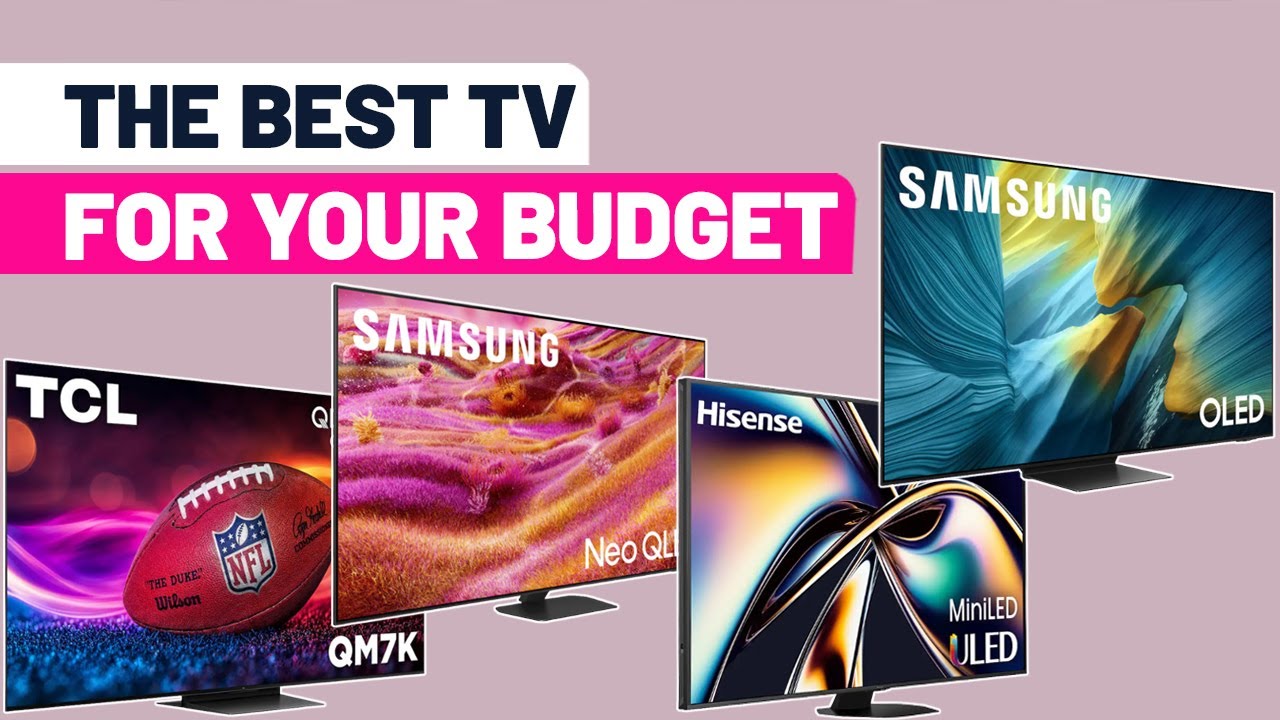
We currently rank the TCL C7K as the best TV between £500-£1,000 for UK-based AV obsessives. Why? Primarily because it comes in an affordable range of screen sizes, rocks bright and punchy picture quality, while its console-focused features make it a great choice for Xbox Series X owners.
This year has also proved you don’t need to mire yourself in debt to pick up a quality mini-LED TV, as the admirable Hisense U8QG has proven. A high-value budget set that delivers superbly bright pictures while mostly combating reflections, this awesome gaming TV would be a fantastic gift for that PlayStation fan in your life.
With the general cost of living in all walks of life proving to be increasingly prohibitive, it’s heart-warming to see both Hisense and TCL are focused on value without overly compromising on quality. Kudos to both manufacturers.
Loser: 8K TVs continue to slip

Let’s be honest: 8K TVs ain’t gonna catch on at this point. Samsung first tested the waters with the pioneering Q900R series back in 2019, and all these years on, “Super Hi-Vision” displays are about as likely to sell as tank tops to residents of Alaska in the height of winter.
Part of the problem is that despite whether you’re blessed with 20/20 vision or not, there’s only so much information the human eye can actually perceive. In a world where the best 4K TVs continue to dazzle, native 8K UHD panels (7860 x 4320 pixels) are overkill.
Granted, the brilliant Samsung QN900F is a hugely commendable set owing to its fantastic upscaling. Yet at sensible viewing distances, you’d be hard pressed to tell the fine details of your favorite Ultra HD movie or show on the 8K display from the current best 55-inch 4K TV in the form of the phenomenal LG C5 OLED.
Considering 4K TVs took the best part of a decade to establish a significant foothold in the market after the technology debuted around 2012-2013, the future looks pretty bleak for 8K. Especially when you consider our current favorite “budget” 8K TV, the Samsung QN800D, still costs almost $3,000. Considering the costs of investing in an 8K panel, the notion of these future-proofed sets overtaking 4K screens looks absurd.
But hey, if you’re the sort of early adopter optimist who invested in a 3D TV back in the 2010s, we’re sure you’ll enjoy Avatar: Fire and Ash if it ever – very unlikely – gets an 8K Blu-ray release.
Loser: Amazon Fire TVs flop

Talk about unnecessarily shooting yourself in the foot, Team Bezos and Co. The Amazon Fire TV Omni mini-LED was one of our favorite budget 4K sets when we reviewed it at the beginning of the year. With vibrant image quality and snappy 120Hz gaming features, it delivered a whole lot of bang for not a lot of bucks.
And yet, The Big A decided to shotgun a couple of its toes off with the subsequent introduction of the Amazon Fire TV Omni QLED. Despite rocking an incredibly similar moniker to the mini-LED model, this affordable set – that retails for a bank balance-friendly $479.99 / £649.99 for the smallest 50-inch model – is actually worse than its predecessor in certain key areas.
While it's commendable that Dolby Vision and HDR10+ are supported at a reasonable price point, the fact it sports lower brightness compared to its mini-LED sibling due to its LED backlight is an almighty tough pill to swallow. Throw in the reduction to a 60Hz panel, which makes it decidedly more sluggish should you want to play the best PC games on the Omni QLED compared to the mini-LED, and it’s hard not to look at this as an Amazon Fire flop.
Winner and Loser: 4K Blu-ray hangs in there

Is this entry a bit of a cop out? Maybe a little bit. Still, it’s hard not to indulge in some slightly embarrassed fence-sitting when it comes to whether 4K Blu-rays being a viable thing in 2025 and beyond is beneficial for the studios that actually produce them.
If you’re a hardcore cinephile who is lucky enough to own one of the best 4K Blu-ray players, there’s still no finer way to enjoy big-budget movies in the comfort of your own home. With that said, such is the inherent streaming picture quality of the likes of the Apple TV 4K (2022), for all but the staunchest nostalgists, the existence of physical Ultra HD discs are becoming harder to justify.

➡️ Read our full guide to the best TVs
1. Best overall:
LG C5
2. Best under 1000:
US: Hisense U8QG
UK: TCL C7K
3. Best under 500:
US: Roku Plus Series
UK: TCL C6K
