
 Become a TechRadar Insider





TechRadar’s camera experts have been testing 360 cameras since the format first emerged. Early models were bulky and inconsistent, but a lot has changed over the years. Now, the best 360 cameras are powerful, pocket-sized tools that shoot high-resolution video on the fly and make it easy to edit the results.
The Insta360 X5 is a great example of what a 360 camera can do – and that's why it's at the top of our rankings. It's an evolved form of its predecessor, the X4, and impressed us with awesome video quality even in low lighting. It's an incredibly flexible tool for creators, though the DJI Osmo 360 and GoPro Max 2 are also worth checking out if you're working with a budget.

I'm TechRadar's Cameras Editor and I've been a tech journalist for over 15 years. I've had the pleasure of covering countless major camera launches, including every 360 camera in this guide, and I have personally used most of them for capturing 360 content. The growth of the 360 camera market doesn't surprise – smartphones may have taken a huge bite out of the point-and-shoot camera market, but 360 degree cameras offer unique photo and video features that help them continue to standout today.
Why you can trust TechRadar
Every 360 camera featured in this guide has been tested extensively by one of TechRadar’s seasoned reviewers. Our experts have been testing 360 cameras since the very first consumer models hit the market, so we have intimate, first-hand knowledge of the format.
⭣ Read more
We evaluate 360 cameras in the kind of conditions and use cases they’ll face in the real world, ranging from immersive content creation to capturing fast-paced action. We test for several key factors, including image quality, the effectiveness of image stabilization, and the smoothness of stitching. We also think about the user experience, looking at app functionality, editing flexibility, and how easy each 360 camera is to use.
All of our camera recommendations are based on first-hand experience. We consider each model on its own merits, as well as comparing it to its competition on price and performance. The goal is to give you a complete view of what’s available for your needs and budget.
Meet the team

Sam has been writing about tech and digital culture for over 20 years, starting off in video games journalism before branching out into the wonderful worlds of consumer electronics, streaming entertainment and photography. Over the years he has written for Wired, Stuff, GQ, T3, Trusted Reviews and PC Zone, and now lives on the Kent coast in the UK – the ideal place for a camera reviewer to ply their trade.

Mark is TechRadar's Senior news editor and has been a technology journalist since 2004. Formerly Trusted Reviews and TechRadar's Cameras Editor, Mark has tested cameras over many years from all of the leading brands.
Best 360 camera specs compared
Comparing specs in your head can be difficult. To help you make sense of what the best 360 cameras offer on paper, we’ve set out the key numbers for our top three models side-by-side in the table below. Specs only tell half the story, though, so be sure to read our in-depth review of each 360 camera to get the full picture.
| Row 0 - Cell 0 | Insta360 X5 | Akaso 360 | DJI Osmo 360 |
Price | $549.99 / £519.99 / AU$929.99 | $199.99 / £199.99 / AUS329.99 | $TBC / £409.99 / AU$759 |
Max. video resolution | 8K/30fps | 5.7K/30fps | 8K/50fps |
Max. photo resolution | 72MP | 72MP | 120MP |
Waterproof | 15m | N/A | 10m |
Max. battery life | 208 minutes | 60 minutes | 190 minutes |
Weight | 200g | 180g | 183g |
Today's best 360 degree cameras
Why you can trust TechRadar We spend hours testing every product or service we review, so you can be sure you're buying the best. Find out more about how we test.
Below you'll find full write-ups for each of the best 360-degree cameras on our list. Our team has tested each one extensively, so you can be sure that our recommendations can be trusted.
The best 360 degree camera overall


Insta360 X5 sample video
✅ You want a versatile 360-degree camera: With smooth footage, replaceable lenses, and improved audio, the Insta360 X5 is the total package.
✅ You often shoot in low light: the Insta360 X5's larger sensors make filming in 8K a breeze – no matter the conditions.
❌ You already have an X4: The X5's predecessor is still a great 360 camera, and upgrading to the X5 might not be worth the investment.
❌ You need a sturdy action camera: the X5 is waterproof, but a dedicated action camera will deliver better results for flat footage of your adventures.
The Insta360 X5 refines a winning formula. In our review, we found it a more polished and powerful follow-up to the X4, with notable performance improvements. Most significant is the image quality: we found that its larger 1/1.28-inch sensors deliver sharper, cleaner video, particularly in low light. Combined with Insta360’s AI-powered image processing, the results are consistently impressive.
We appreciated other practical upgrades, too. Deeper waterproofing to 15m (49ft) gives added peace of mind when shooting underwater video, while the introduction of user-replaceable lenses makes it a 360 camera you can use for longer. Insta360 has otherwise kept the design broadly consistent, which is no bad thing. One neat addition is lock-on points for third-party camera mounts.
The app remains useful for quick edits, although it can be demanding on older smartphones, while the camera’s battery can drain quickly at the highest settings. If you've already got an X4, you probably won't find the X5 that revolutionary, but for everyone else, the X5 is the best 360 camera we've tested in a long time.
Read our in-depth Insta360 X5 review
The best cheap 360 degree camera


Akaso 360 video sample
✅ You want an affordable 360 camera: The Akaso is considerably cheaper than other 360 cameras, and doesn't sacrifice performance in the process.
✅ You want a simple shooting tool: If you're a beginner or just want a streamlined experience, you'll appreciate the Akaso's simple feature set.
❌ You need durability: The Akaso isn't waterproof, dustproof, or shockproof, so it's not a replacement for an action camera.
❌ You want the best image quality: Footage from the Akaso is decent, but it falls off quickly when the lighting isn't perfect.
The Akaso 360 is the most affordable 360-degree camera in our rankings and, during our testing process, we were impressed by how much it delivers at such a budget-friendly price. It’s a compact, lightweight shooting tool with effective automatic stitching that allows pretty much anyone to capture decent 360-degree video with minimal user input. The quality of 5.7K/30p video is solid in daylight, with nice colors, reasonable sharpness, and good stabilization.
That said, there are a few compromises to keep in mind. Quality falls off as soon as lighting is anything less than the best, with noticeable noise and lost detail, especially when viewing footage on a larger screen. Audio is similarly unreliable, with the stereo mics picking up a lot of wind noise outdoors. We were also disappointed to find that the Akaso 360 lacks any kind of waterproofing, too, while the touchscreen can be frustratingly unresponsive.
Despite those trade-offs, the Akaso 360 still left a positive impression. It delivers on the fundamentals, even if it lacks the refinement of premium rivals. For creators who want a no-frills introduction to 360 video, the Akaso 360 is a good entry-level option.
Read our in-depth Akaso 360 review
The best 360 camera for quality


DJI Osmo 360 sample video
✅ You want quality 360 video: Large sensors, big pixels, and 50fps frame rates mean the DJI Osmo 360 delivers quality video.
✅ You appreciate value: Packed with features, the Osmo 360 offers similar specs to the X5 for a significantly lower price at launch.
❌ You want to shoot underwater: While the Osmo 360 is waterproof, it hasn't been optimized for capturing video beneath the waves.
❌ You own an Insta360 X5: It's a strong competitor, but if you already own the X5, there's not really a reason to swap it.
The Osmo 360 is DJI’s first 360 camera, and it’s an impressive debut. In our review, we were struck both by how polished it felt and how much it delivers for the price. It’s robust, easy to use, and offers useful features like built-in storage. It also delivers on quality: using a pair of 1/1.1-inch sensors, the Osmo 360 shoots 10-bit 8K video at 50fps. Test footage revealed plenty of clean detail and vivid colors. We described stabilization as “faultless” as well.
We found the interface easy to navigate courtesy of the sharp 2-inch touchscreen. There are editing solutions for different workflows, too: the AI-powered DJI Mimo app makes for quick mobile edits, while deeper tweaks are unlocked by the DJI Studio desktop app.
It’s not a perfect first effort. We wish that the lenses were replaceable, as they are on the Insta360 X5. And while it’s rated as waterproof to 10m, the Osmo 360 isn’t yet recommended for underwater use due to potential video stitching issues. Even so, we think the Osmo 360 is a strong alternative to the Insta360, especially if you already own other DJI products like the compatible Mic Mini.
Read our in-depth DJI Osmo 360 review
The best 360 degree camera for design


GoPro Max 2 sample video
✅ You want the best quality 8K video: GoPro's Max 2 shoots 'true' 8K, which is slightly more detailed than the Osmo 360 and X5.
✅ You shoot high-risk action: With tool-free swappable lenses and a squat design, the Max 2 is well-suited to shooting action in tight spaces and where it could get damaged.
❌ You shoot long sequences: The Max 2 is a little prone to overheating, which could be a hindrance for long recording times.
❌ You're a low-light shooter: Video quality drops a little more noticeably than rivals in low light.
Coming six years after the original Max, the GoPro Max 2 was a long time coming, but it was a sizable upgrade and worth the wait. During our tests, it recorded the best quality 360 video in 8K, with 10-bit color depth, of all the models in this guide, in daylight at least. Like its rivals, quality drops in low light, but the difference in quality is a little more obvious here.
Like its predecessor (and other models), it uses two 180-degree fisheye lenses to capture anything in the direct line of sight, with invisible selfie stick skills and auto stitching, but those lenses can be removed and replaced should they get damaged, which could be a huge saver versus splashing out for buying a new camera all over again. The X5 offers this too, but the Max 2's lenses can be removed more easily, without tools. It also has a squat, square design, which might fit better than the X5's taller stick design, depending on your use.
Like the Max, the Max 2 benefits from 16ft / 5m water resistance, built-in retractable mounting fingers, and is compatible with GoPro’s entire range of mounting solutions. To round out the top-line features, the Max 2 has a solid internal microphone audio array that captures a truly three-dimensional soundscape. The Max 2 rivals the X5 in many ways, all for a tantalizingly low price. The X5 is the better camera overall, but the Max 2 is arguably a better value.
Read our in-depth GoPro Max 2 review
The best value 360 camera for beginners
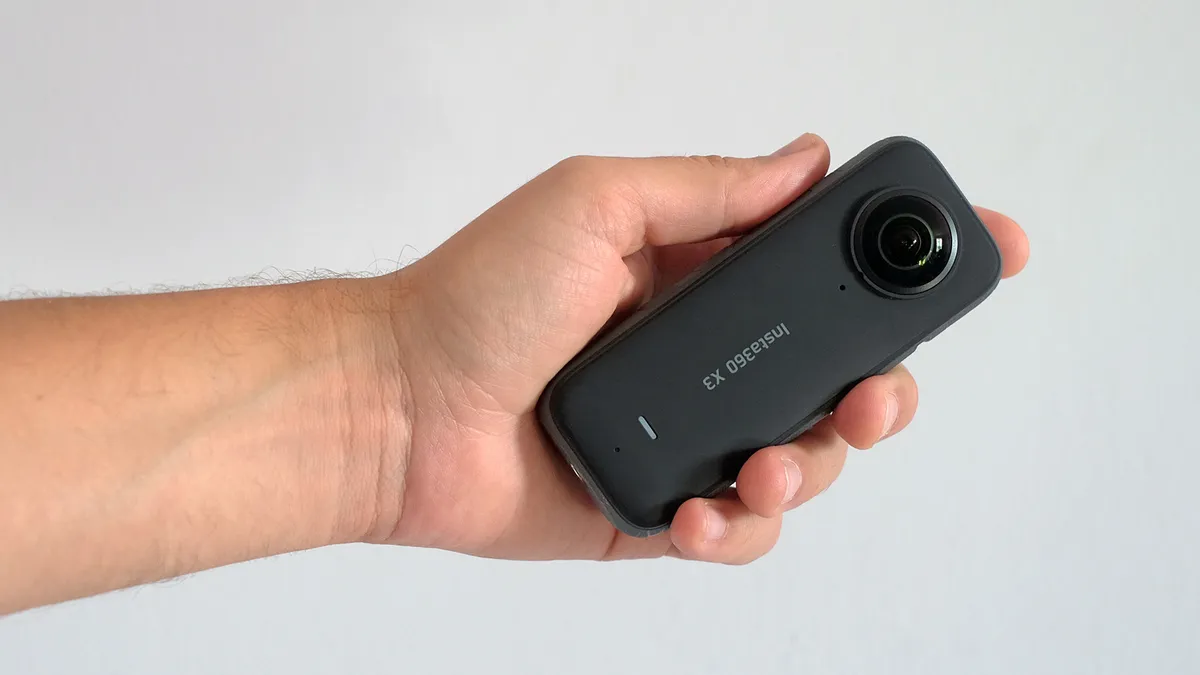


Insta360 X3 video sample
✅ You want a big screen: With a 2.29-inch touchscreen, you'll be able to interact with menus and footage easily.
✅ You need high dynamic range: Active HDR mode works its magic at ensuring that all the necessary detail is retained in the highlights and shadows.
❌ You want natural footage: At times, the camera overprocesses footage and results in an overly synthetic look.
❌ You need ultra-sharpness: 4K videos appear a little soft, which means a lack of overall clarity.
The Insta360 X3 has been updated twice over, but it remains on sale and now represents a good value alternative if you don't need the latest model's new features, which include 8K video recording and improved battery life. We think it's a top choice for first-time buyers.
At the time of launch, the X3 beat the GoPro Max (yet to be updated) for single-lens 4K clarity, and it excelled when it came to shooting 5.7K 360-degree footage. While some processing elements can appear more synthetic than a GoPro, we found its Active HDR mode was brilliant at retaining detail in highlights. The continued effectiveness of FlowState image stabilization was also impressive in testing.
We felt its significantly larger 2.29-inch touchscreen made the Insta360 X3 a much easier camera to use handheld, even if there remain a few software quirks to be ironed out. Once you’re familiar with the interface, though, it’s largely a breeze. Insta360’s editing workflow also proved seamless in testing, with diverse and intuitive tools complementing the experience. Our review time revealed the claimed 81-minute battery life to be realistic, too. Add in 10m water resistance – twice that of the GoPro Max – and the Insta360 wins out in the battle of the best X4 alternatives.
Read our in-depth Insta360 X3 review
Also consider

We've reviewed a whole range of 360 cameras, which means there are plenty more that almost made it into this list. Here are a few honorable mentions to consider.
Insta360 X4: With quality 8K 360-degree footage, a superb 4K single camera mode, and improved battery life, the X4 still has a whole lot to offer and can now be picked up for less than the X5.
GoPro Max: Its hardware is many years old now, but the original Max remains a capable 360 camera, and I've seen it on sale for a very low price in recent sale events. If you spot it for sub $200, the 5.6K shooter could be worth snapping up.
Kandao QooCam 3 Ultra: formerly in the shortlist above, the QooCam 3 Ultra can shoot superb quality 8K video and 96MP stills in 360, but Kandao, being a smaller company, means that the overall workflow, including the app, is less polished.
Insta360 Evo: Thanks to its hinged design, the Insta360 Evo can capture 3D VR content across an 180-degree field of view. A perfect solution when paired with a VR headset, if you can find one second-hand.
How to choose
How do I choose the best 360 degree camera?
The best 360 cameras come in a range of shapes, sizes, and styles. That said, most models work similarly: they use multiple camera modules (usually two wide-angle lenses placed back-to-back) to capture footage which can then be digitally combined to create a fully spherical video.
But there are also plenty of differences between the 360 cameras in the list above. Many 360 cameras include features such as automatic stitching (which saves you the hassle of manually aligning multiple captures) and image stabilization for steady shots. The top options, including the Insta360 X5 and GoPro Max 2, can also use software trickery to digitally erase compatible hand grips and selfie sticks from the frame, so you can record yourself without a big boom arm blocking your shot.
Video resolution varies from camera to camera. The best consumer 360-degree cameras shoot in 8K – and with such a wide field of view from twin ultra-wide lenses, resolution matters; if you crop down to a flat frame, the resolution will be much lower.
This cropping functionality allows you to extract a standard ‘flat’ video from the 360-degree footage. This means you can shoot everything that’s going on around you, then select an area of focus when you’re back home. This is particularly useful for fast-moving and unpredictable subjects, such as safari animals or extreme sports enthusiasts.
The relevance of other features, such as GPS, Wi-Fi, and slow-mo modes, will depend on what and how you like to record. Many of the best 360-degree cameras feature creative shooting tools and handy connectivity features, plus smartphone apps that make editing and sharing easier.
The X5 and Max 2 also introduced a new feature – replaceable lenses. This feature is a godsend for users who put the camera in the thick of the action and put the lenses at risk of damage. In such a situation, cost-effective replacements can be installed, rather than forking out for an entirely new camera.

What’s the best 360 camera for virtual tours?
360-degree cameras are a great choice for shooting immersive virtual tours. Upload 360-degree images or video to a compatible hosting platform (such as Facebook or CloudPano), and visitors will be able to explore a location in full 360 degrees from the comfort of their home. This is particularly useful for venues such as hotels and museums, as well as real estate listings.
The right 360-degree camera for your virtual tour will depend primarily on whether you plan to shoot a video tour or a static photo tour.
It’s possible to create a virtual tour simply by walking around a location while recording video. If this will be your approach, any of the top cameras in the list above should produce smooth, sharp 360-degree footage. The Insta360 X4 and Kandao QooCam 8K Ultra can capture detailed 8K video and benefit from SuperSteady stabilization smarts (although file sizes for 8K video are much larger and may be compressed by certain platforms).
Most virtual tours use 360-degree still shots by a tripod-mounted camera. The best 360 cameras in 2026 can capture sharp, immersive images, which are perfect for virtual tours. The Insta360 X4 is again a great option here: it shoots dynamic still images at a resolution of 72MP (the highest of any camera in our list), allowing viewers to pan around sharp virtual scenes. It also features a tripod mount on its base for easy positioning.
If you’re looking for a less expensive option of our favorite 360 camera, the Insta360 X3 is an affordable way to shoot 360 stills for virtual tours. It also features a tripod mount and captures 360 stills at a respectable 18MP.

How we test 360 degree cameras
Our reviews are always hands-on and actively compare cameras to previous versions or alternative models. We look at various elements, including design, features, performance, and image and video quality.
First up is the camera's design. During this step, we want to get an idea of how the camera handles. Is it small or big, light or heavy, and is that positive or negative for the target audience? We'll put the user interface through its paces and decide how user-friendly and intuitive the workflows are. All of this will be done utilising the built-in touchscreen, which will be assessed for size, quality, and responsiveness.
360-degree cameras are well known for having various modes and feature sets that complement the core 360-degree filming functionality. We test all of these features to see how good they are and whether they are usable in a production context. While doing this, we'll use a formatted SD card to capture both video and photos to enable us to comment on the performance as it relates to quality, low-light performance, and battery life.
These types of cameras rely heavily on the use of a companion app, which we also download and test. If the app unlocks specific features or enables a live-feed view, then we'll comment on that too.

To compare photo and video quality across different 360 cameras, we shoot a consistent range of scenes with each model, from expansive landscapes to close urban environments. We then analyze the resulting footage side-by-side.
For stills, we assess detail retention and color balance, as well as highlights and shadows in unedited, full-resolution exports. We also inspect stitching lines closely, looking for visible seams or ghosting where 360 cameras blend output from their multiple lenses. We’ll also test HDR modes where available, but we use the raw outputs for a fair comparison.
When it comes to 360 video, we evaluate footage shot in both bright outdoor and dim indoor conditions. We look at dynamic range, noise levels, and consistency across the stitched frame.
Stabilization is a key test, too. We walk with each camera to see how well the footage holds up when in motion. The aim isn’t just to confirm marketing claims, but to see how these cameras perform in real-world use, whether you’re creating immersive travel videos or quick social clips.
After all our testing is complete, we take everything we've learned about the camera and factor in its price to get a sense of the value-for-money it offers before reaching our final verdict.