





Today's fastest VPNs protect your online privacy without massively impacting your connection speeds, so you won't have to deal with long page load times and stuttering streaming content.
While the best VPNs encrypt the traffic leaving your device, making it unreadable to snoopers, the extra steps required could negatively impact your overall speeds.
We regularly test and re-test VPNs to see which are the fastest despite their encryption capabilities. We use a 10 Gbps cloud computer alongside everyday connections and devices to see not only how fast a VPN can be, but how well this translates to everyday environments.
These tests occur throughout the year, meaning there's nowhere to hide if a VPN's performance falters.
The fastest VPNs at a glance





Latest update: We've completed a new round of testing, and it's shaken up the field massively! So much has changed, in fact, that we've reformatted this guide to ensure you're not left with just a wall of speed figures to look at that, in some instances, are too close to call a difference between. Instead, we're now focusing on use cases alongside the benefits of raw speed, where PrivadoVPN now reigns supreme.
The fastest VPN services in 2026
Why you can trust TechRadar We spend hours testing every product or service we review, so you can be sure you're buying the best. Find out more about how we test.
The fastest VPN overall

For raw speed, even the best VPNs can't come close to PrivadoVPN right now. We recorded WireGuard speeds of 2,334 Mbps when connecting locally in our most recent tests. These speeds are over double what we last recorded for the provider, and nearly twice what we recorded for NordVPN (1,249 Mbps).
This means, unless you're using broadband with speeds well in advance of 2Gbps, you should never see huge amounts of speed loss while connected to PrivadoVPN. What's more, it should make downloading large files and streaming in 4K super easy across an unlimited number of simultaneous connections.
Read more about PrivadoVPN ▼
That said, I can't ignore that its OpenVPN speeds were poor this time around. WireGuard is always my protocol recommendation for speed-focused users or those primarily streaming or gaming with a VPN. But OpenVPN's increased security and stability can prove useful when navigating stricter firewalls.
So, PrivadoVPN only achieving 405 Mbps here is a concern. It puts the provider far below the average and at less than half the speed of the likes of Surfshark or ExpressVPN over the protocol.
What's more, your only alternative is IKEv2. This protocol is older and, while it's known for its speed and mobile compatibility, it can struggle with tougher firewalls. So, should you encounter issues using OpenVPN in locations such as hotels and airports, you could quickly be stuck for options.
The fastest VPN for long distances
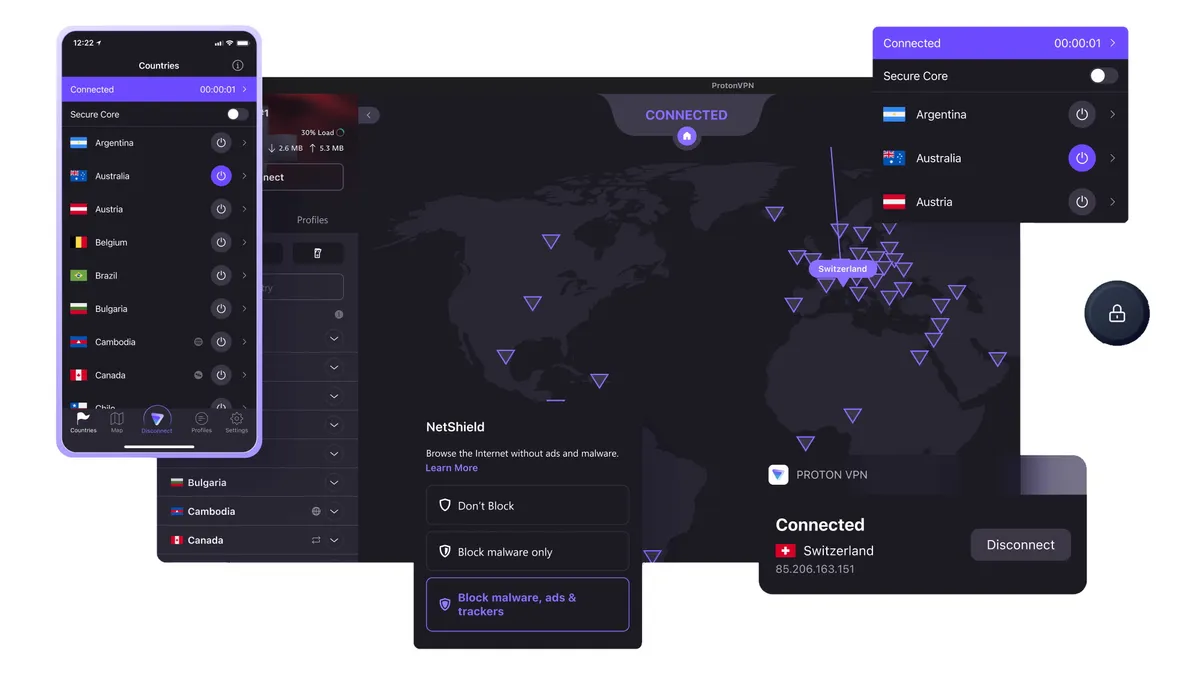
Proton VPN balances superb speeds with maintained performance over distance to a degree that makes it superb for almost anything. In our testing, its WireGuard speeds reached 1475 Mbps when tested locally. When we switched to testing between the UK and the US, this rose to 1548 Mbps, the highest speed we recorded when connecting intercontinentally.
Given the irregularity of the US to UK speeds, there may be something in our testing restricting the accuracy of the local test results. This is something we're looking into. Regardless, both the local and long-distance speeds Proton is capable of are more than enough for any online task, no matter where you're connecting to.
Read more about Proton VPN ▼
For example, if you’re looking for a super-fast VPN for travel (let's say you're headed to the US on vacation and leaving the UK behind, but still want UK World Cup commentary at your fingertips), you'll scarcely find a VPN that is better equipped to handle it. This is especially true given Proton's superiority as a streaming VPN when compared to providers like PrivadoVPN.
Proton VPN's OpenVPN speeds have also improved, though not enough to shout about. Having previously achieved 240 Mbps, Proton achieved 449 Mbps this time around. Not a superb result by any means, but still an improvement on PrivadoVPN's 405 Mbps. This should help you out if you need a more stable protocol against a stubborn firewall.
We also put Proton VPN’s proprietary Stealth protocol to the test, seeing speeds of 403 Mbps, it was surprisingly not far off its OpenVPN results. While slower than WireGuard, this is the range we expected to see for a privacy-focused protocol – and Stealth is designed to conceal your VPN traffic and evade VPN bans in privacy-unfriendly countries, and not necessarily for streaming HD and 4K content.
The fastest OpenVPN service

ExpressVPN's speeds are reasonably impressive this time around. It achieved 1177 Mbps using its Lightway Turbo protocol. However, since this is a Windows-only protocol, it's quickly overshadowed by the worse performance of its more broadly supported protocols. That is, however, aside from OpenVPN.
On OpenVPN, ExpressVPN achieved 1038 Mbps. This made it not only the fastest provider on OpenVPN, but the only provider to achieve over 1000Mbps this time around. When we connected over long distance using OpenVPN, it was slightly slower than Surfshark, achieving 703 Mbps compared to Surfshark's 851 Mbps, but either of these speeds will be more than enough for any secure browsing you might need.
Read more about ExpressVPN ▼
OpenVPN is a handy protocol to have solid performance on since it can be effective against firewalls and restrictions that don't require the full force of dedicated obfuscation protocols. So, if you find yourself encountering problems in hotels, airports, and similar places, choosing a good OpenVPN provider is key.
As mentioned already, ExpressVPN's Lightway (non-Turbo) and regular WireGuard protocols were far less effective than most in this round of testing.
WireGuard was the most effective, despite lacking ExpressVPN's proprietary Lightway technology, achieving 967 Mbps. This is more than enough for most tasks and is one of ExpressVPN's dedicated post-quantum-encrypted solutions. So, if you're worried about 'harvest now, decrypt later' attacks, this is a top choice. That said, it still achieved less than half of the speeds the very fastest VPNs were capable of.
Lightway (non-Turbo) performed even more poorly. Achieving just 428 Mbps, only two protocols we've tested this year performed worse. This could again be due to a currently unknown issue with our testing. However, since this isn't the first time we've seen poor results from the protocol, it's probably not the case.
The fastest gaming VPN


NordVPN is by no means a slow VPN. Its WireGuard-based NordLynx protocol achieved 1249 Mbps this time around, while its OpenVPN speeds were around 688 Mbps. What's more, its OpenVPN speeds remained identical over long distances, and 689 Mbps using NordLynx long-distance makes it the second-fastest option we've listed so far.
But, it's NordVPN's latency and jitter capabilities that put it on this list, as it remains the fastest gaming VPN I've tested. High latency or jitter is fatal for gamers as it can result in choppy gameplay or delayed responses that could be the difference between a win or loss in competitive games. In an ideal world, Latency should be well below 20ms, and jitter below 5ms.
Read more about NordVPN ▼
Last time around, NordVPN achieved 17.2ms latency and 2.4ms jitter. This was tested on a physical PC in the UK. This time around, testing on a US-based cloud PC, it achieved only 48ms latency and 21ms jitter.
Yes, this appears much worse than previous results, but given the complexities of testing on a US-based cloud PC from the UK, the results were always going to look worse on the surface. This is evidenced by the fact that every VPN recorded similarly poor numbers.
What's impressive, though, is that NordVPN was the only VPN to maintain similar performance when connecting over long distances, too. Its latency was only 9ms more, and its jitter was only 2.2ms. So, if you're not using a cloud PC, which I'd assume most aren't, you should see little to no difference from what should be very solid gaming performance, no matter where you connect to.
The fastest free VPN

Free VPNs can often see their performance limited to match the eradicated price tag, but not Windscribe Free. In testing, it achieved a whopping 1594 Mbps using WireGuard. While this is far below its paid plan's result of 2263 Mbps, it's still the 4th fastest speed we recorded of any VPN, both paid or free.
That said, this speed does come with a drawback. Since Windscribe free has a 10GB data limit, were you to use this speed to its full potential, you'd run out of data in minutes!
Read more about Windscribe free ▼
In fact, we ran out so quickly that we failed to get reliable OpenVPN results, nor could we do our usual testing between the US and UK on WireGuard. So there's no doubt Windscribe free is fast, it's just worth rationing the time you spend using it so you don't run out too quickly.
What makes this more frustrating is that Windscribe free performed suprisingly well with streaming services. Free VPNs often struggle with streaming services due to the reduced number of servers they offer and the limited performance. Windscribe free, however, only failed to unblock Prime Video and YouTube US, two services that bested most paid VPNs this time around anyway.
If this puts you off, upgrading could be as simple as choosing its super-cheap monthly plan. It's $9 per month, cheaper than almost every other VPN with a monthly rolling plan. Alternatively, it's $69 for one year of protection if you choose the fixed duration of protection.
TechRadar's VPN speed rankings
Want to know the raw speeds that we discovered in our testing? Check out the table below where each provider is listed according to its US speed. You'll find some of our top performers, consistently quick providers, and a few newcomers who have shot through the ranks.
Remember, the table is based solely on speed, which is why curate providers that combine maximum performance, consistent speeds across regions and protocols, and other qualities in our countdown above.
Vendor | Nearest Server | USA - UK | Tested |
|---|---|---|---|
PrivadoVPN | 2334Mbps | 1389Mbps | Apr 2026 |
Mullvad | 2308Mbps | 938Mbps | Apr 2026 |
Windscribe | 2263Mbps | 1209Mbps | Apr 2026 |
Windscribe Free | 1594Mbps | (data ran out, not checked) | Apr 2026 |
CyberGhost | 1480Mbps | 1058Mbps | May 2026 |
Proton VPN | 1475Mbps | 1548Mbps | Apr 2026 |
NordVPN | 1249Mbps | 688Mbps | Mar 2026 |
ExpressVPN Lightway Turbo | 1177Mbps | 1117Mbps | Apr 2026 |
Hotspot Shield Basic Hydra | 1084Mbps | 921Mbps | May 2026 |
ExpressVPN OpenVPN | 1038Mbps | 703Mbps | Apr 2026 |
Surfshark | 1021Mbps | 935Mbps | Apr 2026 |
Norton VPN | 1010Mbps | 782Mbps | Apr 2026 |
ExpressVPN | 967Mbps | 699Mbps | Apr 2026 |
Surfshark OpenVPN | 825Mbps | 851Mbps | Apr 2026 |
Windscribe OpenVPN | 770Mbps | 223Mbps | Apr 2026 |
Hotspot Shield Basic | 757Mbps | 447Mbps | May 2026 |
IPVanish | 742Mbps | 461Mbps | May 2026 |
TunnelBear | 738Mbps | 639Mbps | May 2026 |
NordVPN OpenVPN | 688Mbps | 689Mbps | Mar 2026 |
PureVPN | 560Mbps | 363Mbps | June 2026 |
Norton VPN OpenVPN | 514Mbps | 307Mbps | Apr 2026 |
Proton VPN OpenVPN | 449Mbps | 413 Mbps | Apr 2026 |
ExpressVPN Lightway (Turbo Off) | 428Mbps | 265Mbps | Apr 2026 |
PIA | 419Mbps | 256Mbps | May 2026 |
PrivadoVPN OpenVPN | 405 Mbps | 196Mbps | Apr 2026 |
How we test VPN services - our review methodology
The TechRadar team retests the industry’s top VPNs every six months – and calculating the speed of these providers is often the most time-consuming part of the process. It’s an important consideration, however, as a slow VPN that can’t keep up with streaming, gaming, torrenting, or even day-to-day browsing just isn’t worth using.
We ensure that VPNs are tested across an even playing field by using a Windows set-up and a 10 Gbps Ethernet-based connection. We combine at least three speed testing sites, test our normal connection speed with the VPNs switched off, and then, one by one, we enable the VPNs and record their performance. We repeat these tests at least five times throughout the day and take the median average as our result.
In terms of protocols, we test OpenVPN wherever it is available, along with WireGuard, or any proprietary protocol based on it. Think ExpressVPN’s Lightway or NordVPN’s NordLynx.
We’re aware that speeds can fluctuate based on the distance between our home base and the server location, too. So, while we test the speeds of the closest UK-based server, we’ll also record the performance of a VPN when connected to a US-based alternative to record the fairest representation of the provider’s performance.
You can read more about our full VPN testing methodology here.
Fastest VPN FAQs
Which VPN is fastest?
PrivadoVPN is the fastest VPN overall, achieving 2334Mbps using WireGuard.
Do VPNs make your internet slower?
VPN encryption renders your data unreadable to snoopers, but this does add extra steps to the process of connecting to the web, which can impact your overall speed. However, today’s best VPNs invest heavily in their infrastructure to ensure that this impact is as negligible as possible, and that you’ll barely notice that you’re connected to a VPN in the first place.
We test and review VPN services in the context of legal recreational uses. For example: 1. Accessing a service from another country (subject to the terms and conditions of that service). 2. Protecting your online security and strengthening your online privacy when abroad. We do not support or condone the illegal or malicious use of VPN services. Consuming pirated content that is paid-for is neither endorsed nor approved by Future Publishing.
