


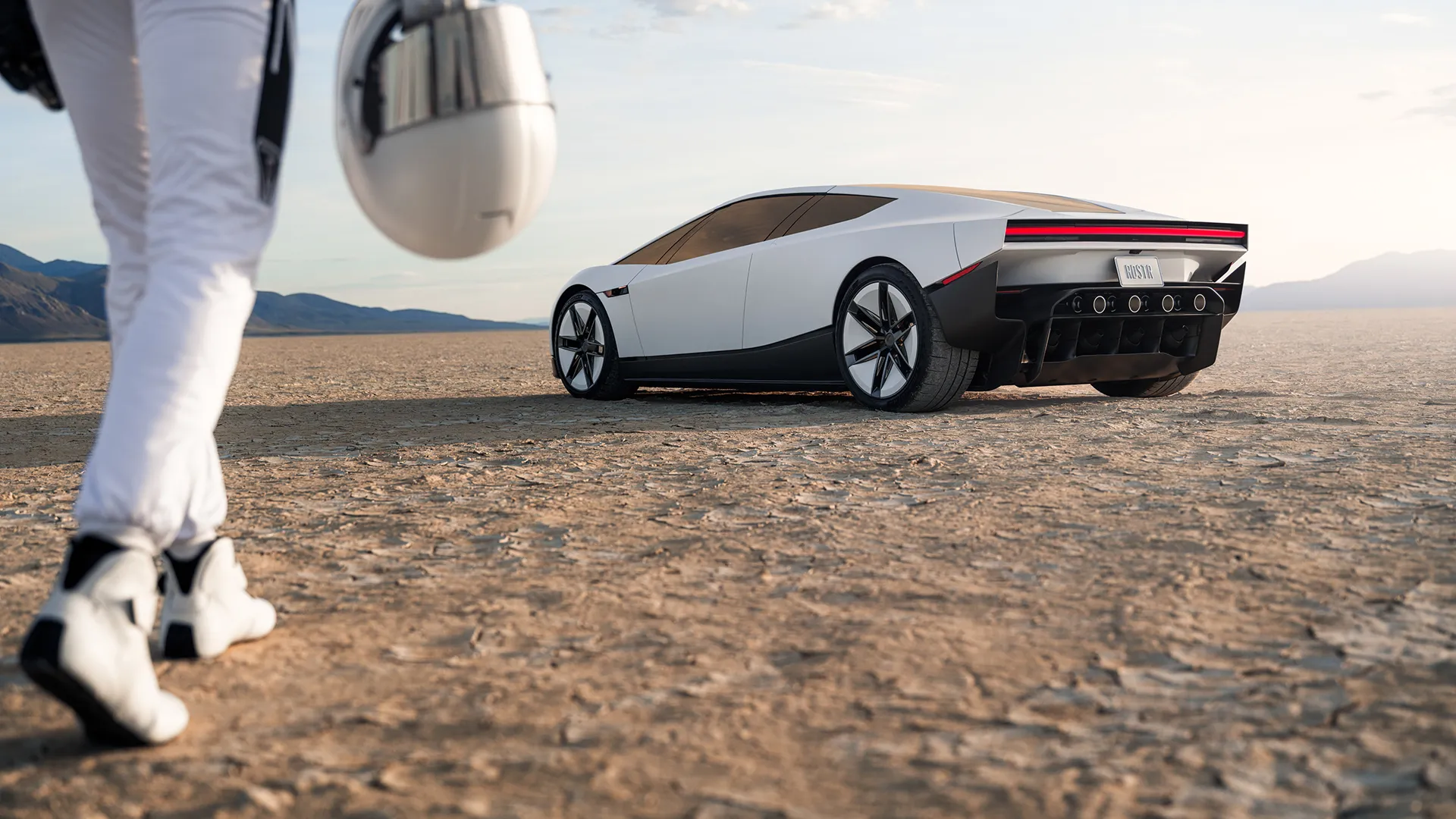
After almost a decade of teasing, flip-flopping on design, and generally testing the patience of every single customer that originally placed a deposit, Tesla has taken the wraps off its completely radical and utterly bonkers Roadster.
What started as a reimagining of the car that arguably kicked it all off for Tesla — complete with curvaceous looks, epic real-world performance, and a 600-odd-mile range — has transformed into an angular, space-age speed machine that’s capable of around 300 miles on a single charge, can accelerate faster than most human bodies can withstand, and can “fly” for short periods.
I insist on placing the word “fly” in quote marks simply because the recent live demonstration at SpaceX’s Rocket Test and Development Center in McGregor, Texas, showed the car being flung into the air by cold-gas thrusters before employing yet more SpaceX-derived thrust technology to ensure it came down onto the stage below gently.
Roadster event livestream https://t.co/G0jU4mWfidOctober 15, 2026
In essence, enormous jets of compressed gas force the vehicle to become airborne, while separate thrusters mounted around the car can make it spin (performing a “kickflip,” as Tesla Vice President of Engineering Lars Moravy called it) and then land safely on more jets of rapidly decompressed propellant.
It’s all deeply impressive, and the additional use of McMurtry Spéirling-esque fan technology to create insane levels of downforce will likely contribute to some pretty astonishing lap times if Tesla chooses to go down that route.
But take a deep breath, ignore the hype for a moment, and ask one simple question: why?
All but the “entry-level” Performance model can likely only be used on private roads or specific race circuits, while the completely nuts Rocket model, with its full cold-gas thruster setup, is available to purchase by invitation only, meaning Tesla will decide who's able to use it.

Viewed simply, this is Tesla pushing the boundaries as far as they can be pushed, proving that it is one of the most innovative automotive and technology companies on the planet.
Perhaps in Elon’s mind, it wasn’t good enough for the Roadster badge to be resurrected and placed on an entirely plausible and rather handsome EV. It had to be a halo car that showcased not just Tesla’s talents, but those of its sister company, SpaceX.
This fits with the views of certain corners of the internet, which believe the entire stunt was set up to promote a potential SpaceX and Tesla merger, further pumping up investor hype.
“It was an engineering flex with no commercial value beyond embarrassing traditional car makers,” Gene Munster of Deepwater Asset Management told Automotive World. “The Roadster event is the latest example of why Elon can’t wait to bring (Tesla) and (SpaceX) together.”
Tesla needs to get real

As impressive as this week’s Roadster demonstrations have been, the new halo car has no real bearing on the sort of products we can expect from Tesla in the future.
Heck, the Roadster isn’t even a proper 'roadster', seeing as it uses removable T-panels rather than a traditional convertible top.
There was absolutely no mention of innovative battery technology, not a peep about rapid charging, and no messaging around next-generation infotainment or software-defined breakthroughs.
Ignoring the Cybertruck, which now sells in tiny numbers, Tesla only offers two vehicles — the Model 3 and Model Y — with no plans to introduce anything else soon. Instead, it appears set on incrementally improving them over time.
Dig through the convoluted Roadster specifications list, and the only road-going variant, the Performance model, is simply a very fast electric performance car with a multi-mode suction system that has already been introduced by a rival.
It can only manage 300 miles on a single charge, it develops 1,350 hp (a Porsche Cayenne Turbo Electric manages 1,140 hp), and, more importantly, it’s arriving almost 10 years after it was originally planned.
The more events Tesla holds like this, the more it feels like a distraction from the fact that the competition, predominantly coming from China, is actually moving the game forward.
BYD with its nine-minute Flash Charge, Nio with its battery-swap technology, and Geely with its Level 4 Afari Smart Driving autonomous systems all feel like innovations that could have genuine real-world impact.
Tesla wrote the blueprint for electric vehicle ownership when it established the groundbreaking Supercharger network and delivered cars that were effortless to live with.
Now, it’s peddling humanoid robots and other sci-fi stunts to deflect from the fact that its EV business is stagnating.

Follow TechRadar on Google News and add us as a preferred source to get our expert news, reviews, and opinion in your feeds.
