


- Sony unveils 1000X The Collexion headphones for $649 / £550 / AU$999.95, available in May 2026
- Custom 30mm driver, and new processor with DSEE Ultimate and '360 Upmix' spatial audio modes
- Design focuses on comfort, with gentler clamping force and larger earpads
Sony has just unveiled its most expensive (and possibly most-leaked) wireless headphones to date, which it's calling 1000X The Collexion. If you just want to read whether they're any good, then you can go straight to our Sony 1000X The Collexion review, because we've been using them for a few weeks.
But if you want to know more about what makes them different, and why Sony produced them in the first place, stick around here — I spoke to Sony insiders from the UK and Japan to hear more about what makes them worth their high price tag.
And what is the Sony 1000X The Collexion's price tag? That would be $649 / £550 / AU$699 when they're available sometime during May.
That price is a major leap over the $459 / £349 / AU$699 you now pay for the Sony WH-1000XM6. But Sony hopes that you'll think The Collexion (as I'll call them from here) are worthwhile — the company told me "we wanted to go further then ever before, to create something that isn’t just the next in our line-up, but that represents 70 years of audio mastery."

Building on that, Sony's Personal Entertainment Product Manager, Mike Somerset, said: "Is this just the 1000XM7? The answer very clearly is: no. It’s aimed in a totally different direction… We’re bringing some new things to these headphones that we have never done before."
The Collexion being a "different direction" makes them interesting to compare to the XM6, because they're an improvement over the XM6 in several ways — but are actually a step back in others, and that's not an accident. So here are the upgrades and arguable downgrades you need to know about.
1. A striking new look (and case)

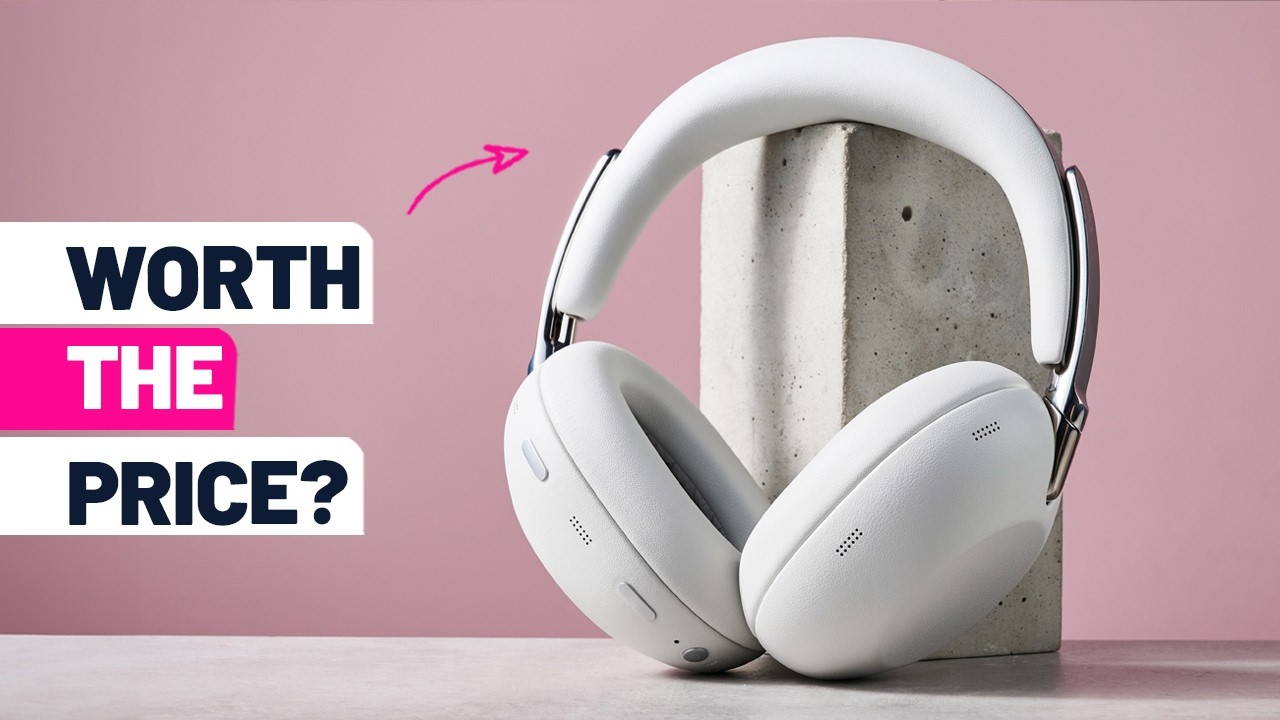
The Collexion's look is very Sony if you've been following the evolution of the Sony WH-1000XM5 and then the XM6 — but it's clearly a little more premium and full of flourishes.
Sony says the name for the design "theme" used for The Collexion is: "Resonate".
It comes in Black or Platinum (ie, white) finishes, and a key element according to Sony is that "every visible part is made from two materials," with the intention of creating "contrasting textures".
There's a new case design too, with a handle — it's more 'handbag-like' in some ways.

That even runs through into the metal detail in places — for example, the hinge connecting the earcups to the headband is "hand-polished by skilled craftspeople", and mixes a sand-blasted finish with glossy chrome.
Sony says that the faux leather material alone was two years in development. The company also put in a lot of work, such as working with a split-design battery for the first time, to reduce the thickness of the earcups to just 40mm for a sleeker profile when wearing them — that's compared to 45.4mm in the XM6 cans.

The combination of the slimmer earcups and the metal detailing gives them a look that's more than a little reminiscent of the Sonos Ace, and that's no bad thing.
Sony also said that the goal here was to create a "timeless design", and I think there's something to this: the matte metal headband reminds me of the metal headphones you'd get with a Sony Walkman in the '80s, yet the rest of the design is undeniably modern Sony.
2. A focus on comfort
The redesign isn't just about the aesthetics, of course. Sony also said that it's particularly focused on comfort here, so that you can wear them for hours and hours, and barely notice they're there.
Specifically, the gap in the earpads is larger in these headphones than in the XM6, so they're less likely to touch the outside of your ears, and they give you a little more breathing room — and are likely to fit better with glasses.
The headband is also a little thicker, so the pressure is distributed a little more evenly — and the clamping force of the headband has been reduced, so you'll feel less pressure wearing them. This last point will come back later, though, because it's a double-edged sword…
3. A more powerful processor

Sony is introducing a new audio processor for the first time in The Collexion: the Integrated Processor V3. This is then combined with the same QN3 noise-cancellation processor used in the Sony XM6.
The V3 is Sony's most powerful headphone processor yet, and it means that these are the first headphones to include DSEE Ultimate. DSEE is Sony's audio upscaling tech, meant to take limited-quality Bluetooth streams and to upscale and add back in detail and dynamic range that's been cut out by compression.
"DSEE Ultimate is the best that Sony has ever done, and we’ve never put it in headphones before," the company said — DSEE Extreme was the previous best tech in its headphones, while Ultimate was limited to its music players, such as the Sony NW-A306.
The key difference is that it's powerful enough to upscale both the sample rate and the bit-depth of the sound at the same time — Sony says this is thanks to AI, as so many things today are. Sony says the sample rate will be upscaled to 96kHz, and the 16-bit depth will be upscaled it to 24-bit.
Sony says that it also brought a bunch of other audiophile engineering developments over from the Walkman line to the V3 processor design, including a low-phase-noise crystal oscillator for “perfect timing”, advanced solder containing gold at “key audio points on the circuit board”, and various component optimizations to improve “the signal to noise ratio across all frequencies”.
The V3 processor also enables new spatial modes, so let's get into those, because they're important enough for Sony to have devoted a whole new button to them.
4. Spatial Audio 'Upmix' modes

Sony is going big on spatial audio in The Collexion, and is using the power of the new V3 processor to offer four "360 Reality Audio Upmix" modes, which can take any audio source and turn it into spatial audio, but with a different kind of signature to the space depending on the mode.
There will be a Cinema mode (which the Sony XM6 also have) to feel like you're in a home theater, but now also a Music mode (designed to sound like you're in a live venue), and Game mode. There will also be the great Background Music mode from the XM6, which sounds like you're listening in a café or somewhere with soft ambient music.
There's a new button on the headset to switch between these modes, though by default it'll cycle between Music, Cinema and the mode being off. You can customize it to add Game or Background music in the Sony Sound Connect app.
Unfortunately, we don't think these are very good — you can read all about that in the full Sony 1000X The Collexion review.
I asked Sony why it doesn't support Dolby Atmos for this, since the experience there tends to be great. It said that there were several factors, ranging from how Android itself and different phones deal with Atmos encoding, to what’s possible in chipsets it's using — but Sony also said it wanted to give the same experience to all users, regardless of your device of streaming service of choice.
5. New speaker driver and sound tuning

Sony said that its goal with The Collexion was to "faithfully reproduce sound as the creator intended" and to “allow listeners to relax and immerse yourself in the lingering resonance of the music".
To do that, it developed a new "bespoke" 30mm driver, which has a similar design principle to the one used in the Sony WF-1000XM6 earbuds: it's a dual-material design, with a very hard central dome to improve detail, and a softer outer edge for better bass response.
The harder center is made using a "unidirectional carbon-layered core composite", which apparently means it's made from long carbon strands — "like hair", Sony said. The XM6 headphones' driver also uses carbon, but a lower percentage of it in the mix of materials (including paper). More carbon means more rigidity.
Sony said that the sound character it's aiming for includes "perfect balance, and really fantastic sound and detail" that is "toned to reproduce the sound as artists intended".
Sony also said that it was focusing on "a wider stage, and greater separation between instruments and vocals" with "a smoother, more pleasant bass" that it described as "appropriate fullness".
In comparison to the XM6, Sony said the older model is "in between the monitor and the consumer" in terms of its profile, and that the sound is "punchier" (which is exactly how my colleague Harry Padoan described the difference in his Sony The Collexion review) — but The Collexion has a wider soundstage and more focus on "natural-feeling" sound.
6. Shorter battery life
OK, it's time to move onto the areas where The Collexion are (arguably) a step down from the XM6 headphones. First up is the battery life, which is rated at 24 hours — Sony's other 1000X headphones have clocked in at 30 hours.
That's below average compared to basically all the best noise cancelling headphones — even Bose, which was happy offering 24 hours for years, raised its game to 30 hours for the Bose QuietComfort Ultra Headphones 2nd Gen. Pretty much the only competitor it's not lower than is the AirPods Max 2, which offers a measly 20 hours.
Sony told me that this change was due to making the earcups slimmer, and acknowledged that it was a compromise compared to the usual amount — but it also noted that it was sufficient for the longest flights.
Sony also highlighted that the batteries can be replaced in the future without trouble, because they're just held in with screws, rather than glued in.
7. Not optimized for noise cancellation

The Collexion have the same general noise-cancellation tech as the Sony XM6 — including the QN3 processor and 12 microphones — plus an improved driver, so you might assume it would Sony's best noise-cancellation yet… but Sony was clear not to expect this.
Sony emphasized that it would still steer you to the XM6 if you want its top ANC power. The reason is that the focus on comfort — elements such as the lighter clamping force and change in earcup material and design — means that these headphones won't have quite as strong a physical seal against outside sounds as the XM6.
Again, in our The Collexion review you'll read they're actually very good for noise cancellation, and are on par with AirPods Max 2 — but yes, the XM6 are noticeably better when it gets loud. It's a fair trade-off for the comfort, though.
8. They're not foldable

This won't be a dealbreaker for everyone, but some people really prefer headphones that fold for travel, and we were really pleased that Sony added this feature back into the XM6 headphones, having dropped it in the Sony XM5.
The Collexion don't fold, but Sony said that portability was something it had in mind when creating the slimmer earcups, and between that and the case being a little smaller, it's still a nice small thing to put in a bag — and also of note for travellers, the wider headband means they're more comfortable to wear around your neck.

Follow TechRadar on Google News and add us as a preferred source to get our expert news, reviews, and opinion in your feeds.
