As soon as I flipped the last digital page of my ebook, Ken Follett's Circle of Days, I started my deep digital dive on Stonehenge, one that quickly led me to YouTube. Maybe that was my first mistake.
Stonehenge, the prehistoric World UNESCO Heritage Site, is the subject of Follett's book, and it posits a dramatic narrative around how many experts now believe the iconic edifice was created thousands of years ago. It's a remarkable story, and if you ask AI, it somehow involved guys with hard hats. I kid you not.
It didn't take long for me to find a treasure trove of information about how people in the Megalithic and Neolithic eras used traditional tools like antlers and flints, and some surprising physics ingenuity, to move and lift into place the giant sarsen and bluestone rocks. Wikipedia is a great source, and much of what Follett wrote about the process tracks. The first YouTube video I found (embedded below) had the perfect title: "Stonehenge: How Did Ancient People Build THIS?" It also admitted up front to being an AI recreation. If it were being accurate, it would've said, "AI Slop Recreation."
The video starts off well enough, properly identifying the location, Salisbury Plain, and showing off what looks like the real ruins, though it's clearly an AI rendering. It walks you through the initial build and how the location was a meeting place for many cultures (often during the solstice). It addresses the structures that existed there before the stones (wood that did not survive the centuries) and how archeologists discovered in the 1960s evidence of wooden posts and "remnants of a feast."
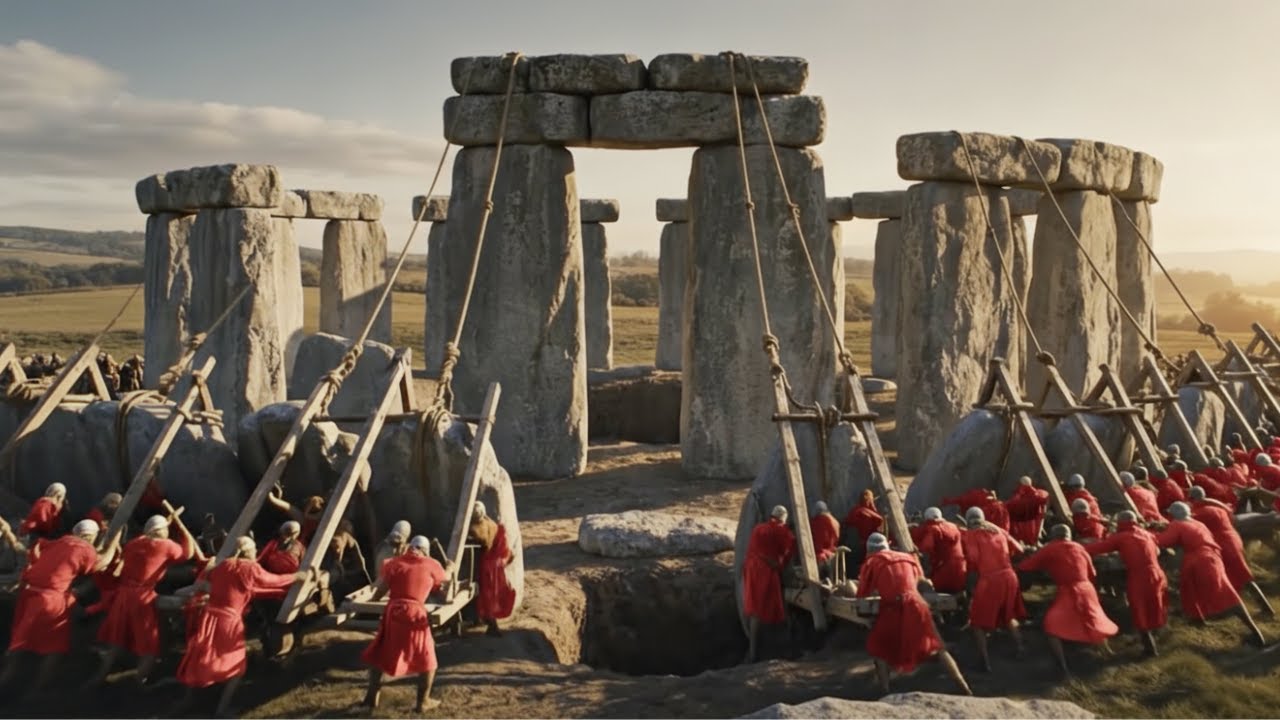
There are clips of thousands digging the initial ditch and using chalk to create the inner and outer bank. So far, so good.
The scene keeps switching through various stages of the build, with a monotone voice narrating each scene, and suddenly we see the moment when a team of workers excavates 56 large pits — and they're all wearing modern hard hats, yellow vests, jeans, and gloves. Oh, and the location inexplicably looks like the present-day interior of the US Capitol-like building in Washington, D.C.
I could almost feel the slippery slide of AI Slop under my feet.
Later in the video, as they attempt to explain how these primitive people used wooden sleds to move the giant stones (accurate), the screen switches to workers dragging a gigantic stone away from the pyramids of Egypt.
The video seemed to be transforming from a historical record into a travelogue. Another scene depicts people of India pulling massive ropes tied around another giant, intricately decorated stone — one that bears no resemblance to anything at Stonehenge (or even Easter Island, for that matter).
At another point, we find ourselves somewhere in China, and for the celebrations around the delivery of the stones to the building site, we're transported to a celebration in modern Mexico.
With all the stones in place, construction is handed back to modern construction workers.
Could I build it better?
Look, the video is a mess, the worst form of AI slop, and fortunately only has about 500 views. Still, it's presented as a history lesson, and that makes me sick.
I have a good idea of how it was made. The 12-minute video is clearly comprised of dozens (if not hundreds) of short AI-generated clips. Each one was based on an inexpertly crafted prompt that often left too much to the AI's imagination. What's even more disturbing is that whoever created this didn't even bother to check their work. They just took all the clips, slapped them together, and posted them on YouTube.
This video, by the way, is just one of many AI-generated history YouTube videos, and some have tens of thousands of views. I can only imagine the junk history that's being fed to unenlightened audiences.
For as disgusted as I was by this twisting of historical fact into AI fantasy, I was curious about the creation process.
I have no information about which tool was used to build this Stonehenge video, but I have an idea. It might might Google Veo 3.1, which can combine audio and video. To test my assumption, I fed Veo this prompt and set the thinking to "Pro" for "Advanced thinking and code with 3.1 Pro":
I want to create a landscape video of the creation of Stonehenge. It should be historically accurate, set it the Neolithic age. Use this image as reference for what the stories should look like. The film should depict transporting the stones on giant wooden sleds along paths lines with logs and branches. It should show how they used tools like flints and antlers to shape the stones and rough-hewn A-frame wooden structures to lifts them into place. Please also include audio narration. Details on the history can be found here https://en.wikipedia.org/wiki/Stonehenge. Set all of it in daytime and make it look photorealistic
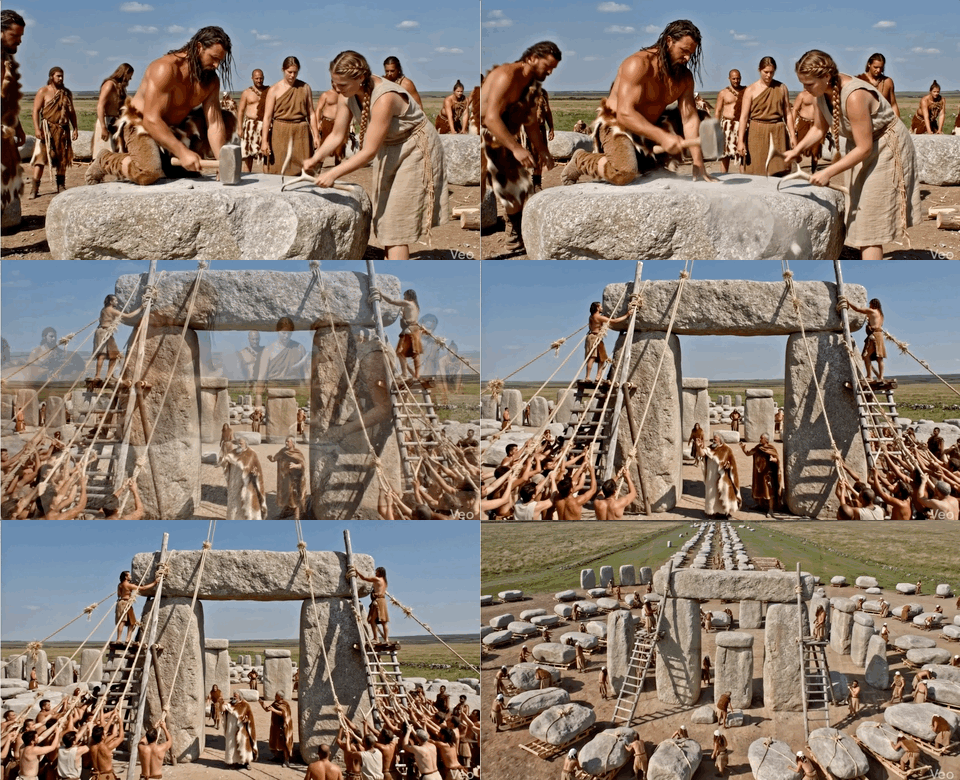
I got a pretty good eight seconds, and I could see how neatly it would slip into the AI video above. My second prompt was less successful. First, it sort of repeated a portion of my first video, and second, it made one giant stone lighter than air. At least I didn't get any hard hats.
Look, I love reading historical fiction, which is called fiction for a reason: it takes the facts and then wraps characters and interpersonal events around them that may or may not have happened, but the thrust is always toward accepted truth: these events happened but the people may not have fought, fallen in love, had that conversation, or lived and died in that way.
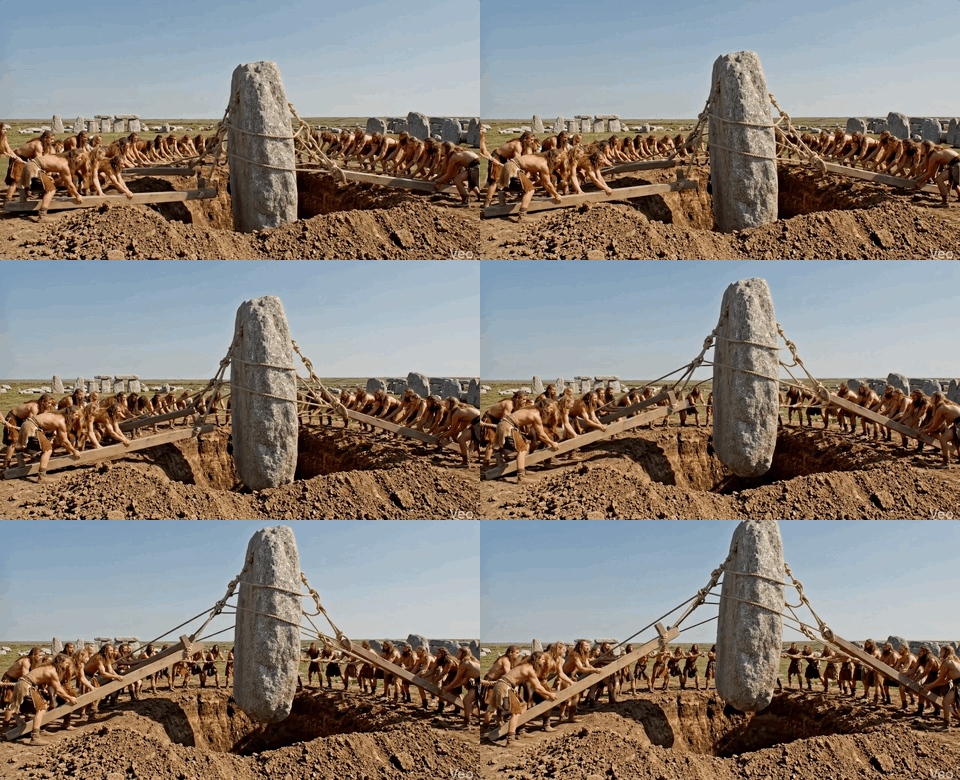
Unlike the novels, though, these "Historical" AI videos are just a mess of barely-understood factoids, outright fantasy, and nonsense. People, places, and time frames are meaningless. AI doesn't know or understand history and is much more interested in completing the prompt. It takes people, places, and things from any era and employs them like puppets to fulfil that effort.
On the other side of this equation are the people building and posting these AI slop videos. They're far more interested in speed and views and the potential for view-based ad revenue they might provide than verisimilitude. YouTube, for its part, appears agnostic about this content. It's served up alongside accurate history videos.
If you, like me, care about history, beware. These "You Are There"-style videos are everywhere, and they can't be trusted to produce accurate views of history, unless, of course, you believe people in hard hats living in China, Mexico, and India somehow worked on Stonehenge in the Neolithic era.

Follow TechRadar on Google News and add us as a preferred source to get our expert news, reviews, and opinion in your feeds.