I’ve always liked the Google Pixel Fold. It was, for a time, one of the thinner and more interesting folding phones on the market, but it’s since been nudged aside by ultra-slim Samsung Galaxy Z Fold devices, and now the still-fresh and oddly shaped Galaxy Z Fold 8. The new Google Pixel 11 Pro Fold is, however, an exciting new entrant in the growing foldable field.
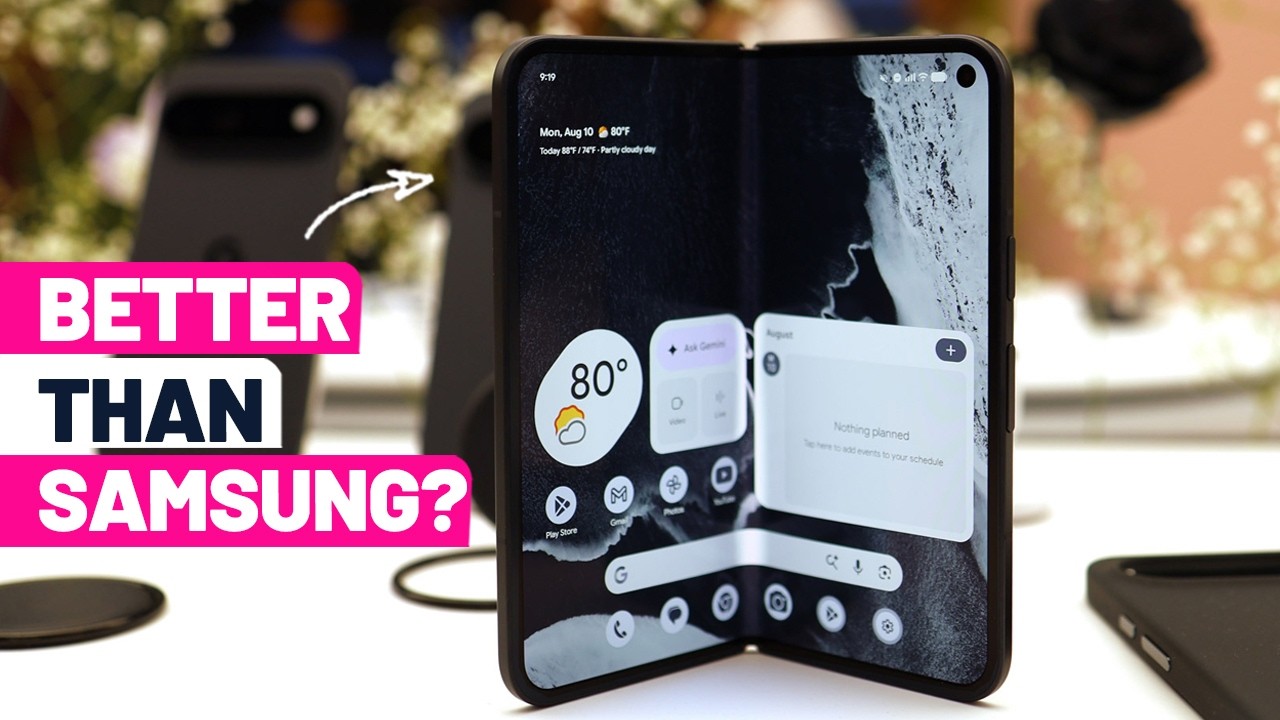
It's not just thinner (slightly) and a lot lighter than its predecessor. Google has cleaned up the design, shrinking bezels, enlarging a screen, reducing the size of the hinges, vastly reducing the size of the camera array island, and even adding an unusual hardware notification feature.
In my brief hands-on time with this new foldable, I found the Pixel 11 Pro Fold surprisingly intriguing.
Unfolding more price hikes

Like so many other consumer electronics gadgets this year, the Pixel 11 Pro Fold is more expensive than the last model ($1,899 versus $1,799 in the US). One might assume that this is due to design and feature enhancements, but I think it’s all down to the rising cost of memory and storage, which we can mostly blame on the demands of AI — which I guess we can also blame in part on Google itself. After all, Gemini is now at the heart of almost everything the company makes and does, including the Pixel 11 Pro Fold. It’s packed with Gemini-related features, most of which I did not have the chance to try out during our jam-packed hands-on session.
At a high level, Google has obviously taken notes on all the ways the Pixel 10 Pro Fold didn’t quite hit the mark, and refined in this new foldable to seriously compete with the likes of the Galaxy Z Fold 8 Ultra and Z Fold 8.


On the cover screen, the black bezel around the display has shrunk significantly to accommodate the now 6.5-inch Super Actual display. The main, flexible screen is still eight inches, but the bezels around it also look thinner.
Folded, the phone’s hinge looks even more well-hidden, now sitting essentially flat against the two folded halves. Google tells me the internal panels under the folding display feature a Titanium plate and flexible hinge panel under layers of polymer, slightly thicker and stronger Ultra-Thin glass, and the OLED panel. The hinge mechanism itself is wider on the inside to further reduce deformation. When unfolded, the phone looks virtually flat, and the crease is harder to detect than on the Pixel 10 Pro Fold.


While not as thin as the 4.1mm-thick Galaxy Z Fold 8 Ultra, the Pixel 11 Pro Fold has slimmed and trimmed a bit compared to its predecessor. It’s now just 5mm thick, as opposed to the roughly 5.1mm of the 10 Pro Fold. More notable is the 239g chassis weight; that’s almost 20 grams lighter than the Pixel 10 Pro Fold, and I can tell you that in my hand the weight loss is noticeable. This is now a relatively lightweight and quite attractive device that also still happens to be IP68-rated, something no other foldable can claim to be at the moment.
As with virtually every other smartphone on the planet, the thinner profile is broken by a camera island that juts out of the back to accommodate, among other things, the three lenses. I was, though, pleased to discover that Google has shrunk this island considerably, so that it no longer looks like a giant block slapped onto the back of an otherwise attractively smooth and flat surface.


The other big and noteworthy design and hardware addition — and one that lives in that island — is HiLight.
HiLight is a collection of multi-colored LEDs that sit on the back of the phone, inside the space typically devoted to the LED flashlight. It’s designed to be used when the phone is face down on a table; HiLight won’t even work when you're holding the phone in your hand (we tried).
For now, HiLight has just two jobs. One is to be an animated Gemini interface. It glows and flows in shades of blue, like the standard Gemini interface, to let you know it’s listening and working with you. The effect is quite nice, and indicative of more than just the work of a handful of LEDs.

HiLight’s other job is to let you know when someone who matters to you is calling. You can assign different colors (there are maybe five options) to various family members and even groups. When they call, your HiLight, which is also found on other Pixel 11 phones, pulses in that color. Again, it’s a compelling effect, though I’m not sure how many people will use it; after all, most of us, for better or worse, live with our phones in our hands.
Camera snapshot

Google hasn't upgraded the headline camera specs, leaving us with the 48MP wide, 10.5MP ultra-wide, and 10.8MP telephoto, but the main camera now has a new sensor that offers, according to Google, 50% better low-light performance, a potential boon for night photography.


There are also a pair of 10MP cameras for selfie shots on the main and cover screens.
I do wish Google had upped the megapixels of the cameras to better compete with the likes of the Galaxy Z Fold 8 Ultra (its main camera is 200MP), but at least we have that 5x optical zoom camera with optical (and electronic) image stabilization.
I took a few photos with the cameras, but not enough to draw any conclusions, though I would say the ultra-wide seems pretty good for macro photography.


There are some new camera features of note (AI-powered and otherwise) that, as is usually the case, will set the Pixel line apart until Google gifts them to partners like Samsung. One is called Magic Capture, which lets you photograph the peak moment without really thinking about how to capture the moment. Google says it analyzes 500 frames to find the right shot, and then crops and even unblurs it to turn it into a usable photo. I did not get to try this feature out.
Camera Looks applies aesthetic filters during capture, which is something I’m not sure I’d ever use. I prefer to see the unvarnished image, and then decide if it needs some adjustment to give it more drama or punch.
I am excited to try the Creators Suite, which is adding, among other things, an on-screen teleprompter. That would be a huge help for me when I film video reviews and need to read off a script.
Good looks and smaller battery

Everything from websites to maps and photos looked great on both screens. Neither display is significantly different to those on the Pixel 10 Pro Fold, but both do enjoy a nice peak brightness bump, up to 3,600 nits from 3,000. I pushed the screens to peak brightness, although being indoors I could not tell if they were sunlight beaters.
I was a little surprised to learn that the battery size has dropped from 5015mAh to 4750mAh, a fact that may account for the Fold’s lighter weight — this change might have made more sense if Google had switched to the denser silicon carbon battery technology (same charge in less space) now found in the entire Galaxy Z8 line. While I’m worried that the smaller battery might result in shorter battery life, Google is still promising 24 hours of use on a full charge.
On the bright side, the Pixel 11 Pro Fold still has Pixel Snap, a MagSafe-style magnetic charge ring that lets the phone magnetically snap onto Qi charge stands and phone grips. I tried it on the new device, and it's just as satisfying to use as ever.
In my brief time with the phone, I enjoyed smooth performance (helped in part by a 1-120Hz display), which is mostly due to some impressive specs. The Pixel 11 Pro Fold arrives with 16GB of RAM (even more than you get with the base Pixel 10 Pro), and starts with 256GB of storage, going up to 1TB.
More exciting, though, is the Google Tensor G6, the first 2nm-process mobile CPU. I don’t expect the processor to be wildly faster than the best Apple and Qualcomm have to offer, but that 2nm might make it far more efficient. In fact, it could be the reason why Google felt comfortable reducing the size of the battery.
Overall, I’m encouraged by what I see. This is easily the best-looking Pixel Fold to date. It’s lighter, thinner, possibly faster and more efficient, and, of course, should be a fantastic showcase for Gemini. My one Gemini experience, by the way, was taking a macro photo of a floral array and then giving Gemini screen access so I could ask it to identify the flower. It did so quickly and effortlessly.

As for how the Google Pixel 11 Pro Fold competes with the new Galaxy Z Fold 8 Ultra and the unusually shaped Z Fold 8, well, it stands nearly toe-to-toe with the Ultra model, though I think the Ultra has it beat on photo capabilities. The Z Fold 8 Ultra is also considerably lighter, making it feel like a no-compromises flagship with a secret 8-inch display. It’s harder to compare the Pixel 11 Pro Fold to the Galaxy Z Fold 8. The aspect ratios are so different, and the camera capabilities are quite far apart (favoring the Pixel). Ultimately, I think the two foldables are for completely different customers.
If you’re thinking about a pure Google and Gemini experience on the biggest screen you can fit in your pocket, the Pixel 11 Pro Fold is a pretty good bet, and may make you happier than the pricier Galaxy Z Fold 8 Ultra, which might overwhelm you by packing no fewer than three on-board AI systems.

Follow TechRadar on Google News and add us as a preferred source to get our expert news, reviews, and opinion in your feeds.