





TechRadar Verdict
Amazon’s second-generation Echo Studio arrives with some noteworthy improvements, but there are a few too many concessions made on sound quality and value for money that make it harder to recommend than the first-generation model. That said, it manages to thrive where many Echo speakers fail, and during sales events, it may be among the best Echo deals you can find.
Reasons to buy
- +
Broadly strong audio and speedy Alexa performance
- +
Great smart-home functionality
- +
Attractive redesign and 40% smaller than the first-gen
Reasons to avoid
- -
Audio quality is hit or miss depending on the track
- -
No 3.5mm jack
- -
Alexa+ is US-only at the time of release
Why you can trust TechRadar We spend hours testing every product or service we review, so you can be sure you're buying the best. Find out more about how we test.
It’s been a while since the original Echo Studio launched way back in 2019. So, it makes sense that it’s such a drastic overhaul; the new, 2025 model is 40% smaller with a total design refresh, Alexa+ compatibility and new Fire TV features.
The original Echo Studio launched way back in 2019, and the fact that it’s taken this long for a second-gen model to arrive makes the Studio an outlier in Amazon’s smart speaker range, with other Echos receiving more regular upgrades.
It makes sense, then, that this is a fairly major overhaul: the 2025 model is 40% smaller and gets a total design refresh that brings it into line with other Echos, along with Alexa+ compatibility and new Fire TV features.
While the previous-gen Studio was more than a little clunky in terms of its design, it was pretty well received — much to the surprise of many who’d long bemoaned the audio quality of Amazon’s Echo speakers. Then, in 2022, a slightly upgraded version was released with some modest improvements; this wasn’t considered a new generation of the Studio, but again it surprised and largely delighted users.
So, has lightning struck twice (or technically, thrice) with the new Echo Studio? Well, not quite, but this is still an impressively capable speaker, especially at its size.
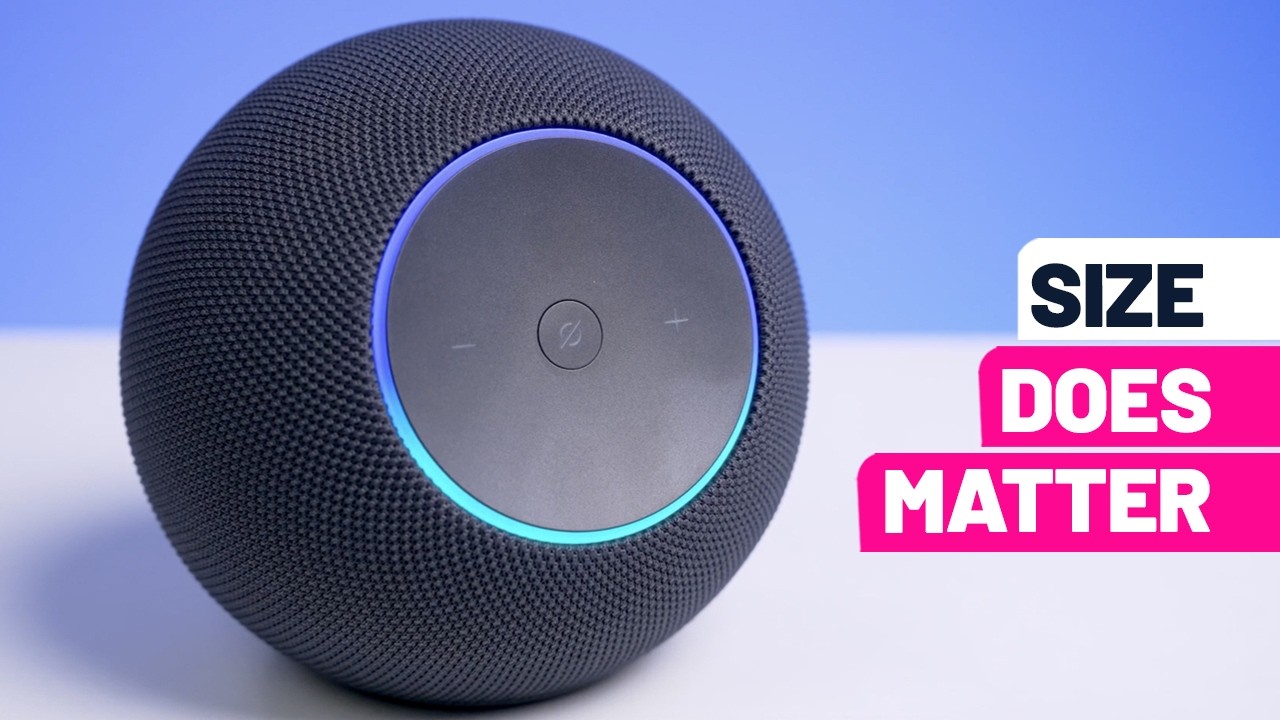
There’s an inevitable trade-off between the speaker’s size and its audio quality. In its smaller form factor, the second-generation Studio is certainly more appealing, and the spherical design, new knit-fabric exterior and front-facing controls are much more homely compared to the original, the design of which resembled a medieval knight’s bucket helmet.
With the latest Studio packing Amazon’s new AZ3 Pro chip and offering Alexa+ compatibility, and some great smart home compatibility and sensors, there’s a lot to love, but having tried both the newer and older models, I don’t think the new audio hardware quite lives up to its predecessor. That being said, it’s most certainly the best Alexa speaker for audio available today… unless, of course, you can find a first-gen model on resale.
Echo Studio (2nd gen, 2025) price and availability
- List price: $219.99 / £219.99 / AU$429
- Released November 2025
The new Echo Studio is the most premium Echo speaker in Amazon’s lineup, offering home-theatre buffs and audiophiles an Alexa-powered alternative to standard speakers. You concede some audio quality, sure, but it’s pretty compact, and the smarts you gain are decent enough.
It’s available in black (graphite) and white (glacier white), and costs $20 / £40 / AU$100 more than the original Studio at $219.99 / £219.99 / AU$429; the price hike is explained, in part, by the rising cost of hardware, but it’s worth noting nonetheless.
It’s also Alexa+ compatible, meaning US Prime subscribers have immediate access to the currently-in-beta service (at the time of writing). Whether or not that’s a positive or a negative, I’ll leave you to decide.
My main issue with the value proposition here is that, at times, the Echo Studio (second-generation) just doesn’t live up to its Studio moniker; and yet, allowing for inflation, it costs the same as the previous generation. Had Amazon skipped some of the smart features and delivered a stronger all-around audio performance, I’d have less of an issue; as it is, and as is the case with almost every new Echo device I’ve reviewed in the past few years, this is one I’d only go for during a sale, and I’d be looking for at least a 40% discount.
- Value: 3.5/5
| Row 0 - Cell 0 | Echo Studio |
Dimensions |
6.1 x 5.6 x 5.8 inches / 155 x 142.2 x 147.3mm (W x D x H) |
Speakers |
1x 3.75-inch high excursion woofer, 3x 2.25-inch full-range drivers |
Processor |
AZ3 Pro |
Connecivity |
Zigbee, Matter, Thread Border Router, eero |
Voice assistant |
Alexa |
Weight |
53.5oz / 1.63kg |

Echo Studio (2nd gen, 2025) design
- New, more premium design and materials
- 40% smaller than the previous generation
- Fewer ports, fewer audio-first design features
Like the Echo Dot Max, which I tested a few months ago, the Echo Studio has a new, more sophisticated look and feel, featuring a chunky knit-fabric exterior, front-facing controls, and a 40% smaller frame than the previous Echo Studio models.
Now, instead of resembling a bucket-shaped medieval knight’s helmet, the Echo Studio is more akin to a rounded spaceship (read: Death Star), and it’s a change I’m quite happy with aesthetically. The base is flat and slightly rubberized, housing a screw-mount for any users who might wish to wall-mount their speaker(s).
The neater look and smaller footprint make it a much more appealing option for around the home, and the new front-facing controls are easily accessible and clear — especially when compared to the original’s small and fiddly buttons. There are volume controls as well as a physical mute button on the plastic control panel. Plus, if you give the Studio a gentle pat on the top, you can stop or start tracks, stop timers and alarms, or end calls and drop-ins.
The iconic illuminated Alexa ring, which glows blue when the speaker is listening to you, now encircles the control panel, and changes colour and brightness for different types of alert (for example, orange for an Amazon marketplace-related notification, or red for connectivity issues).
There’s been a complete hardware refit, too. The new Echo Studio uses the latest AZ3 Pro chip to power Alexa commands and other on-board smarts like ambient sensing and spatial sound. Where the last-generation speakers had three two-inch side-mounted mid-range speakers, a two-inch upward-firing midrange speaker, a 1-inch front-facing tweeter, and a 5.25-inch downward-firing sealed woofer and cutout spaces to allow for airflow to enable powerful and deep bass, the latest model has just three full-range drivers and a single high-excursion woofer. More later on how that impacts performance, but as far as design goes, it does make the focus on the newer model’s aesthetics feel like a big trade-off when you compare the hardware specs.
Connectivity is another area where the new Studio has taken a hit. On the rear, you’ll find a single power port – that’s right, no more 3.5mm combo port for standard audio cable input and Mini-Optical, and no micro-USB port for service/Ethernet adapters. For most, these inputs will be no great loss, but the inflexibility of these speakers will be disappointing to some, and especially to those who know a bit about home theater.
Objectively, I can’t say I dislike the look and feel of the new Echo Studio – it’s more pleasing to the eye, and a lot easier to find a home for at its smaller size. However, many of the concessions made ultimately impact performance and usability — and for a supposedly top-of-the-range speaker I’d always prize those qualities over look and feel.
- Design: 4/5

Echo Studio (2nd gen, 2025) audio quality
- Complete hardware refit compared to previous generation
- Solid, clear audio across a range of genres
- Mid-range performance for home cinema
Sitting at the top end of the Echo speaker lineup, the Echo Studio in principle offers the best audio you can get from an Amazon speaker. However, while that’s indeed the case, not everyone who loved the first-generation Studio will enjoy this newer version.
As mentioned above, the new Echo Studio trades its predecessor’s three two-inch side-mounted mid-range speakers, two-inch upward-firing midrange speaker, 1-inch front-facing tweeter, and 5.25-inch downward-firing sealed woofer for three full-range drivers and a single high-excursion woofer. Plus, under the hood, the new AZ3 Pro chip does a lot of the legwork, working in tandem with onboard far-field microphones to deliver Automatic Room Adaptation, fine-tuning the audio experience based on the room’s acoustics. There’s also spatial audio, Lossless High Definition and Dolby Atmos support.
So, what difference do these hardware changes make in practice? I played a variety of tracks from different genres to test the speaker’s audio quality, as well as trying out the new Amazon Home Theatre feature, to find out.
It’s a tale of trade-offs; on the one hand, the soundstage is well balanced overall, producing beautifully clear layers and expressing texture in tracks well. Hans Zimmer’s Cornfield Chase was rendered with beautiful depth and clarity, especially at louder volumes, as was Jeff Buckley’s Last Goodbye, with the Echo Studio proving amply capable of rendering Buckley’s quivering vocals beautifully while preserving the layered rhythmic guitars and mounting tension. Dynamic songs like Glory Box by Portishead offer well-rounded bass, with every detail of the track, right down to its vinyl crackle, represented with impressive clarity.
However, the Echo Studio lacks the powerful bass and overall volume of older models, and certain tracks suffer as a result: Running Up That Hill by Kate Bush plays much more faithfully than on the Echo Dot Max I tested a few months ago, but the Echo Studio still lacks the pummeling bass I so adore. Similarly, Fleetwood Mac’s The Chain, especially at lower volumes, fails to fully deliver the track’s signature thunderous, driving bass.
With Amazon removing many of the audio-first design features (like the sound-carrying cutouts) and squeezing the device into a far smaller form factor, the new Echo Studio ultimately loses a lot of its oomph. It also now downmixes stereo content to mono, and compresses the mix more aggressively at higher volumes than the original model.
That said, when I was testing this speaker in my apartment, I wasn’t looking to push the volume beyond 70% (mostly for the sake of my neighbours), and the bass was, broadly, suitably present for my living space, this is aided by the Automatic Room Adaptation, which works well to really flood a space with sound.
Of course, the Echo Studio can do more than just play your music. You can connect up to five Echo Dot Max or Echo Studio speakers plus an optional Echo subwoofer to a Fire TV Stick 4K (2nd-gen), Fire TV Stick 4K Plus, Fire TV Stick 4K Max (2nd-gen), or Fire TV Cube (3rd-gen) to use Amazon’s new Home Theatre feature. I gave this a quick try, albeit with just the one Echo Studio, watching a few scenes from Red Sonja, The Batman and Oppenheimer to put its through its paces. I was pretty happy with how much depth and clarity the Echo Studio provided (it’s all handled over Bluetooth, so I did notice a bit of a delay with lip-synching initially; thankfully, you can adjust this in the settings), and I can imagine with a full set the sound would be really quite impressive.
That said, the dynamic range was pushed to its limit during my testing, and I ultimately found myself toggling the volume fairly often. Plus, its downmixed mono playback makes it a hard sell for a cinephile – of course, you can opt to spend $1,000 / £1,000 / AU$2,000 on a full Amazon Home Theater setup, but for that price I’d wager there are far superior surround sound systems. It’s only if you’re benefitting specifically from the Echo Studio’s place in Amazon’s Fire TV / Prime / Alexa+ ecosystem that I can see this being a viable option.
- Audio quality: 3.5/5

Echo Studio (2nd gen, 2025) features
- Smart and accurate sensors
- Speedy Alexa commands
- Alexa+ compatible
Much like the Echo Dot Max, the Echo Studio is locked and loaded with clever sensors and smarts to help run your smart home, including the same temperature and ultrasound motion sensors as the Echo Dot (4th gen) as well as a new Wi-Fi sensing capability.
I set these up at home for even smarter Alexa Routines; when I enter a room, an automation turns on my smart lights, and when the temperature drops, my electric heater turns on to keep me toasty during the UK winter months. Everything worked as expected on test, and it’s good to see the Echo Studio keeping pace with other smart speakers here.
The new AZ3 Pro chipset delivers super-speedy Alexa responses, though you probably won’t notice the difference unless you’ve been using Alexa-enabled devices from a few years ago. Where you will feel the difference is if you have access to Alexa+, as that’s the real driver behind the additional computing power. I’m testing this speaker in the UK, where we don’t currently have access to Amazon’s full agentic AI platform, but my US-based colleague Lance Ulanoff shared his first impressions of the service overall.
- Features: 4/5

Should I buy the Echo Studio (2nd gen, 2025)?
Buy it if…
Don’t buy it if…
Also consider
| Row 0 - Cell 0 | Echo Studio |
Echo Dot Max |
Echo (4th-gen) |
Dimensions |
6.1 x 5.6 x 5.8 inches (W x D x H) |
4.27 x 4.27 x 3.9 inches |
5.7-inch x 5.7-inch x 5.2-inch |
Speakers |
1x 3.75-inch high excursion woofer, 3x 2.25-inch full-range drivers |
0.8-inch tweeter and 2.5-inch woofer |
3-inch neodymium woofer and two 0.8-inch front-firing tweeters with Dolby Audio support |
Processor |
AZ3 Pro |
AZ3 |
AZ1 Neural Edge |
Connecivity |
Zigbee, Matter, Thread Border Router, eero |
Zigbee, Matter, Thread Border Router, eero, Wi-Fi 6 |
Zigbee, Matter, Thread border router. Dual-band Wi-Fi, eero, Bluetooth 3.5mm audio line-in/out. |
Voice assistant |
Alexa |
Alexa |
Alexa |
Weight |
53.5oz / 1.63 kg |
505.3g |
970g |
How I tested the Echo Studio (2nd gen, 2025)
- I used the Echo Studio as part of my smart home setup
- I played lossless audio through Spotify
- I used the standard Alexa and other advertised features.
I tried all of the advertised features of the Echo Studio (barring Alexa+ which is not currently available in the UK) to assess its performance and audio quality.
As well as testing Alexa’s ability to follow commands and surface information, I used my Echo Studio as a speaker, streaming lossless tracks via Spotify across a variety of genres and moods to test the speaker’s dynamic range, clarity and volume. I also tried using the new Echo Studio as part of my Amazon Home Theatre setup, listening to various TV shows and movies to see how well the speaker would serve cinephiles.
I’ve had an Alexa-powered smart home for years, having professionally tested smart home devices for over four years. In addition to my at-home Alexa setup, I’ve also used both Google and Apple devices to assess the strengths and weaknesses of the most popular smart home ecosystems.
