





TechRadar Verdict
The Apple Watch Series 12 is a worthwhile upgrade for anyone using a Series 9 or older, with Readiness Score and improved health sensing making everyday tracking more useful. It's a less compelling upgrade from the Series 10 or 11, though, and Apple's upcoming AI features aren't ready to tip the scales just yet.
Reasons to buy
- +
Readiness Score is terrific and not locked behind a paywall
- +
Refreshed Health Sensing System
- +
S11 Chip ensures smooth, responsive performance
- +
Still delivers all-day battery life
Reasons to avoid
- -
No major design changes
Why you can trust TechRadar We spend hours testing every product or service we review, so you can be sure you're buying the best. Find out more about how we test.
Apple Watch Series 12: One minute review
While the Apple Watch Series 12 is a decidedly modern-looking smartwatch in a pleasingly thin profile, it’s not a major redesign from the Cupertino-based tech giant. And if you're upgrading from the Series 11, you'll probably notice more of a difference in what the watch can do rather than in how it looks. Apple has updated the Health Sensing System (its array of LEDs and sensors used to collect your health data), introduced Readiness Score, and made everyday tracking more useful, with real-time steps and heart-rate information easier to access.
I've been wearing the Series 12 for more than a month, and Readiness Score is the addition I've found myself using the most. It takes your sleep and other health data and turns it into a score out of 10, giving you a quick idea of how ready you might be for the day. I've generally found the results match how I feel, and it's a feature that can genuinely influence what I do, whether that's heading out for a workout or taking a longer walk with my dog, Rosie.
I've also been comparing the Series 12 with the Series 11, Apple Watch Ultra 3 and Ultra 4, as well as the Oura Ring 5 and Pixel Watch 5. That has helped me put Apple's latest watch into context, particularly when looking at health tracking and heart-rate readings. The Series 12 has generally delivered the sort of everyday experience I'd expect from an Apple Watch, with battery life that's worked well for me most of the time.
A couple of things to consider, though. The design is very familiar, so there's little reason to upgrade purely for its appearance, and I did have two nights when the battery ran out before morning. Apple's upcoming AI features are also still a reason to wait rather than buy immediately. If they're what you're most interested in.
For anyone using an older Apple Watch, particularly a Series 9 or earlier, the Series 12 makes a much stronger case. The combination of newer health features, Readiness Score, performance, and battery life makes this an upgrade worth considering.
Apple Watch Series 12: Specs Table
Component |
Apple Watch Series 12 (42mm) |
Apple Watch Series 12 (46mm) |
Price |
$399 / £369 / AU$679 for the 42mm |
$429 / £399 / AU$699 for the 46mm |
Dimension |
46 x 40 x 9.7mm |
42 x 37 x 9.7mm |
Weight |
31.5g (without band) |
38.6g (without band) |
Case/bezel |
Aluminum, Titanium, or Ceramic |
Aluminum, Titanium, or Ceramic |
Display |
42mm Always-On Retina LTPO3 OLED display (up to 2,000 nits) |
46mm Always-On Retina LTPO3 OLED display (up to 2,000 nits) |
Processor |
Apple-made S11 chip |
Apple-made S11 chip |
GPS |
Precision L1 GPS (GPS, GLONASS, Galileo, QZSS, and BeiDou) |
Precision L1 GPS (GPS, GLONASS, Galileo, QZSS, and BeiDou) |
Battery life |
Up to 24 hours with normal use |
Up to 24 hours with normal use |
Connections |
4G LTE, Satellite SOS, Wi‑Fi 4 (802.11n), Bluetooth 5.3 |
Wi‑Fi 4 (802.11n), Bluetooth 5.3, and 4G LTE |
Water resistant |
Water resistance 50m |
Water resistance 50m |
Apple Watch Series 12: Price and availability
- $399 / £369 / AU$679 for the 42mm
- $429 / £399 / AU$699 for the 46mm
- Prices unchanged from last year
The Apple Watch Series 12 starts at $399 / £369 / AU$679 for the 42mm with a recycled aluminum case and standard strap, and $429 / £399 / AU$699 for the 46mm. LTE-capable models, which can be added to your data plans, as well as optional improvements to the finish — titanium or ceramic — are available at an additional cost.
It doesn’t represent outstanding value in the same way as, let’s say, the Amazfit Active 3 Premium might, but it’s fine — the price has actually held steady on Apple Watches for the last couple of years, which is encouraging given the electronics industry is undergoing a supply chain crisis at the moment.
- Value score: 4.5/5
Apple Watch Series 12: Design

- Same ‘squircle’ and digital crown design
- Retains slimmer look from Series 11
- Redesigned sensor array and GPS architecture
If you expect the Apple Watch Series 12 to look substantially different from the Series 11, you'll be disappointed. Apple has kept the familiar rectangular ‘squircle’ design, with the Digital Crown and side button on the case, and the overall look remains very much the same.
After using the Series 12 for more than a month and comparing it with the Series 11, I haven't found the exterior to be a major reason to upgrade. It doesn't look dramatically different on your wrist, and Apple hasn't tried to reinvent a design that already works.
That's not necessarily a problem, though. The Apple Watch Series 12 remains a comfortable everyday smartwatch, and wearing it all day and overnight matters when you use it for sleep tracking and the Readiness Score. The biggest changes are on the rear of the case, as Apple has redesigned the LEDs and internal architecture to make its data collection more accurate. However, a watch can have all the health features in the world, but they're less useful if you don't want to wear it consistently.

The Series 12 comes in 42mm and 46mm sizes, with aluminum and titanium options alongside ceramic, which is returning and still adds a bit more heft. That gives you some choice in look and finish, though the core experience stays the same. The aluminum model is the more straightforward choice for most people, while titanium and ceramic offer alternatives if materials and appearance matter more to you.
The always-on OLED display is familiar, too. It lets you glance at the time, check a notification, or see your workout metrics without having to wake the screen manually. That's one of those features that quickly becomes part of your routine, particularly if you use complications to keep useful information on the watch face.
One addition I've found handy is the real-time step-count complication. I check steps regularly, and seeing the number at a glance saves me from opening the Fitness app. The heart rate complication works the same way, especially when I want to keep an eye on my readings during the day.
Compared with the Ultra 3 and Ultra 4, the Series 12 feels more like a familiar everyday watch. The Ultra models have their own appeal, particularly if you want a larger, more rugged watch, but the Series 12 is easier to recommend to someone who doesn't need that design.
The main point is that the Series 12 doesn't feel like a new design generation. If you're upgrading, look at the back of the case, with its improved health features enabling the Readiness Score and overall experience, rather than expecting a noticeable aesthetic change to the watch itself.
- Design score: 4.5/5
Apple Watch Series 12: Features
- Readiness score is a major boon
- More frequent heart rate data collection
- Upcoming Audio Intelligence features
The Readiness Score is the biggest reason I'd consider the Series 12, and it stood out most during my testing. It uses overnight sleep and HRV data, along with other health and activity information and some custom processing, to produce a score from 1 to 10. The idea is to give you a quick indication of how ready you might be for the day, rather than leaving you to interpret a collection of separate metrics yourself. Tested against the Garmin Cirqa, our senior fitness editor Matt Evans found both devices provided identical Readiness scores after wearing both for one week’s worth of sleep.
I like how Apple presents it: a half-moon graphic that’s easy to read, with an accompanying explanation that gives context for the score. It feels grounded in the data, rather than relying on vague wellness language that doesn't explain why you got a particular result.
My scores have generally been high, and they've mostly matched how I've felt. Getting my first 10 out of 10 was satisfying, of course, but the more interesting part is how I can use the information. If I've slept well and feel good, a strong score might encourage me to fit in a workout or take Rosie on a longer walk. It won't make every decision for me, but it gives me another useful piece of information to consider.
I've used an Oura Ring before, so I know the appeal of a daily Readiness score and the help it can provide beyond raw data. I appreciate that Apple built the feature into the watch I already use. I don't need to add another device to my routine, and Readiness Score doesn't require a separate subscription.
That makes it a particularly interesting addition for existing Apple Watch owners who want more from the health data their watch collects. Instead of simply checking how long I slept or looking at the previous day's activity, I get a more immediate summary I can use to plan my day. However, we have to acknowledge the wait for this feature — most other devices have had Readiness for years, but Apple has stated the feature has been enabled by its redesigned sensors taking heart rate and HRV readings more frequently, up to 60 times more often than previous Apple Watches.

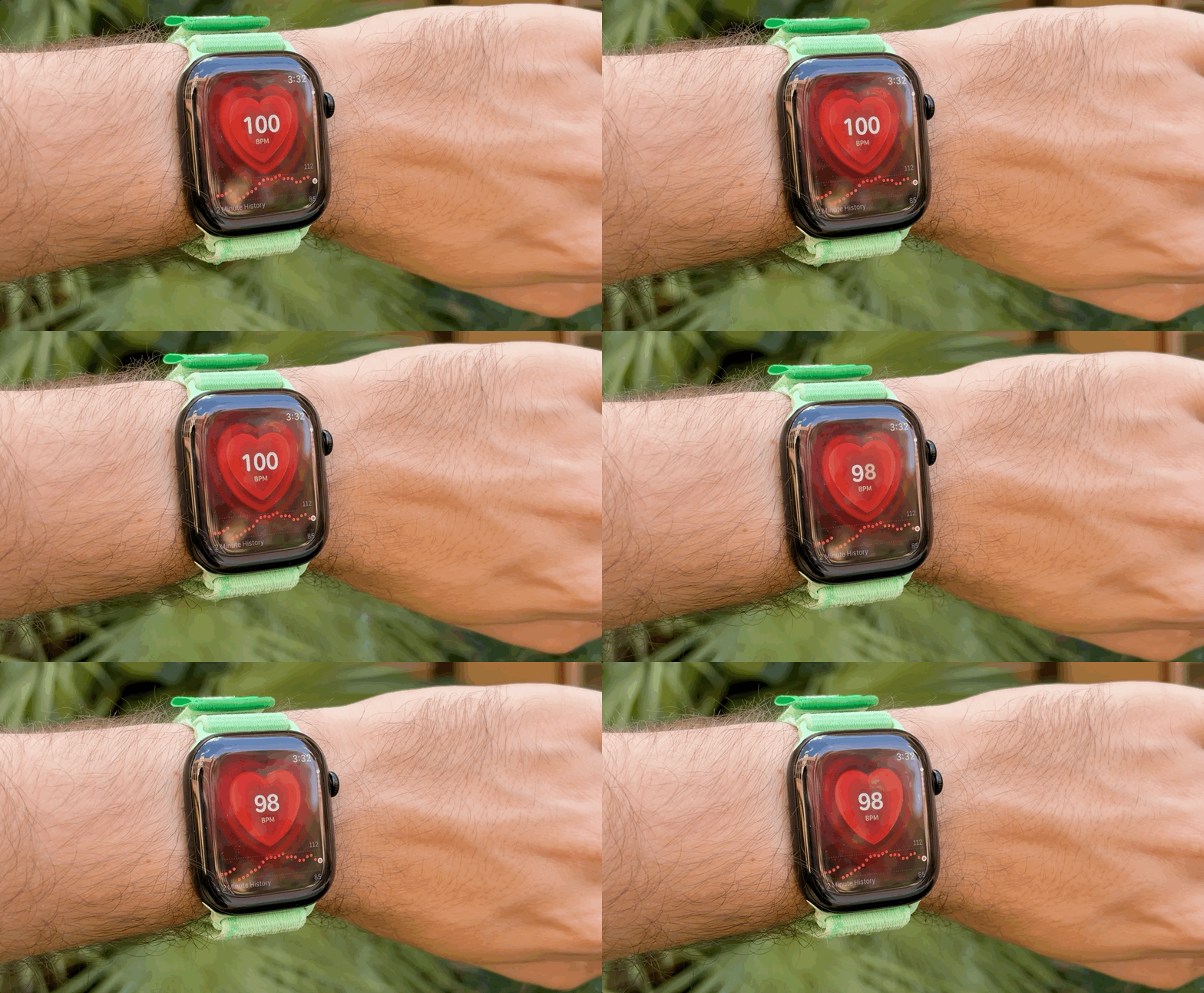
I've also been paying attention to heart rate readings while comparing the Series 12 with the Apple Watch Series 11, Ultra 3, and Ultra 4, along with the Oura Ring 5 and Pixel Watch 5. In my everyday use, the Series 12's readings have been broadly consistent with what I've seen from those other devices.
Having heart rate information readily available is useful during workouts, too. I've used the watch for yoga, outdoor walks and runs, and indoor cycling, and it has fit naturally into those sessions. The real-time heart rate complication also makes it easier to check my readings without navigating away from the watch face.
The Series 12 retains the wider Apple Watch health feature set, including ECG, heart-rate notifications, wrist-temperature sensing, sleep tracking, respiratory-rate tracking, cycle tracking, hearing-health features, hypertension notifications and blood-oxygen tracking where supported. These aren't all new to this generation, but they contribute to the overall package.
Apple's upcoming AI (‘Audio Intelligence’ this time) features aren't a strong reason to buy right now. Live Rewind and Siri Recap sound interesting, but I haven't been able to test them because they aren’t out yet. If you're considering the Series 12 for those, I'd wait until Apple confirms when they're shipping and what will be available in your region, as there is some contention with Siri AI in certain regions such as the EU.
For now, Readiness Score is the feature I'd focus on. It's useful today, fits into the existing Apple Watch experience, and has made the biggest difference in how I use the Series 12. Best of all, it’s not locked behind another subscription … and that’s simply refreshing.
- Design score: 5/5
Apple Watch Series 12: Performance

- S11 chip drives excellent performance
- Accurate compared to other wearables
- Responsive with no stutters
While the Series 12 still feels and looks like an Apple Watch in pretty much every sense of the word, you can’t judge a book by its cover, especially when it comes to performance. Under the hood, the Series 12 runs on Apple’s new S11 chip, and the new health-sensing system on the back enables the Readiness score and HRV features. All of this comes together to make the Series 12 feel responsive, with none-to-minimal stutters when calling on a particular feature set.
I've now used the Series 12 for more than a month, and I've compared it directly alongside the Series 11, Ultra 3, and Ultra 4. These comparisons have helped me understand how the Series 12 fits into the wider wearable landscape, and while the latest generation doesn’t run laps around the previous gen or the one before that, the responsiveness is definitely noticeable.
Whether you’re customizing a Watch Face with your favorite complications, calling on Siri to remember a piece of information or drafting a message, controlling media playback, making a call, recording a voice memo, checking your activity score, monitoring your heart rate, or starting a workout, the Series 12 feels very responsive. We’ve also tested the same heart rate system, albeit on the Ultra 4, against a chest-mounted heart rate monitor, the Frontier X2, alongside the Garmin Fenix 9 Pro, and found Apple’s latest gen is highly accurate.
Battery life has been good overall, and it certainly meets Apple's all-day battery life promise. On a normal day with plenty of interaction points and one extended workout, I typically have around 30%–45% battery remaining by bedtime. That's enough to get through a normal day, and faster charging makes it easier to top up when I need to. Depending on how I use it, I can get through a full day and sometimes stretch it to a day and a half.
So far, the Series 12 has run out of battery overnight twice, and I think it’s especially worth mentioning because you need a full night of sleep data to wake up with a Readiness Score. And that means an unexpected shutdown can interrupt that routine. My general solution, even if the percentage hasn’t dropped super low, is to give it a quick charge before bed rather than assuming it will always have enough power to last the night.
The faster charging helps here. A short top-up with the USB-C to Apple Watch dongle that ships with the Series 12 can make it easier to keep the watch going overnight while still wearing it.
If you’re coming from an older Apple Watch, the all-day battery life paired with fast-charging will likely make a big difference. It’s not just a quality-of-life upgrade from, say, a Series 10 or older; compared with the rest of the features, it's a significant leap in what watchOS can accomplish and how long you go before you need to charge.
- Performance score: 4.5/5
Should you buy the Apple Watch Series 12?
Buy it if..
Don’t buy it if..
Also consider
How we tested
We tested the Apple Watch Series 12 by wearing it day and night, tracking workouts, monitoring sleep, and putting its features to the test over multiple weeks. We compared its health and fitness readings with other wearables and an electrical heart rate monitor, tested battery life, and explored as many features as possible to see how it holds up in everyday use.
First reviewed October 2026.
