





I don’t think there’s any way around it — the internet in the sky has never been a perfect experience. However, many airlines are starting to buck that trend, and in the United States, United Airlines has been punching above the rest.
It’s not only frequently updating its app with helpful features — real-time boarding group notifications, anyone? — but also partnering with Apple to help reunite you with your bag sooner thanks to AirTag. Now, it's ambitiously upgrading its onboard Wi-Fi and internet product.
In October 2025, I had the chance to fly aboard United’s first mainline jet — a Boeing 737-900 — with fast, free Wi-Fi powered by Starlink. After the flight, I wrote, “It feels like the internet finally reached the sky.” That’s still accurate and sums up my main feelings, but I got to fly again — this time on a slightly different Boeing 737-900 — and United has been hard at work speeding up these installations.
Now, every United Express regional jet boasts Starlink — a big upgrade, as those aircraft previously had some of the least reliable satellite internet — and United has Starlink on 18 mainline jets. This was a more packed flight, with a lot more media, creators, and influencers really taxing the network. That’s expected for a Starlink demonstration flight, but even with slower speed tests, I didn’t experience latency or much lag with any task that would normally struggle on current in-flight internet systems.

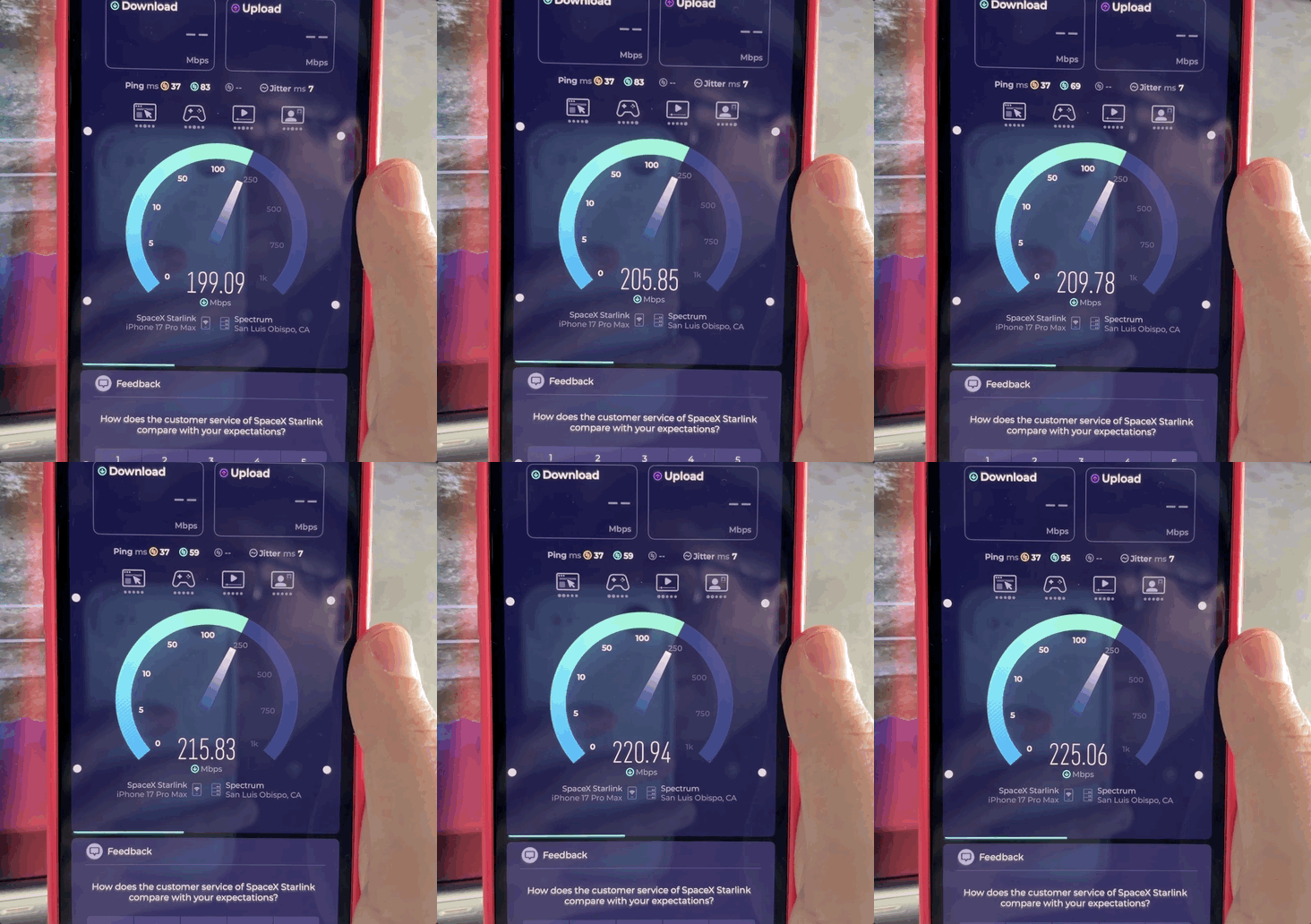
At its best, via an iPhone 17 Pro Max, I scored 291 Mbps download and 35.1 Mbps upload. Toward the end of the flight, before beginning descent, I got around 41.7 Mbps download via an iPhone Air.
Even with those variations, I could livestream a show or movie, or even select a “live channel” via Disney+ on an iPad, watch any video on YouTube, and scroll through TikTok or Instagram Reels without the slowdowns or loading issues typical of non-Starlink-equipped United flights.
But maybe the best part is simply being able to stay connected. I never had an issue sending a message via iMessage, WhatsApp, or even Facebook Messenger. I could send and receive texts, photos, and videos — thanks to my brother for sending pictures of my pup Rosie. I didn’t feel disconnected, even while flying over Los Angeles at 35,000 feet.
It all felt very instant, with speeds similar to using my iPhone on 5G cellular or home and office Wi-Fi networks. United has also made the process really simple to get connected — and it’s entirely free.
Right now, for standard in-flight Wi-Fi, you could pay anywhere from $8 if you’re a MileagePlus member — or $10 without — to upwards of $17.99 for international routes, where the network can be especially spotty.
You’ll start by connecting to United Wi-Fi, which you can do as soon as you board. From there, follow the on-screen steps, starting with a screen that says, “Break the Barrier.”
That’s United’s slogan for its Starlink-powered Wi-Fi. You’ll swipe through about three screens, including three rules you’ll need to abide by:
- Voice and video calls are prohibited by federal law
- Enjoy audio, video, online gaming, and live event content while using headphones
- If others could find what you're viewing offensive, please choose something else to stream
You’ll sign in with your United MileagePlus account — it’s free to join and unlocks the free Wi-Fi — or, if you’re signing in on your phone with the United app installed, it should auto-fill. From there, you’ll watch two quick ads — I saw a 30-second Starlink one and a 17-second United credit card one — and then you’re connected and off to the races.
Throughout the flight — which felt like a better representation of a true commercial Starlink experience, something United is now running daily — the in-flight Wi-Fi was consistent, smooth, and, most importantly, didn’t cause any roadblocks.
While not allowed on a typical commercial flight, we were permitted to try video calls to really push Starlink’s capabilities to the max. I was able to FaceTime with TechRadar’s Editor-at-Large, Lance Ulanoff, and it was clear, with no noticeable latency or voice or video garbling. He reported that I looked great on the other end. Same with my family, who I wanted to show a live, 35,000-foot view of the California coast.
It was seamless — I could easily browse the web, scroll through cloud storage like Google Drive or iCloud, stream videos, download songs to a Spotify playlist while streaming, hop into a live newscast, respond to emails, and use pretty much any device I had.
Back in October 2025, I also tried connecting the Nintendo Switch 2. United has been looking into it, and while I still couldn’t get it to connect on this second Starlink demonstration flight, the airline tells me a patch is coming, and the console should begin working in the coming weeks.
Similarly, while I could upload videos to TikTok and Instagram — and even go live on both platforms — uploads aren’t lightning-fast. A sub-one-minute video took about five minutes to upload, but it’s passable. I likely wouldn’t use a flight to upload long-form video, but for collaboration, tools like Google Docs or Pages worked well.
Just like the Boeing 737-800 I first flew with Starlink in October 2025, there are two Starlink antennas mounted on top of the aircraft near the front, along with four onboard routers distributing the connection. It’s also multi-device — I connected two iPhones, an iPad, and a MacBook Pro without issue.
United is still on track to have its entire fleet fitted with Starlink by the end of 2027. That’s still a long way off, but progress is steady — with 16 more mainline aircraft added since October 2025 and the full United Express regional fleet now equipped. Next up are larger jets — like the 787, 777, 757, and 767 — as well as other variants of the Boeing 737 and the Airbus A321.
We can only hope the timeline continues to accelerate as United refines the installation process. It’s also clear the airline is onto something, as others — both domestic and international — are making similar moves.
Zach Griff, travel expert and author of travel newsletter From the Tray Table, shared with TechRadar, "Starlink really is a game changer for in-flight Wi-Fi. The low latency and blazing-fast download speeds make streaming a breeze. On United, Starlink is an even bigger deal because the existing satellite-based Wi-Fi providers can be lackluster at best."
"That’s why I believe the next 18 months are going to be painful for United flyers. They’ve now seen the future with what fleetwide Starlink WiFi is going to be like, but they’ll need to wait until the end of 2027 to experience it on every jet."
And I agree, United’s vision of “enabling the living room in the sky” experience feels genuinely distinct — something Grant Milstead, United’s Vice President of Digital Technology, reinforced on this test flight and even earlier, when Starlink was just an announcement.
As of now, 344 aircraft feature Starlink, and United has operated more than 167,000 flights with the faster, free Wi-Fi — but for those who are waiting, that rollout can't come soon enough.
Follow TechRadar on Google News and add us as a preferred source to get our expert news, reviews, and opinion in your feeds. Make sure to click the Follow button!
And of course you can also follow TechRadar on TikTok for news, reviews, unboxings in video form, and get regular updates from us on WhatsApp too.
