





TechRadar Verdict
The Lumix L10 is the spiritual successor to the legendary LX100 series of premium compacts — and its attractive retro form factor bears a striking similarity to the popular Fujifilm X100VI, compared to which it's a versatile zoom lens alternative. And this is far from a mere refresh of a dated Lumix series — Panasonic has packed the L10 with its latest Micro Four Thirds sensor, processor, autofocus system and a bigger battery. The result is a powerful everyday and travel camera that deserves what will be its inevitable popularity.
Pros
- +
Attractive design
- +
Snappy performance
- +
Excellent handling with an EVF, flip-out touchscreen and hotshoe
- +
Powerful photo and video features
- +
Sharp and versatile lens
Cons
- -
Notably larger body than the Lumix LX100 II
- -
Not all of the sensor's 26.5 megapixels are used, with stills limited to 20.4MP
- -
Lack of IBIS limits handheld use
- -
Startup (and power down) time is slowed by the lens
- -
Zoom lens not weather sealed
- -
No AF joystick
- -
No built-in flash (but there is a hotshoe)
Why you can trust TechRadar We spend hours testing every product or service we review, so you can be sure you're buying the best. Find out more about how we test.
Panasonic Lumix L10: Two-minute review
Panasonic marked the 25th anniversary of Lumix cameras by announcing the attractive Lumix L10 premium compact camera. If it looks familiar, that's because its retro design cues are taken directly from the popular LX100 series — the most recent being the Lumix LX100 II from 2018 — while its form factor brings to mind the popular Fujifilm X100VI.
Unlike other recent Lumix compact cameras, such as the ZS300 / TZ300, there are genuine upgrades in the Lumix L10 — it's fitted with Panasonic's latest 26.5MP Micro Four Thirds sensor, processor, and autofocus system, a higher-capacity battery, and it even has a viewfinder!
The 24-75mm f/1.7 to f/2.8 Leica Summilux lens with 3cm macro focusing is based on the lens in the LX100 II, with Panasonic saying it's been refined for the L10's higher-specced sensor. How exactly, is unclear, but the user experience is essentially the same, for better or worse; the sharp detail and bright aperture are a major boon, but it's not weather-sealed, and it slows the camera's startup and shut-down time.
In the hand, the Lumix L10 is a joy to use, and it's quickly become one of my favorite compact cameras. Beyond its charming retro design there's a decent 2.36m-dot OLED viewfinder, a bright 1.84m-dot vari-angle touchscreen, and a proper hotshoe for accessories such as a flash.
The lens is beautifully crafted, and offers direct aperture control, a zoom ring and a customizable switch, with a choice of functions including a stepped zoom, Real Time LUTs, and aspect ratio selection.
Speaking of aspect ratios, it's a cinch to switch between 4:3, 16:9, 1:1 and 3:2, which aids composition for various outputs including social, but the drawback is that not all of the sensor's pixels are usable because of the imaging circle of the lens. 4:3 stills get you the highest-resolution stills at 20.4MP, while 1:1 is an oddity in that it technically doesn't use all of the pixels that it could (based on the imaging circle of the lens).

If you compare the L10 to the older Lumix LX100 II, the latest model is feature-packed and snappier in operation, while video performance is in another league, with 5.7K recording, Log color profile, and Real Time LUTs downloadable through the Lumix Lab companion app. Lumix Lab, by the way, is one of the best apps around, with new features regularly being added, the latest being raw editing. (You can shoot raw with the L10 without needing editing software such as Lightroom.)
Battery life is better too, with a larger and higher-capacity battery slotted inside the grip. The downside is that the L10 is notably bigger than the LX100 II, which is a real shame if you like your cameras extra-small. That being said, the size and form factor are a good fit in the hand, and already-available extras further improve the camera's handling — I had the excellent the SmallRig thumb grip and hand grip for my review.
Overall, the Lumix L10 is exactly the kind of camera Panasonic fans — and, indeed, any compact camera fan — needed. There's no other model like it with such a heady mix of powerful features, large sensor, versatile 3.1x optical zoom, in an attractive retro body.
I'm not convinced the L10 is totally for me — I like my sensors big and bokeh extra creamy, meaning I'm in the "please Panasonic announce a full-frame Lumix S9 with a viewfinder" camp — but the L10 should be the one for many photographers hoping for a powerful everyday and travel camera that's simply enjoyable to use. The zoom-lens versatility is the real winner.

Panasonic Lumix L10: price and release date
- Announced on May 12 2026 to mark the 25th anniversary of Lumix
- Available in black or silver versions for $1,499 / £1,299 / A$2,599 from June 2026
- The Titanium Gold Special Edition (pictured) costs $100 / £100 more and comes with extras, with limited availability from July 2026

The Lumix L10 costs $1,499 / £1,299 / A$2,599, which feels about right for this type of camera, and one with such powerful features, and the current market conditions. That's a full $400 / £300 less than the Fujifilm X100VI, which has a fixed lens, but which overall feels a little more premium.
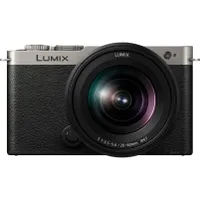
If it's a purely compact package you're looking for, then another option is picking up a full-frame Lumix S9, which body-only costs hundreds less. Add the tiny new 40mm F2 or the collapsible kit zoom lens, and the package is around the same price as the Lumix L10. You'll miss out on a viewfinder, but you will have an L-mount camera with a powerful full-frame sensor, and a wider choice of colors.
The Lumix L10 pictured throughout this review is the Titanium Gold Special Edition, which costs an additional $100 / £100, and is available through select outlets, namely Panasonic's store (and it's not available in every region). You're not paying a premium just for the color — the kit also includes a titanium-colored auto lens cap, a Lumix-branded leather strap, and a dedicated L10 lens cloth. The menus of the camera are suitably monotone to match the warm tones of the camera, and the camera model name is etched onto the camera's lower right-hand side on the back.
- Price score: 4/5
Panasonic Lumix L10 specs
Type: |
Compact camera |
Lens |
Leica DC Vario-Summilux 10.9-34mm (24-75mm equivalent), F1.7-2.8 |
Sensor: |
26.5MP Micro Four Thirds (20.4MP effective) |
Video: |
5.6K up to 60p / 5.2K 30p open gate / 4K up to 120p / FHD up to 240p |
ISO range: |
ISO 50-25,600 |
Burst shooting |
Approx 11fps mechanical, up to 30fps electronic |
LCD: |
3-inch articulated, 1.84m dots |
Viewfinder: |
2.36m-dot, OLED EVF. 0.39in, 0.74x magnification |
Memory: |
1x UHS-II SD |
Battery |
DMW-BLK22 rated to approx 420 shots |
Dimensions |
5.01 x 2.91 x 2.64 inches / 127.1 x 73.9 x 66.9mm |
Weight: |
1.12lbs / 508g with battery, SD card and hotshoe cover |
Panasonic Lumix L10: design
- The prettiest Lumix in years, available in silver, black or a limited-edition Titanium Gold
- Roughly the same design as the Lumix L100 II, which also has a 24-75mm f/1.7-f/2.8 lens, but overall it's bigger
- There's a flip-out touchscreen and a handy EVF

Design-wise, the Lumix L10 is very much the spiritual successor to the Lumix L100 II, which remains a popular and versatile everyday camera for keen photographers.
And if it ain't broke, don't fix it; there's essentially the same control layout, 24-75mm f/1.7-f/2.8 lens, vari-angle 1.84m-dot touchscreen and 2.36m-dot EVF, and every part works perfectly well for casual photo and video use.
One key difference is the size and weight of the 2026 model — the L10 is noticably bigger and a little heavier than the L100 II, with a strikingly similar profile to the Fujifilm X100 VI.
A chief reason for the larger body is that the L10 is fitted with a larger battery — the same kind used in Panasonic's mirrorless bodies such as the Lumix GH7. Of course, a bigger battery means better battery life, and it's also better able to support more powerful features.
The actual difference in battery life isn't so much as you might imagine, though; the L10 runs for up to 420 shots compared to the L100 II's 350 shots. However, the L10 also packs better-quality video, and video capture is more demanding of power.


The lens is a defining feature of the camera — it's a versatile 24-75mm optic which is improved from the Lumix 100 II's, although Panasonic hasn't made clear how, besides describing it as being fine-tuned for the L10. It's impressively sharp, and the maximum aperture is bright throughout the zoom range, and able to produce reasonable subject and background separation, especially using the telephoto setting.
Macro focusing is down to 3cm, but that's at the wide-angle end of the lens. Zoom in to 75mm and the minimum focus distance is more like 30cm, which is hardly 'macro' — see my comparison photos below to get an idea of how close the camera is able to focus at either end of the zoom range.


The lens still isn't weather-sealed — and users of the LX100 series have reported dust ingress in the lens, so that's very much a possibility with the Lumix L10. And with a slightly plasticky feel in parts, it's a camera that probably needs to be looked after, rather than tossed into a bag or used in extreme conditions.
Besides the lack of an AF joystick, there are plenty of external controls at your fingertips, most of which can be customized to taste, and it certainly pays dividends to take the time assigning the L10's custom controls to your regularly used settings.
Take the switch on the lens, which can be used to control anything from aspect ratio to stepped zoom or Real Time LUTs color profiles — that's a handy range of controls.


Despite its decent video credentials, the L10 is very much the stills-oriented camera by design. Yes, there's a mic jack, but no headphone or HDMI. The camera can be charged via USB-C.
The rangefinder-style 2.36m-dot OLED viewfinder and 3-inch 1.84m-dot vari-angle screen make viewing and composing images a cinch in just about any scenario — even if both units are a little dated now.
Overall, I have no major complaints about the L10's design. It's highly enjoyable to use, and it's a very attractive camera too, which made me want to use it all the more.
- Design score: 4.5/5
Panasonic Lumix L10: Performance
- Panasonic's latest 26.5MP MFT sensor and processor, but the sensor is not stabilized
- Snappy and reliable hybrid phase-detection autofocus with subject detection
- Startup / power down time is slowed by the lens extension / retraction
The L10 is an altogether different kettle of fish compared to recent Lumix compacts (which were basically re-releases with USB-C added, but, annoyingly, with the viewfinder removed). It's a genuine upgrade from the eight-year-old LX100 II, equipped with Panasonic's latest sensor, processor and autofocus system.
Throughout my three weeks and counting of testing, the camera has never missed a beat; it happily rattles through 11fps burst shooting sequences, and records high-resolution 5.6K video with no lag and minimal rolling-shutter distortion.
Autofocus is snappy and reliable, and includes subject detection for humans and animals (including pose recognition), plus vehicles and more. At times, however, I missed having a joystick for quick and easy manual selection of autofocus points. The camera offers this control through two steps: pressing the autofocus mode option on the D-pad, then pressing down on the D-pad, at which point the pad can be used to shift the autofocus points in play.


If there's one drawback in using the Lumix L10 for everyday and street photography, it's the retractable lens design. From powering up, there's around a two-second wait for the lens to extend before the camera is ready to shoot, and around the same time for it to retract when turning the camera off.
We get the same 26.5MP MFT sensor as used in recent mirrorless cameras such as the Lumix GH7, but with one major difference: the sensor isn't stabilized (the lens is), which can limit the camera's handheld use, especially in low light or for creative long-exposure photography, for which you'll want a support for the camera.
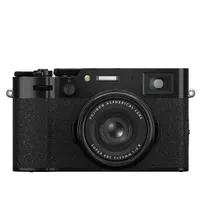
Rival cameras including the Ricoh GR IV and Fujifilm X100VI have in-body image stabilization (IBIS), as do most MFT mirrorless cameras at this sort of price point, including the OM System OM-5 II and Lumix GH series.


Overall, however, there are few cameras that are able to perform as smoothly as the L10 while offering such processor-intensive features — inside that retro body is some serious grunt.
- Performance score: 4.5/5
Panasonic Lumix L10: Image and video quality
- Multi-aspect stills up to 20.4MP, from the 26.5MP sensor
- The lens is sharp and bright
- A wide range of color profiles, including Real Time LUTs


I've had more than enough time with the Lumix L10 to get a feel for its capabilities and image quality, and it's really grown on me.
When I started writing this review, I was ready to table my request for a fixed-lens Lumix with full-frame sensor instead, or a Lumix S9 Mark II with a viewfinder; but I've come to appreciate the versatility of the L10's 24-75mm lens, which I value more than prime-lens image quality for everyday photography (see the range above).
The lens is impressively sharp, and crucially its maximum f/1.7-2.8 aperture is plenty bright. This is a camera that's as comfortable with street photography scenarios as it is for macro photography or portraiture.
Lens distortions are kept to a minimum — there's only an occasional touch of chromatic aberration in out-of-focus areas, and rainbow flare when shooting towards bright sunlight, while sunstars are crisp (check out the gallery below).


The unfortunate drawback to the camera's design is that the imaging circle of the lens cuts into the sensor area, meaning that not all of the sensor's 26.5 megapixels are usable — the maximum photo resolution is 20.4MP.
That's still a big resolution bump from the LX100 II, which had an effective 12MP resolution, but some way behind high-resolution alternatives such as the 40MP Fujifilm X100VI.
The low-light quality of a Micro Four Thirds sensor is also limited compared to larger-sensor alternatives, especially since there's no IBIS which would otherwise enable users to use longer shutter speeds when shooting handheld.


Detail across the aperture range is surprisingly sharp for a zoom lens, and you'll struggle to find a better-equipped compact camera for video at this price point — just what I would expect from a modern-day Lumix.
And then there's the unsung highlight of a photographer's life with a Lumix camera: attractive color profiles and free Real Time LUTs uploads from the always-improving Lumix Lab app.
I've easily paired the L10 with the Lumix Lab app to remotely control the camera and view scenes, and upload Real Time LUTs profiles directly onto the camera (remember there's a switch on the lens which can be assigned as direct access to these profiles). These profiles can be used for photo and video.
Put simply, it's straightforward to get the look you want for photo and video in-camera, minimizing time needed with editing software. I've never been more tempted to save space on my memory cards and shoot JPEG-only.
Panasonic Lumix L10 sample gallery


- Image and video quality score: 4/5
Panasonic Lumix L10: testing scorecard
Attributes |
Notes |
Rating |
|---|---|---|
Price |
An expected price for this type and level of camera, and I'd be surprised if it's discounted any time soon |
4/5 |
Design |
Really attractive retro body, equipped with a wide range of controls, EVF and vari-angle touchscreen |
4.5/5 |
Performance |
Besides the boot-up time, the camera never missed a beat. I missed in-body stabilization, however |
4.5/5 |
Image and video quality |
Stills max out at 20.4MP, and the MFT sensor has the usual low-light quality limitations, but there are stunning Real Time LUTs profiles available |
4/5 |
Should I buy the Panasonic Lumix L10?
Buy it if...
Don't buy it if...
Panasonic Lumix L10: also consider
How I tested the Panasonic Lumix L10

- I've had the Lumix L10 since its global announcement, meaning 3 weeks and counting at the time of writing
- It's been by my side daily, capturing every day moments and travel scenes
- I've compared image quality at various aperture settings and focal lengths, and experimented with various color profiles
Panasonic handed me the Titanium Gold Special Edition of the Lumix L10 one day ahead of the camera's global announcement, together with the limited edition accessories plus a thumb grip and hand grip made by SmallRig. I've used all of these accessories for my review.
The camera has been slung over my shoulder a lot of the time throughout the three weeks and counting that I've had it, during which time I've been on two trips and also used the camera to capture every day moments, day and night.
I've tried the various aspect ratios, color profiles, video settings and fully tested the lens's capabilities across its various aperture settings and focal lengths, plus its macro focusing skills. I continue to fine tune the camera settings to my own preferences. I've made sure to assess battery life and autofocus performance too.
- First reviewed: June 2026
- Read more about how we test
