



 Become a TechRadar Insider


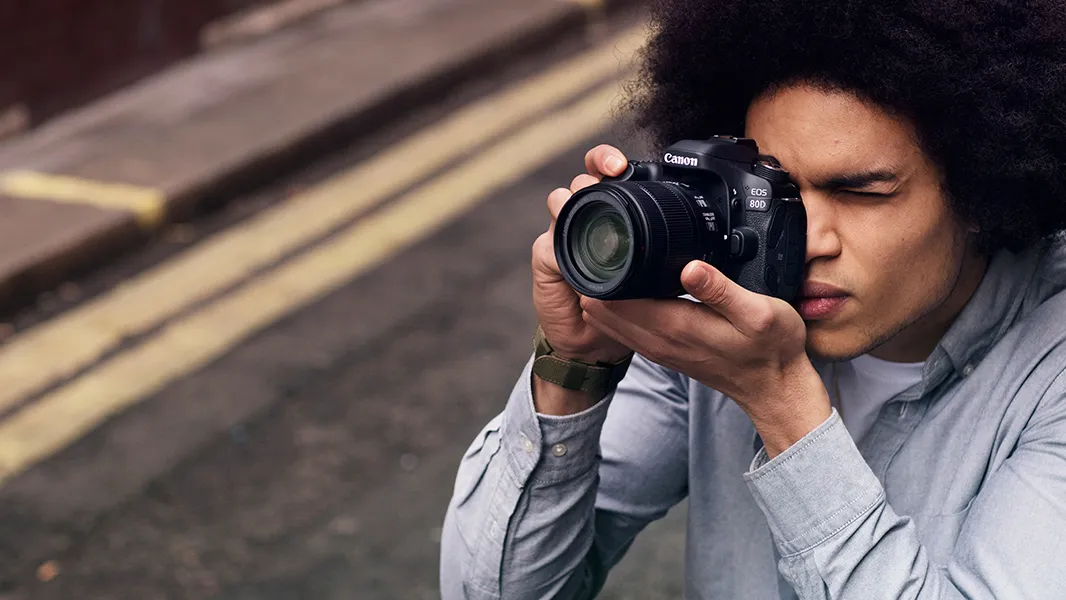
TechRadar Verdict
Though it's now a generation old, and there are lots of mirrorless competitors, the 80D is a good, solid, mid-level camera for those who have no need or desire for the absolute latest tech. It's got a well-built chassis, sensibly arranged controls, good ergonomics plus an extensive feature set (despite its age). Most importantly, image quality is fantastic, with images displaying bags of detail, especially at the lower sensitivity settings.
Pros
- +
24Mp sensor resolves detail well
- +
Fast and effective AF system
- +
Excellent screen
Cons
- -
APS-C format rather than full-frame
- -
Complex AF system requires time to master
- -
Quick Menu not customisable
Why you can trust TechRadar We spend hours testing every product or service we review, so you can be sure you're buying the best. Find out more about how we test.
Launched in 2016, the Canon EOS 80D has since been replaced by the Canon EOS 90D in Canon's enthusiast-level DSLR range. It's a solid performer for those who want an all-rounder but don't necessarily have the need - or perhaps the budget - for the latest technology.
As an enthusiast camera, it needs to appeal to people who like to shoot a variety of different subjects in lots of different conditions. That means they need lots of features, but don't necessarily need something heading into professional territory.
We still consider the 80D to be one of the best DSLR cameras around, especially if you're in need of a bargain.

Features
The Canon 80D has a 24-million-pixel sensor along with a Digic 6 processing engine. This may sound similar to the 24Mp 750D and 760D, but these lower-level cameras have Hybrid AF III devices, not the Dual Pixel CMOS AF sensor of the 80D.
The 80D's sensor and processor combination brings a native sensitivity range of ISO 100-16,000 (a third of a stop higher than the 70D - its predecessor), and a maximum expansion value of ISO 25,600 (the same as the 70D).
And while the maximum continuous shooting rate is the same as the 70D's at 7fps, the burst depth has been increased to 110 JPEGs or 25 raw files when a UHS-1 SD card is used; that's a significant step up from the 65 JPEG or 16 raw files possible with the 70D.

Modern SLRs have two autofocus systems, one for when using the camera conventionally and composing images in the viewfinder (i.e. in reflex mode) and the second for use in Live View and video mode. Canon improved both of these systems for the 80D in comparison with its predecessor the 70D.
The reflex mode system, for instance, has 45 AF points, all of which are cross-type, whereas the 70D has 19 points. This means the new camera has better AF point coverage, making it more able to find and follow subjects around the frame.
Furthermore, all of the points are cross-type with lenses that have a maximum aperture of f/5.6 or greater while the central 27 operate at f/8 and nine of them are cross-type at f/8. That's good news for anyone using telephoto lens/teleconverter combinations that reduce the maximum aperture to f/8.
The 80D can also use colour information from the 7560-pixel RGB+IR (infrared) metering sensor to help with subject tracking.
Turning to the Live View and video autofocus system, the 80D uses Dual Pixel CMOS AF technology like the 70D, which means it has phase detection points on the imaging sensor itself.
According to Canon the new system is more sensitive and faster than the one in the 70D, but because fast autofocusing often isn't desirable when you're shooting video, it's possible to vary the speed of the 80D's system over seven steps for slower focus changes.
Although the 80D lacks one of the most in-vogue video features – 4K recording – it improves upon the 70D's video offering with a headphone port for audio monitoring and the ability to record Full HD (1980 x 1020) footage at 50fps for 2x slow-motion playback.
Like the 70D, the 80D also has an external mic port (volume can be adjusted manually in-camera) as well as HDMI Mini and A/V Digital out terminals, but the 80D can record in MOV or MP4 format whereas the 70D can only shoot in MOV format. Canon's excellent Video snapshot feature is also on hand to help create more dynamic short films in-camera.

Canon got onboard with Wi-Fi connectivity in its cameras relatively early on, and also includes NFC (Near Field Communication) in some of its models – including the 80D. This enables the camera to be connected to an NFC enabled smartphone or tablet, the Canon Connect Station CS100 or other Canon cameras with just a tap.
As well as enabling images to be shared quickly to the internet, this connectivity enables the camera to be controlled remotely using Canon's free app. Furthermore, if the new EF-S 18-135mm f/3.5-5.6 IS USM lens is mounted and used with the Power Zoom Adapter PZ-E1 announced at the same time, the app can be used to zoom the lens from one focal length to another.
Canon introduced its Anti-flicker system with the 7D Mark II to help produce predictable exposure and colour when shooting under a light source that's prone to flickering (for example fluorescent light). This clever technology, which detects the frequency of the flicker and times shots so that they're taken when the impact on exposure and colour is minimal, is also found on the 80D.
Another point worthy of note is that, like the 5DS/R and 1DX Mark II, the 80D has Ambience priority and White priority options for the automatic white balance system. Using the Ambience priority setting produces images that retain some of the colour created by the lighting whereas the White priority setting is intended to remove the colour cast.
Save on top-quality cameras and accessories with our latest Canon coupons. Find great deals on gear for every shot.