





TechRadar Verdict
Reasons to buy
- +
Compact form factor
- +
Great battery life
- +
Packed with features
- +
Wi-Fi router option
- +
High quality, multi-touch screen
Reasons to avoid
- -
It's still Windows Mobile underneath
- -
Browser navigation is temperamental
- -
No camera flash
- -
Poor app support
Why you can trust TechRadar We spend hours testing every product or service we review, so you can be sure you're buying the best. Find out more about how we test.
Hot on the heels of the excellent HTC Legend and the even more impressive HTC Desire, is the HTC HD Mini. But whereas the Legend and Desire both come equipped with Android 2.1, the HD Mini has to make do with Windows Mobile 6.5.3.
Don't be put off by the less-than-trendy operating system though, because if anyone knows how to make a Windows Mobile phone usable, it's HTC, and the HD Mini is a fine example of just that.
With HTC Sense UI thrown on top of Windows Mobile, the HD Mini is not just easy to use, but actually quite enjoyable.

So, has HTC managed to make a silk purse out of a sow's ear? (Sorry Microsoft.) In a word, yes. But there's far more to the success of the HD Mini than the slick masking of Windows Mobile.
HTC has created a phone that is simply packed with features, while also being far more compact and pocketable than its direct competitors.
At just under 104mm tall, the HD Mini is noticeably shorter than the HTC Legend and even the disappointing Nokia X6.
At 57.7mm wide and 11.7mm thick, the HD Mini is also extremely comfortable to hold – in fact it feels far more like a traditional phone than, say, the Desire or iPhone. It's not too heavy either, coming in at 110g, which is 23g lighter than both the Desire and the iPhone 3GS.

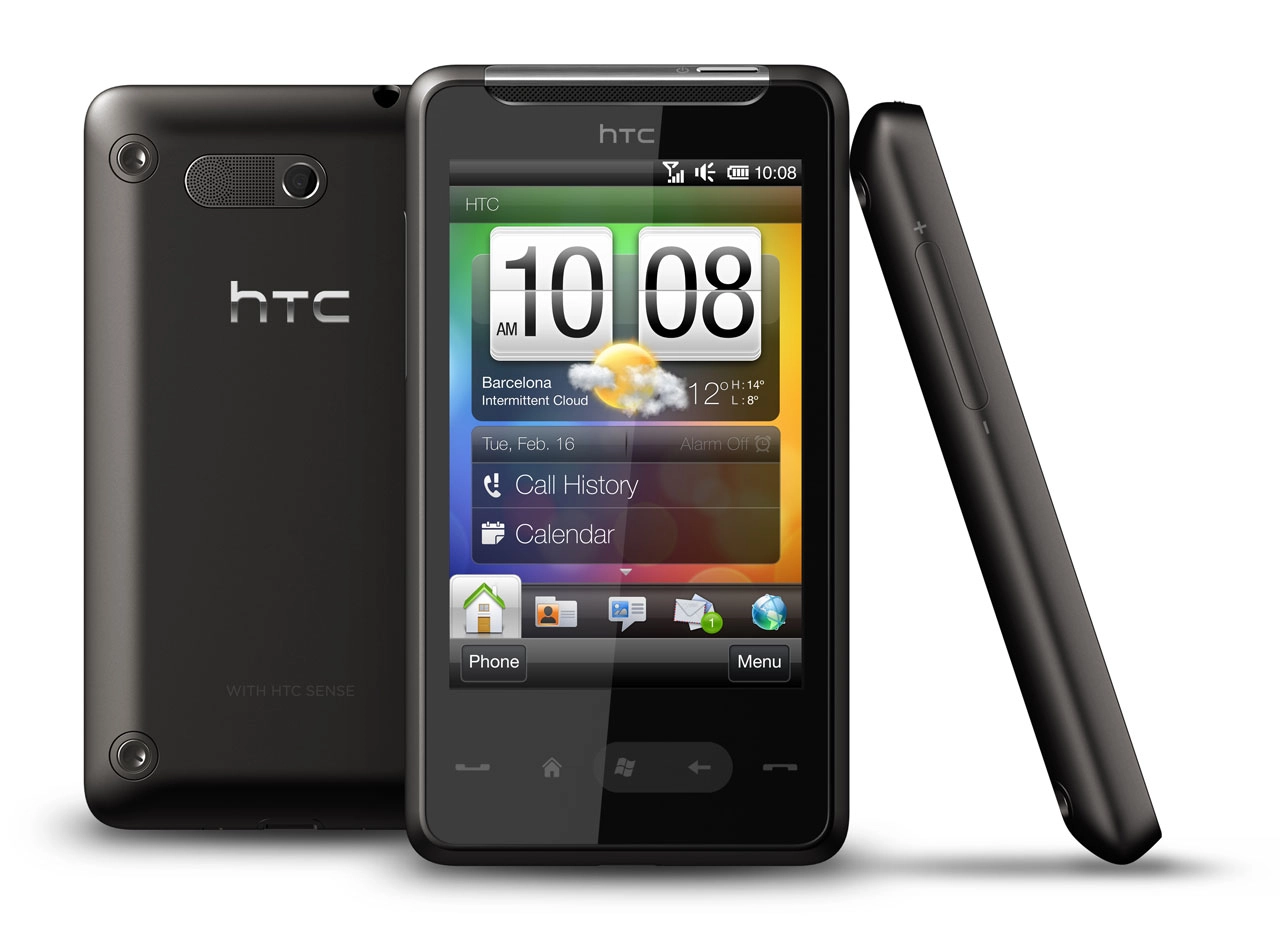
HTC has gone down the industrial chic route for the design of the HD Mini and the results are pretty successful. The bevelled back has a tactile, rubberised finish that ensures you always have a good grip on the device.
A design highlight comes in the shape of the four visible screws in each corner, which remain in place when the back is removed.
And when that back is removed, you realise that HTC's designers aren't just about those clean industrial lines, because the whole inside of the phone is finished in bright yellow, with the bottom half translucent, no less!
It's a great design juxtaposition, like the glove box in the new Jaguar XJ Supersport being trimmed in bright purple velvet – you won't see it very often, but whenever you do, it will bring a smile to your face.

Another nice touch is that the microSDHC card slot is mounted sideways, so you don't have to remove the battery in order to access it.
There was no card included with our review sample, but if you're serious about music and video on your phone, it's worth investing in a 16GB card, which will set you back around £35 online.
The phone will support cards up to 32GB and although these are now available, you'll be looking at over £150 for the privilege.

The front of the phone is as sleek as you can get, with a single glass sheet covering its entirety. HTC has achieved this look by making the HD Mini devoid of any physical buttons.
Instead there are touch-sensitive controls for Call, End, Home, Windows Menu and Back. Although touch sensitive buttons can be a pain, the ones on the HD Mini are both responsive and accurate.
The 3.2-inch capacitive screen is bright, vivid and viewable under pretty much any lighting condition. It can be a struggle to see under very bright, direct sunlight, but then that could be said about almost any phone.
The screen feels larger than it actually is, simply because the handset itself is comparatively small. Although HTC doesn't state that the screen uses AMOLED technology, it does appear to be identical to the 3.2-inch example seen in the Legend.
PC connection comes via the microUSB port mounted in the base of the unit. It's worth noting that the port juts through a hole in the rear cover, which means that you can't take the back off while the phone is connected, unless you want to unceremoniously rip your USB cable out as well.

On the very top edge is a metal strip that houses the power button, while the 3.5mm headphone jack sits on the bevelled edge of the rear casing.
The only other control is a volume rocker on the left edge, which is again a solid metal strip, adding to the industrial design statement as well as the phone's overall quality feel.
The traditional HTC oblong box is used once again for the HD Mini, and it houses the usual array of kit – which is to say, not much.
As well as the handset itself, you get a mains charger with a USB port, a USB to microUSB cable for charging and connecting to your PC, and finally a stereo headset.
The latter isn't as bad as some bundled headsets we've seen, but if you have any real interest in listening to music on the HD Mini it's worth investing in a decent set of noise-isolating earphones.