There’s a good chance you’re familiar with the story of Hercules and have seen Disney's retelling in a classic, 1997 animated film, but I bet you've never seen it on a boat. The story of how scenes are set, props are built, and characters come to life in a new staged production aboard a moving cruise ship is a hero's journey worthy of the original.
As I’ve already unpacked, Hercules aboard the Disney Cruise Line’s Disney Destiny ship is using a boatload of technology in some unexpected ways – yes, there are projections on scrims, the stage, and the walls surrounding it in the Walt Disney Theater, but it’s also being used on performers to take one of the classic songs to new heights.
'It’s hard to figure out how to bring those characters to life'
Arin Dale
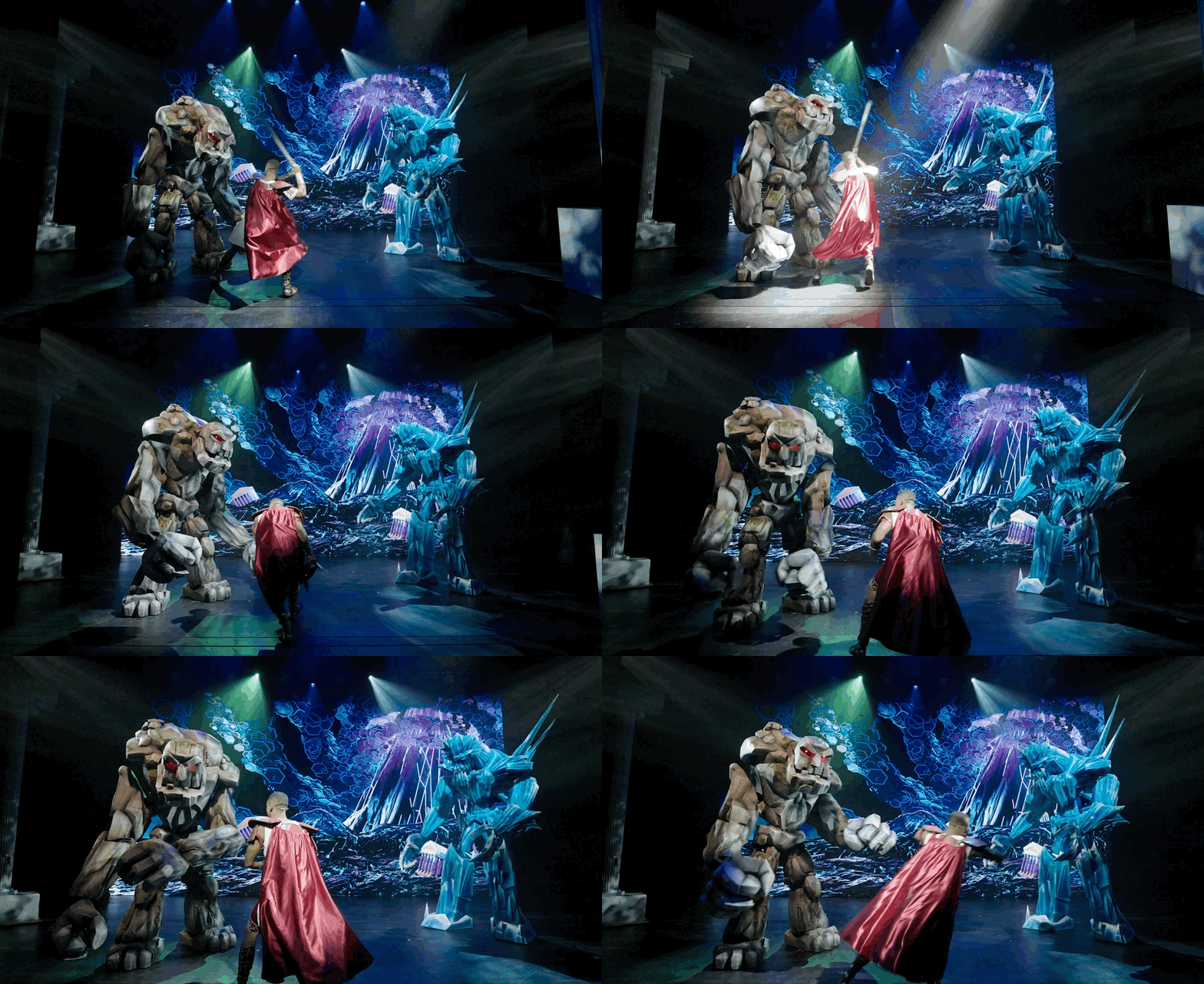
Even more surprising, though, is that inside the two Titans that make themselves known during a battle scene with Hercules is an exoskeleton. The Ice and Rock Titans, as pictured above and below, mark the first time Disney Experiences is using exoskeleton technology.
“It’s hard to figure out how to bring those characters to life in a larger-than-life kind of way,” explained Arin Dale, a Disney Live Entertainment producer. “Our Hercules is 6 feet tall, so you really have to make sure that those characters are epic and that they are effective and impactful.”
Turning exoskeleton tech into storytelling

While exoskeleton technology is far from new – and we’ll likely see a lot of it at CES 2026 – this application is firmly in line with Disney’s approach to using technology in service of storytelling and immersion.
Disney has been developing this exoskeleton system, dubbed Project EXO, since 2020, and here it functions as a puppet-style mechanical suit worn by the performer.
At its core, the system transfers the majority of the Titan’s weight down through the frame and into the ground, rather than placing that load on the performer’s body. In that sense, it operates less like a powered robot and more like a wearable puppetry mechanism.
The exoframe is primarily human-driven, with the performer controlling movement through their own body, but it also incorporates pneumatic assistance at key joints to help augment strength when moving oversized limbs. That assistance doesn’t drive motion on its own; instead, it reduces strain and makes repeated, expressive movement possible during a live performance. It's a key way for Disney to bring these characters from screen to life, though.
Essentially, Project EXO allows a single performer to operate a massive character by combining weight transfer, leverage, and mechanical assistance. The scale involved is significant: the Ice Titan stands roughly 13 feet tall, while the Rock Titan, though smaller at around 9 feet, is still imposing – underscoring why this hybrid of puppetry and mechanical support is necessary to bring towering beings to life on a stage.
'We’re moving around, you know, 110, 120 pounds of mass'
Michael Serna
Even with that size, the performers inside – each Titan is controlled by a single human – can move the arms, heads, legs, and other parts of the body. They engage in stage combat with Hercules and can move quickly across the stage.
To make that sustainable over the course of a complete performance, the Titans include built-in support points – effectively canes integrated into the design – that allow the performer to take a brief respite. However, the exoskeleton does a lot of the heavy lifting.
The base Project EXO frame weighs 40 pounds, and as Michael Serna, Executive Creative Director, explained, the Rock Titan adds roughly 60 pounds of additional structure, while the Ice Titan adds closer to 70 pounds.
“So we’re moving around, you know, 110, 120 pounds of mass that Zion is responsible for – and he has to do fight choreography,” Serna said.

What it takes to move a Titan
Zion performs as the Rock Titan, while Cam takes on the Ice Titan. Both are dancers with Disney Live Entertainment and didn’t expect to find themselves operating and performing inside exoskeletons.
“I was just excited to move in something like this, so it was a cool thing for me to get to do while being able to dance as much as I want to as well,” Zion said.
It clearly works in the show, and the fight sequence between Rock, Ice, and Hercules is one of its most compelling moments, complete with effects hitting the Titans themselves and CO₂ emitting from Ice as cold air.

Under the surface, Project EXO is formed from specific materials designed to balance strength with weight. “There’s all kinds of stuff – 3D-printed titanium, minicell padded work, parts for that,” Serna said.
That design approach comes with hard limits, particularly around weight and complexity.
“Added animation and added functionality also comes at a cost – yeah, comes at a weight, and you’re just complicating it unnecessarily,” Serna said.
For the team, the goal was never to call attention to the mechanics themselves, but to let the performance take over.
“I don’t want people to think about this stuff at all,” Serna said. “I want them to be wowed and at the end go, ‘Wait, how did that – how did that happen?’”
A stress test at sea

In that sense, Hercules aboard the Disney Destiny isn’t just a showcase for Project EXO – it’s a stress test.
This is the first formal deployment of exoskeleton technology in a Disney live performance, and it’s happening inside a theater with a 40-foot wide stage, tight wing space, flying scenery, and the added complexity of a ship that’s constantly in motion.
'Video and doing effects doesn’t always work'
Arin Dale
Yet the technology holds, and more importantly, it serves the story. The Titans don’t feel like technical demonstrations or effects-driven spectacles – they feel like characters that belong in the space, whether viewed from the balcony, the orchestra, or standing just feet away as they cross the stage.
That physical presence is intentional. As Disney Live Entertainment producer Arin Dale explained, relying solely on screens or projected illusions wasn’t the goal.
“Video and doing effects doesn’t always work,” said Dale. Instead, the challenge was figuring out how to bring something larger than life into the room in a way that felt tangible and believable for the audience.
That philosophy helps explain why Project EXO has taken years to reach this point – and why its first major appearance arrives not in a park meet-and-greet or a brief demo, but inside a full Broadway-style production. The exoskeletons aren’t meant to be noticed as technology; they’re meant to disappear into the performance, allowing the Titans to move, fight, and emote in ways that sell the illusion.
'We’ve learned a lot just from this'
Jeff Conover
And while this marks the first time Disney Experiences has formally used exoskeleton technology in a live show, it’s clearly not positioned as a one-off. The lessons learned here – from weight distribution and materials to performer endurance and choreography – suggest a foundation that can be built upon.
As Jeff Conover, Creative Director, noted during the conversation, “If we do want to do another character that employs this type of tech, we’ve learned a lot just from this.”
A foundation for what comes after
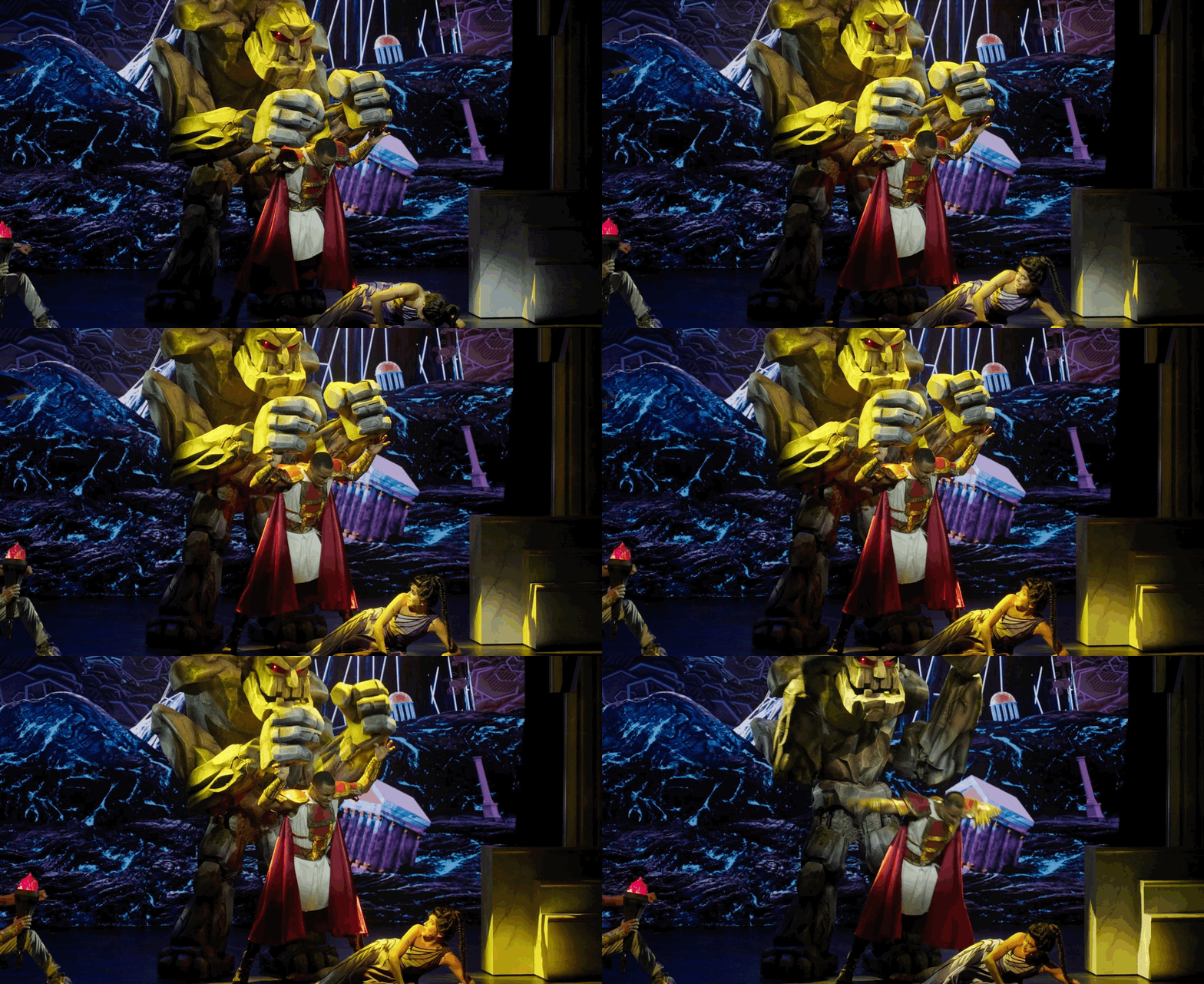
For now, that future-facing potential is anchored firmly in the present. On a moving ship, inside a tightly constrained theater, Project EXO proves that physical performance – not screens – remains one of Disney’s most powerful storytelling tools when paired with the right technology.
Taken together, the technology inside the Walt Disney Theater aboard the Disney Destiny reflects a very deliberate philosophy. The goal isn’t to overwhelm audiences with visible systems or flashy tricks, but to make the physical world onstage feel as convincing as the animated one audiences already know.
As Michael explained, relying purely on digital tools was never going to be enough.
The exoskeleton is really the latest lightbulb piece of technology housed inside the Walt Disney Theater aboard the Disney Destiny – it’s a tech powerhouse. As Mina Shayesteh, stage manager, described, the production infrastructure behind the show is unlike anything Disney Cruise Line has attempted before.
“We have 500 lights, 13 projectors, 10 snow machines, 12 confetti cannons,” Shayesteh said. “We have 100 automation axes, 115 automation cues in Hercules. So anything that moves on stage overall throughout that show, we have 115 different times where I say the word ‘go’ to make these things move – which is greater than any show in the entire fleet that we have across Disney Cruise Line.”
'Technology fusing with theatricality'
Michael Serna
Yet even with that scale, the intention is never for the technology to become the focus. Instead, it’s meant to fade into the background, allowing performers, characters, and story beats to take center stage.
“The technology fusing with theatricality so it doesn’t get in your way, so it's just letting you have a really great experience, but you're not thinking about the technical aspects,” Serna said, describing the balance the team aims for.
That balance is especially evident with Project EXO. Despite years of development, complex materials, and significant weight within the suits, the system’s success is measured by how little the audience notices it – and ultimately what it lets the performer accomplish.
Of course, if you want to see these larger-than-life Titans, you'll need to book a trip aboard the Disney Destiny, which is sailing out of Fort Lauderdale, Florida, but if you'd rather see the Titans in their original form, you can stream Hercules on Disney+.
Follow TechRadar on Google News and add us as a preferred source to get our expert news, reviews, and opinion in your feeds. Make sure to click the Follow button!
And of course you can also follow TechRadar on TikTok for news, reviews, unboxings in video form, and get regular updates from us on WhatsApp too.