

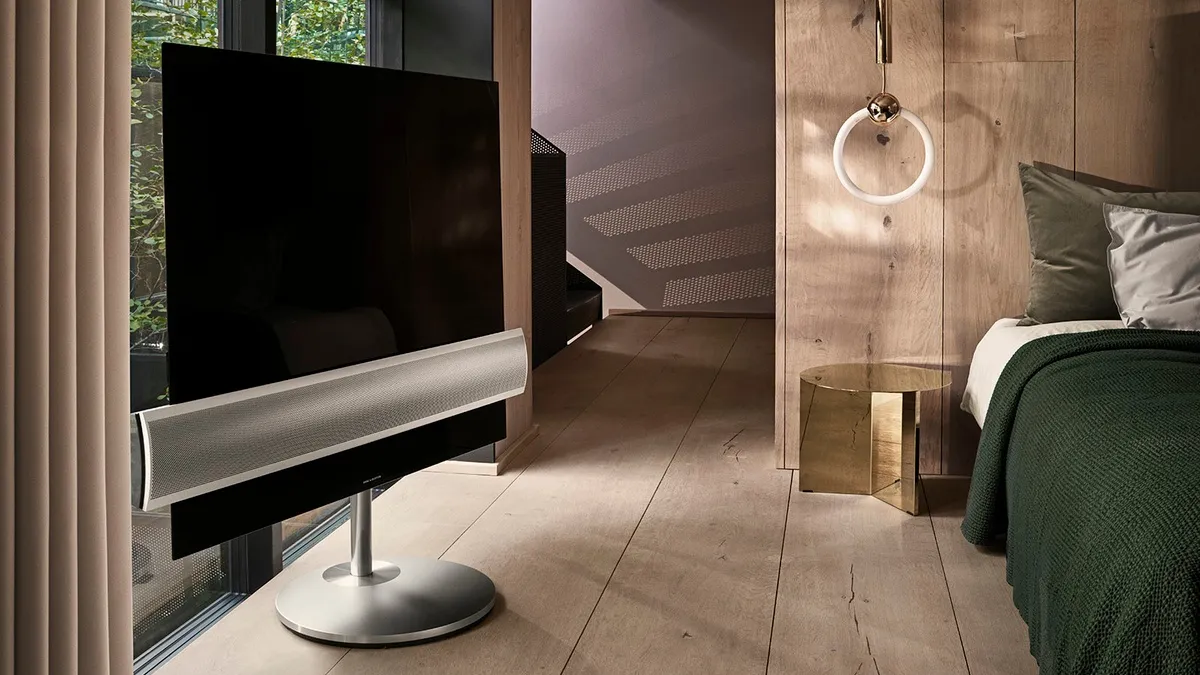
Philips crowed long and loud about its supremacy in LCD TV last Thursday with a special event that also took in the whole company’s entire 2008 product range. The undoubted highlight was the new 9000 series of LCDs, which promise performance even better than that of the Aurea, Philips' current flagship.
Even more intriguing is what Philips has planned for the future, and how it sees TVs developing over the next few years. We caught up with Philips' TV marketing directors Danny Tack and Marc Hamsen to find out what's on the cards.
What’s wrong with Aurea?
The first point on the agenda was Philips’ controversial Aurea - a high-end TV that’s been praised for its performance, but also criticised - not least by us - for focusing on style rather than substance. This is a point that Philips partly concedes, but the company is also keen to stress that Aurea has some real meat on its supermodel bones.
“The way we positioned Aurea originally was that it was more of a luxury, more of an icon. You only have to step outside this hotel to see a luxury sports car out there - the Maserati. They don’t talk about the performance in that car. It’s an assumed performance. It’s a luxury product; it’s an icon. It’s got every goodie inside, but it really is positioned in that [luxury] area,” Hamsen says.
“The key for us is this endless battle, this endless discussion about numbers. It’s very interesting for us in the industry, but for a large amount of consumers, they’re saying ‘what does it bring to me, and where do we end up?’
“We have to accurately reflect that with the 9000 series. We’re going after that performance customer. Aurea is aimed at a different type of customer, who might not be as technology focused, but wants that reassurance that they’ve just bought all the bells and whistles. And with the 5000 and 7000 series we’re offering a similar level of performance, but not at such a high level of cost.”
Aurea R&D
Hamsen points out that the most contentious part of the Aurea - the Ambilight Spectra and Active Frame light emitting bezel - is the result of a great deal of research at Philips. Danny Tack weighs in with this point:
“The evidence from the Munich survey [Philips conducted last year] was very strong. The people who took part in the survey had all kinds of sensors on their heads, on their arms, on their hearts, brains and around their eyes even,” Tack says.
“At that same moment we could measure eye strain was a lot less with Ambilight on, the heart rate variance was normal - it was more peaceful for you - and yet the skin response was higher. So your immersion level was higher, you were more relaxed, and your eyes were working less. It was win-win. In fact, it was win-win-win. Three things at the same time.”
The Active Frame bezel
One of the most notable things about the Aurea is the Active Frame - an extra wide bezel around the display. It contains a complicated array of LED lights, fed by their own dedicated processor, which responds to the action on screen and changes the colour accordingly. This super-bezel seems to oppose the efforts of rival TV makers - Toshiba, for example - who are trying to make the bezel as slim and inconspicuous as possible. Marc Hamsen justified it to TechRadar this way:
“We developed I think 19 different frames for the Aurea. We tried them out at our Customer Experience Centre in Bruges, where we had customers during the development process sitting in a room and rating the experience,” Hamsen says.
“We played with the width quite a bit. We had to find the balance between the natural flow [of light]... The Active Frame has to be a certain width to create that natural transition to the back of the Ambilight. If you make the frame too small, you actually have steps [in the transition], and it doesn’t feel as natural.”
Driven to distraction?
The one thing we’ve noticed about Aurea’s Active Frame is that it can be quite distracting. Hamsen says that’s because the Aurea isn’t like other TVs:
“You have to allow a couple more days to get used to it. That’s why we offer a lot of different settings, from Relaxed to Dynamic. You’re always in control with the remote, so you can change the light level in the frame all the way down.”
That doesn’t get over the fact that you’re effectively looking at a white or multi-coloured surround on a television, even when sitting in the dark, watching a space movie. We were told that’s because we were looking at the frame, rather than the screen... but it’s hard to divorce one from the other, especially when you’re also being told by Philips that the Active Frame is an essential part of the TV viewing experience.
While the overall effect of the Active Frame is pleasing, Philips dodged our questions about making the Active Frame from another material (black? Perforated?) other than white plastic.
Evidently Aurea has been successful enough for Philips to think about expanding the range from one 42-inch model now, to other screen sizes in future. And the results of the R&D that has gone into the Aurea are now being trickled down into other TVs. The 9000 series notably features Ambilight Spectra - a way of projecting multiple light hues behind the set, instead of more basic solid blocks of colour.
The Aurea TV then is a take-it or leave-it proposition. You’ll either love or loathe the concept and looks, but it's hard to argue with the technology inside it - despite the (deliberately) superficial marketing, Philips really is firing on all cylinders. That much is evident, especially in the 9000 series we’ve seen in action at the 2008 showcase.
Philips, plasma and the lure of Ultra High-Def
With both the Aurea and 9000 series, Philips LCD TVs seem to have reached some kind of peak. A demo pitting the 9000 series against its chief rivals from Sharp, Sony and Samsung - while undoubtedly flawed - did show how far ahead of the game Philips is when it comes to advanced TV technology. Its TVs look better, sound better and perform better than those from almost anyone else. Philips is arguably to LCD what Pioneer is (was?) to plasma. Is there anywhere else for it to go? Danny Tack:
“If LCD is mature and cannot be improved anymore, then let’s not talk about plasma. Plasma is at the end of its innovation. Pioneer showed promise [with its super-black Kuro] at CES, but its never going to have enough money to invest to bring it to market.
“If you say LCD is done, finished, I don’t think so. You just mentioned LED backlights. There are a number of things you can do with LED backlight. And then you have resolution - even beyond 1080p, there’s still life,” Tack says.
“We will get new sources. Right now we’re already seeing xvYCC [aka Deep Colour], high dynamic range sources. Then we have 4K transmissions - not 1080p, but two times more than 1080p. Japan is experimenting with it. When 4K comes then your displays will need to increase in resolution, your processing will need to go up. Again it’s a whole new world.”
Blu-ray upscaling?
Tack even talks about Blu-ray being upscaled so it can be watched at a high-enough resolution on a 4K display. We asked Tack when he thought the first 4K, Ultra HD TVs would come to market:
“Not in the next two or three years,” Tack says. “By 2011, 2012. It can go fast. In Japan it could be next year.”
“It becomes about the carrier then,” Hamsen chimes in. He concludes the conversation by bringing us back to the here and now:
“In the next three to four years you’re going to see the real penetration of HD among consumers. And Philips is at the forefront of that. It’s going to become the mainstream.”

Submit your comment
You need to Log in or register to post comments