





TechRadar Verdict
Hot shot 8-megapixel cameraphone at a mid-range price but lacks higher-end features to match the snapper
Reasons to buy
- +
8-megapixel camera
- +
Good-sized 2.4-inch display
- +
Good video recording features
- +
Great music player
- +
MicroSD card expansion
- +
Solid design and build
- +
Bluetooth webcam feature
Reasons to avoid
- -
No 3G or Wi-Fi connectivity
- -
Low spec browser
- -
Limited low-light imaging performance
- -
No 3.5mm headphone socket
- -
Average earphones supplied
- -
No touchscreen
- -
No GPS
Why you can trust TechRadar We spend hours testing every product or service we review, so you can be sure you're buying the best. Find out more about how we test.
Having been quick on the draw with its first UK 8-megapixel mobile sharp shooter, the Renoir KC910, LG has now doubled its 8-million pixel cameraphone line-up with the release of the KC780.
While the Renoir is pitched as a high-end touchscreen device, with a roster of the latest must-have gadgetry, the LG KC780 is a more modestly equipped sliderphone, aimed at bringing 8-megapixel cameraphones to the mass market.
It has a more affordable price tag than the Renoir and other 8-megapixel competitors. But it also has a more down-range set of features than its stablemate - and other current 8-megapixel hot-shots such as the Samsung Pixon and i8510, and the Sony Ericsson C905.
Basic connectivity
Clearly, much of LG's attention has been paid to the KC780's camera abilities. There's no 3G support on the KC780, let alone Wi-Fi connectivity, with this tri-band handset running data over lower speed GPRS/EDGE. It doesn't do any fancy touchscreen control either, relying on a more conventional mobile user interface, and you won't find GPS or smartphone functionality – all options available on other 8-megapixel competitors.
The camera is where the main action is here. Its 8-megapixel sensor is supported by Schneider-Kreuznach certified optics, and there's a dual-LED flash on the back for low-light shooting. Its autofocus-equipped camera gadgetry isn't as extensive as the Renoir's lavish touch-operated system, but it does have more than your average mobile snapper. Video capture too is a few notches above the norm.
Although it doesn't offer 3G functionality, the LG KC780 does have a fairly standard, if unexciting, set of mid-level feature to keep mobile users going. Music and video players, and an FM radio add to the entertainment quota, while a rack of organiser tools are to hand. A novel Bluetooth webcam feature is employed alongside the regular Bluetooth stereo headset and file transfer options.
Sign up for breaking news, reviews, opinion, top tech deals, and more.
Sleek sliderphone
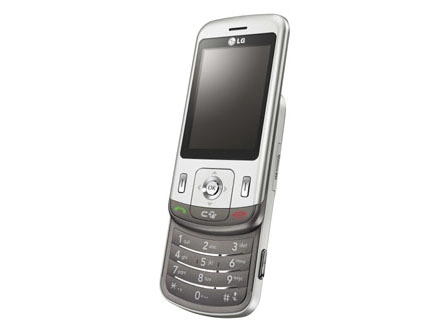
The KC780's slider design is reasonably slim. At 105(h) x 51(w) x 13.7 (d) mm and 119g it's not particularly petite, though. The design of its bodywork is workaday sliderphone, and cased in unspectacular black plastic, it's not particularly hot in the style stakes.
The controls are well-sized with a conventional layout, based around a navigation D-pad, flanked by softkeys under the display and traditional Call, End, and Clear keys. In standby the Clear key also operates the phone's Dashboard function, which brings up calendar, image viewer and a clock features on screen, which you can scroll through and customise.
The Clear key position is a bit tight against the D-pad, which means you do have to be careful with pressing the down arrow, but otherwise controls are pretty straightforward.
It has a decent-sized display or a mid-range handset - a 2.4-inch screen offering QVGA resolution. It's clear and bright enough for viewfinder purposes and video playback, though doesn't match the big-display touchscreen phones for sheer screen space. A motion sensor accelerometer flips the display orientation according to how the phone's being held.
Simple controls
The numberpad on the slider is nicely configured too, with slight bumps under each number and chrome dividers between rows helping fingers to differentiate keys on the otherwise smooth surface.
Sweeping around the phone, a MicroSD slot on the side provides room for memory cards up to 8GB (none is supplied in the box), while there's a typical camera shooter button and volume/zoom controls. Unsurprisingly, there's no 3.5mm standard headphone socket for using your own headphones, the KC780 working the usual LG multi-connector on the side of the phone for charging, USB connection and earphones.
Apart from the Dashboard, it's a fairly straightforward, standard-issue LG mid-tier user interface. The D-pad offers typical shortcut options, while the main menu is a grid-based set-up (though you can swap for lists if you prefer). Sub-menu options are mostly in list format, with numbered options for quick selection via the numberpad rather than scrolling.
Camera focus
With a limited set-of marquee features, the 8-megapixel camera's performance is the focus of this handset.
The good news is that it's well capable of taking high quality images, with the 8-megapixel shooter producing sharply detailed shots that offer good tonal reproduction. Its auto system adapts responsively to changing lighting conditions, and the autofocus appeared reliably precise and efficient, with an impressive macro shooting close-up mode.
Utilising a normal two-step autofocus set up, there's a momentary 1 - 2 second lag as you press the shutter button for a quick shot, so watch out when snapping moving subjects.
Speedy snaps
From standby the camera takes around 3 seconds to start up after pressing the side camera key.
Among the camera features, a face tracking option helps out the autofocus system, locking on to faces it detects as you're composing shots, to get people in focus. A Smile shot option can be selected too for ensuring the camera only shoots when it detects a subject is smiling, even after you've pressed the shutter button.
A good selection of camera gadgetry includes an image stabiliser option, a variety of settings adjustments (white balance, ISO, exposure, colourisation effects), and a Smart lighting setting for tricky lighting conditions - though this, like multi-shot and panorama modes, automatically switches shooting to a lower resolution setting.
Lacklustre flash
Image results can be impressive for a mobile. In good light conditions, images come out particularly well and colours are vibrant, though in murkier conditions, colours do appear softer.
Low light shooting, despite the LED flash, isn't brilliant. A xenon flash, such as that used on the Sony Ericsson C905, would've improved illumination, as an LED flash isn't as powerful or precise enough for snapping in darker conditions over more than a few feet away. Dim-light shots indoors tended to be gloomy and grainy.
Post-shooting, there's a standard-issue set of LG in-phone editing options – a good variety for an average phone, but nothing exceptional for a mid-level LG handset.
Decent video quality
The KC780 puts in a better effort than most for video shooting, capturing footage at 30 frames per second in the highest quality 640x480 pixels (VGA) or 720x480 pixels resolutions.
It produces smooth, reasonable quality video clips for a mobile phone. A slow-motion shooting mode provides another better-than-most playback option, though it does record in lower QVGA resolution.
Playing back video on the 2.4-inch display is decent enough. You can copy over video from a PC or watch content on a MicroSD card, or download clips over the leisurely GPRS/EDGE data connection, with the KC780 supporting DivX video playback. A TV-out option is available in the features, though no cable is boxed with the phone.
Minimalist music player
The KC780 has 140MB of internal memory, so if you have ambitions to listen to tunes on the phone's music player,it would be wise to splash a few quid on a MicroSD card.
The music player software here is again standard LG stuff. It's functional and unspectacular looking but does the job effectively enough. Tracks are organised in conventional lists of categories – all songs, artists, albums, playlists, and genres – and when the player's rolling, the D-pad takes care of control business.
Average quality earphones are supplied in-box, producing a decent sort of performance without being exceptional. Shame there's no 3.5mm socket on the phone or a headphone adapter to upgrade your earwear. Bluetooth stereo headphones are another option, however.
An FM radio is onboard is an alternative music source; the headset has to be plugged in, but you can play through the loudspeaker, should you wish to enjoy that tinny tiny sound system.
Slow browsing
Without 3G or Wi-Fi to speed browsing along, the KC780's online experience isn't particularly exciting.
The browser onboard provides a run-of-the-mill mobile internet set-up that's limited but does an OK sort of job for mobile-optimised sites. It can be slow to load pages though. Email is among the messaging options, with the onboard document viewer software doing an efficient job at opening attachments in Word, Excel, text, PowerPoint and PDF file formats.
Alongside this there's a regular helping of organiser tools, such as calendar, calculator, memo, convertor, alarms, world clock and stopwatch. A bunch of LG's M-Toy motion-controlled games make the most out of the phone's accelerometer; darts, fishing, baseball, hammer-throwing, a maze and a magic ball are there for the shaking. They're a bit of fun, if of limited interest after a while.
Limited appeal
As well as producing decent imaging, the KC780 does the simple call-making stuff well too. Audio is loud and clear and network coverage appears reliable.
Battery performance is adequate rather than exceptional; LG reckons it can deliver up to 250 hours of standby time or 3 hours of talktime. In real-life usage tests, we averaged an acceptable 3 days standby.
While KC780 owners don't have to worry about potentially battery-sapping Wi-Fi, GPS or 3G connectivity, the lack of these sort of higher-end features makes the non-camera functionality of the phone feel somewhat underwhelming.
It puts in a satisfactory performance within its limitations, but a lot of the attraction of the LG KC780 rests on whether the 8-megapixel camera swings it for you. And whilst it produces very good images for a mobile, the camera's shooting performance didn't blow us away enough to make it a must-buy option over better-featured but lower pixel-count rivals.
Network availability: T-Mobile, Orange, O2
Looks: 3.5/5
Ease of use: 4/5
Features: 3.5/5
Call quality: 4/5
Value: 4/5
The TechRadar hive mind. The Megazord. The Voltron. When our powers combine, we become 'TECHRADAR TEAM'. You'll usually see this author name when the entire team has collaborated on a project or an article, whether that's a run-down ranking of our favorite Marvel films, or a round-up of all the coolest things we've collectively seen at annual tech shows like CES and MWC. We are one.