
Updated 6 hours ago

Why Ubuntu has become the flag bearer for Linux

In Depth: The well-marketed distro that's easy to install and use
July 2nd 2009 | Tell us what you think [ 6 comments ]

warty-worthog

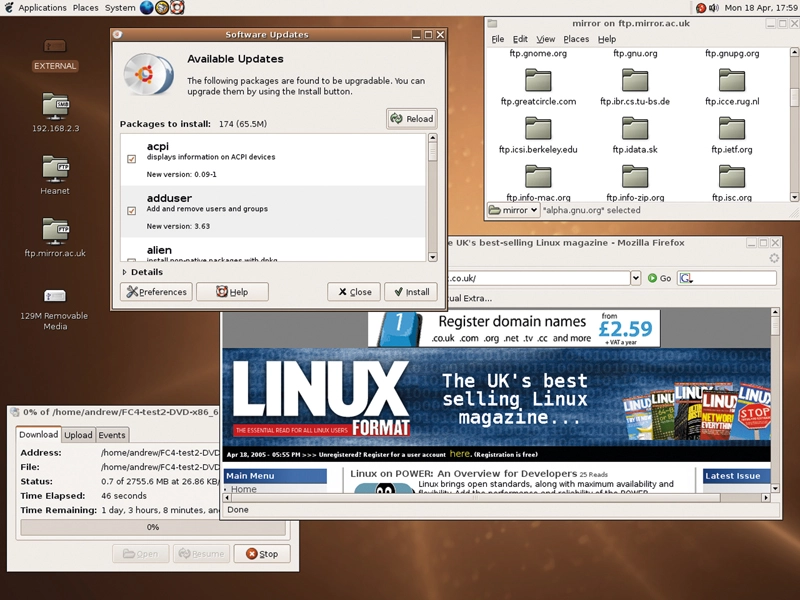
We've come a long way since the Warty Warthog

It's easy to argue that Ubuntu's success is because there's an unlimited supply of investment from its super-rich parent company, Canonical. But Linux isn't like any ordinary software stack.

People aren't forced to use it, and we can all choose something else at no extra cost. Ubuntu has to be doing something right. Ubuntu's biggest, and earliest, success has been in marketing itself. It's become a recognisable brand, not only in the Linux community, but in the wider non-technical world.

For some, the word 'Ubuntu' has become synonymous with Linux. And that's a vital trick. These are people who would never have considered Linux as a viable alternative to their proprietary operating systems before the advent of Ubuntu.

Right from the outset, Ubuntu has been marketed as 'Linux for Human Beings', rather than the stereotypical anti-social, bearded geeks of Hollywood movies. (It also helps if you've got a charismatic spaceman to run the show and you can afford to send out CDs for free.)

Where previously these people may have thought of our operating system as an arcane command-driven interface glowing from an amber display, they now understand that the Linux experience comes very close to what they're used to, and it's even better when it comes to security and performance.

Ubuntu live Marketing the Ubuntu brand has been helped by two things. First, and despite our occasional criticism, there's no doubt that the brown/orange/red colour scheme adopted by both the Gnome desktop and the distro logo has helped to make Ubuntu a recognisable brand. It casts an aura of care over the desktop, and helps new users identify with the people who have created the distribution.

Second, Ubuntu came at just the right time. The release of Warty Warthog in 2004 came after years of Linux teething, a period where many PCs and laptops suffered from poor hardware support in the Linux kernel. From a home user's perspective, almost everything was experimental, from USB modems to your graphics chipset and printer.

Ease of installation

But by 2004 there was a good chance that a standard installation would just work, and Ubuntu was on the inward wave of distributions taking advantage of this new-found stability. From the first release, Ubuntu developers have been canny enough to work only on what's important from the perspective of an ordinary user.

To start with, that means hardware compatibility and ease of installation. Ubuntu single-handedly championed the live CD method of installing the distro, letting users test the water before committing to a complete installation, and distributions feel out of step if they don't offer this feature today.

It was one of the first distributions to recognise the importance of a network manager, for instance, and the new 'shutdown countdown' window on both Ubuntu and Kubuntu, as well as the notification system for Gnome, is a continuation of small usability adjustments making a big difference.

Rather than throwing everything into the cooking pot, the Ubuntu developers recognise what's important and make sure that it works first, even if that means being late to the OO.o 3.0 party.

Over the last five years there have been two other significant factors in its success. First, the rise of Mozilla Firefox has brought open source software – or at least an awareness of it – to every computer. People are now less likely to be suspicious of free software development and understand the role of Linux as a free, open and secure replacement for their operating system.

And second, on a related note, the poor update of Vista and the expense of keeping on the Microsoft bandwagon has led computer users to look at alternatives. As it's the Linux distribution with the highest mainstream profile, both of these factors have played into Ubuntu's hands.

Bed of roses

But Ubuntu hasn't got everything right. The main problem has been the backlash from certain sections of the Linux community who feel that Ubuntu offers nothing new other than a slick Debian makeover and a lesson in marketing. It's also difficult for the average community sponsored distribution to compete with a company that can afford to pay for public relations staff and send out CDs for free to anyone who asks.

It created something of an unfair playing field, a backlash from the old guard and a wider audience. It's difficult to say whether those days of flamewars and snobbery are behind us. Five years after the initial release, the Debian ruckus may have finally subsided, but certain people still feel that Canonical is milking the good work of free software developers without making a significant enough contribution of its own.

Of course, none of this is against a word of the GPL, which is designed to allow and even promote this kind of use, but Canonical can't buy good PR for the Linux community.

-------------------------------------------------------------------------------------------------------

First published in Linux Format Issue 120

Liked this? Then check out At last! Moblin has made Linux look cool!

Sign up for TechRadar's free Weird Week in Tech newsletter
Get the oddest tech stories of the week, plus the most popular news and reviews delivered straight to your inbox. Sign up at http://www.techradar.com/register

Follow TechRadar on Twitter


Your comments (6) Click to add a new comment

ruel24


July 14th 2009

6. Ubuntu is the flag bearer of Linux simply because it came at the right time (for other reasons than you have touched on) and because it's a huge marketing effort - one which its user base helps spread the word.

Around the time of Warty, Mandriva was the king of all desktop distros and was alienating it's user base trying to wrangle them into a Mandriva Club subscription. Red Hat had abandoned the home desktop in favor of the cutting edge Fedora project, and Suse was bought out by Novell, which didn't go over well. The user base was searching for something else.

Ubuntu got a lot of press from the very beginning. It certainly wasn't the first of its kind. Knoppix was the first LiveCD, but installing it required the use of cheat codes. That's a rather techie solution. Along comes Ubuntu on the scene, rather late to the game, but it had a millionaire dot-com backer. This caused quite a stir in the climate at that particular time. Combined with a name that supposedly means "for human beings", Ubuntu's offering seemed like a philanthropic gesture from a wealthy individual. It got a lot of press and word spread quickly.

Since then, the marketing machine has been hard at work. It helps that the word Linux is conspicuously missing from the name of the product. The word "Ubuntu" has almost replaced the word "Linux" in the mindset of many people. Everywhere there is Linux, there is Ubuntu promoting itself. Every Linux conference it can promote, it does. Even a search on Yahoo for "Linux" results as Ubuntu being the first distro listed at the top, and the next distro is not even listed until the next page, and that listing is Debian. The next distro listed doesn't even happen to the 3rd page, and it's Suse. It tries very hard to replace the work "Ubuntu" for "Linux" in the mindset.

It's been covered many times over by different blogs and journals on the internet: Ubuntu does not give back in the form of development upstream in perspective of its marketshare. The kernel releases alone are just plain shamefult. Just 100 or so patches ever since it's inception? Ranking something like 195th in kernel development efforts? So where does this money go? Marketing.

Ubuntu has never been an innovative company. It likes to compare itself to Apple, but it's not even close. It's so far back, Mark ought to keep that thought to himself. It's never been as stable as PCLinuxOS, never as cutting edge as Fedora, not as easy to install and use as Mandriva...as a matter of fact, it offers little outside what Debian offers, except that it dwells in the unstable branch.

Don't get me wrong, Ubuntu isn't a bad distro. I'm using Linux Mint a lot, these days, which is little more than a rebranded Ubuntu. However, the distro truly does little to set itself apart from any of the other distros except the amount of money and energy it puts into marketing.

Alert a moderator

zeke123


July 8th 2009

5. >To give Ubuntu it's due, does any other distro you >care to think about post you CD's with stickers and >stuff for free? I can't.

WTF?

This has nothing to do with Ubuntu and everything to do with having a sugar daddy with deep pockets.

That's one of the reasons Ubuntu is not a model to follow: its success cant be reproduced without someeone to bankroll it. That's why I hope that Mandriva will succeed since they are a publicly traded company with shareholders and responsabilities (and budgets). If that model works, it could be replicated. Aand taht's what is important, not Mandriva or Ubuntu themselves.

THere is so much FUD with Ubuntu and this article just repeats most of it. Their strenght is the buzzword they generated but concretely we have nothing to base the 'its the greatest living distro... for now' stories.

Most of the ways of counting its popularity are pathetic, how many people visit Distrowatch or how many people visit Ubuntu.com vs, other distros.

Ubuntu has cool, zeitgeist or whatever you want to call it but it also has gotten the worse from the macboi community, blind allegiance which embelishes its achievements where we get article after article

talking about how Ubuntu has this cool feature when in reality any distro with the same desktop has it too. But to the new Ubuntu convert, "THEIR" distro has it and its the greatest and then it sounds like grade 6 rhetoric about whose dad is strongest.

I think that's why you are getting a lot of backlash from some people.

>Ubuntu single-handedly championed the live CD method

And this is the kind of thing I was just talking about.

>. It casts an aura of care over the desktop,

This line made me vomit in my mouth. Id be embarassed to own up to it.

The part about timing is pretty smack on.

I only put my folks on Linux (PCLinuxOS if you must know. 25 installs for friends-family and one small problem and that was it) only the past 2-3 years because the Linux desktops just werent ready for mom, pop and the rest. Remember that it wasnt too long ago that we were stuck with no video card support from the vendors, then pieces start coming together one by one. They came in just as the desktop gelled.

I still think the desktop arrived when compiz/beryl/fusion/kororaa came along. It was a proof of concept that made us (and then our friends we tried to impress) notice that this wasnt your dad's RedHat 6.1 anymore.

>forestwalkerjoe

Theyre all simple enough for unschooled people to use. My parents retired more than a decade ago and are both using Linux. My mom, my aunt and mother in law never had a computer before this spring and are now running Mandriva2009/KDE4.2. Dad has been on PCLinuxOS since it was atop the Distrowatch ranking and has no intention of switching.

Overall I have installed Linux on the computers of 12 family members who are RETIRED. 4 NEVER touched a computer before. They know how to use FF, email, use skype and Kopete. Some want to learn more and some just surf to predermined links and want no more.

Took no special training, I spent 90% less time doing service for Windows bugs and do most of my support from home. I have also used Puppy, Xubuntu and lent my own KDE testing laptop (rotating distros) to family members to try out. Kubuntu is not installed because its still not a top 5 KDE distro and is lagging seriously next to Ubuntu.

And if you like easy and mind numbing Mac dumbed down, then you have to try Mint.

Just like PCLinuxOS makes the very good Mandriva better, Mint makes the very good Ubuntu much better.

Alert a moderator

forestwalkerjoe


July 5th 2009

4. with all that backlash in these responses.. Ubuntu is not the greatest out there.. yeah.. we know that.. its a Flag ship linux because it was easy to try out.. it marketed a NEW idea for those who have never seen or even heard of LINUX before. folks can do the WUBI install , with out knowing how to do duel OS.. partition the system or much of anything else. Most of the hardware worked out of the box and in general.. would do what most would expect a windows system to do. The fact that most of it is GUI access and doesnt require any real Terminal work.. for those who have NO clue about terminal.. makes it easy access and impressive for the NON geek user to try. If i had my choice.. Slack is the best.. for stable and able.. and a few others for certain specific uses.. but as a PUSH into the Desktop market.. for a TRY IT see what its like person.. Ubuntu is ideal. GOT a better one? one that doesnt have a user Need to school a bit to use first? bring it on. we want folks to be in LINUX.. make it simple.. let the real students study the harder stuff.. but take the dang floor with simple and easy and let them get used to LINUX first. then they might just learn some thing and go beyond it. being there are no real schools for LINUX and few persons who are willing to train you up in Terminal code.. ya cant start with Hard.. start with brainless simple stuff.

Just a thought.

Alert a moderator

magice


July 5th 2009

3. I find this piece to be awfully opinionated. Okay, I know, opinion is the state of the fashion, but this is too much for me to bear.

First, what does it mean to be flag bearer? Well, if you mean flag bearer as "the most popular boy in the army", then your army must lose constantly, because the most popular boys are not always be the bravest ones. Flag bearers, thus, must be the one who are willing to go to the battle mostly unarmed, with the their own comrades as their greatest weapons, and still need to be on the first row to lead their units ahead. That's not a very sexy role, you know, since those people are easy targets, yet have virtually no way to fight back.

Now, how can Ubuntu be flagbearer?

Does it lead the charge? Okay, maybe on the imaginary battle of "Linux vs. Windows", but such battle does not really exist in desktop landscape. Remember how Red Hat shun it? Well, with a good reason. On desktop market, GNU/Linux (please get the name right) is about freedom in software. It is pretty hard to make money out of software freedom (at least for now), so big vendors don't show much interest here. On the other hand, many GNU/Linux users don't care. I don't. Why should I care if GNU/Linux has small market? Well, a bit of ego, but other than that, as long as I have my freedom and the OS works, that's fine. If people like to be enslave, let them be. Plus, if the price of popularity is freedom, as Ubuntu users have demonstrated a few times, I don't want it. Thank you, but I want the flexibility, the choices, the freedom of GNU/Linux.

Now, how about the battle for freedom? Does Ubuntu lead the charge there? Actually, I suspect this distro stands in the way, not leading the charge. Why? First, it loves the embrace questionable stuffs. In the past is trademark question with Ubuntu One; now is mono. How exactly does Ubuntu expanding freedom, then?

Oh, how about technical battle? Um, you should know, among large distros (Debian, Red Hat/Fedora, Ubuntu, and Gentoo), Ubuntu contributes the LEAST back stream. Okay, the statistic only include kernel, gcc, glibc, x.org, and man pages, but still. True, when you buy a car, the design and color and whatnots are important, but what define the car is its engine. Similarly, what defines an OS is is core, not the theme and that kind of things. Plus, isn't x.org is also a part of GUI? Ubuntu contributes next to nothing.

Oh, I know, Ubuntu must be leader of ease of usage! Really? How? What is special about Ubuntu that no other distros offer? Um, the ugly brown theme? Apt? Ah, the please-don't-show-me-CLI aptitude of the user base! Well, I don't generally define that as ease of usage.

In the end of the day, what does Ubuntu offer? A corporate behind itself? Like, you know, Windows or Mac. Other than that, Ubuntu merely assembles available things, in some known ways, and claims all the credit. Sad, eh?

Alert a moderator

gwydionddu


July 2nd 2009

2. All well and good about Mandriva's achievements, but the article is about how Ubuntu has become a brand. To give Ubuntu it's due, does any other distro you care to think about post you CD's with stickers and stuff for free? I can't.

Alert a moderator

adamw


July 2nd 2009

1. "Ubuntu single-handedly championed the live CD method of installing the distro"

This is nowhere close to true. It had been possible with earlier live distros like Knoppix for quite some time. Of the 'wave' of distros which came to introduce and prominently promote live installation systems around the same time, both Mepis and Mandriva did this clearly before Ubuntu did. In this as in so many other things, Ubuntu followed, it did not lead, never mind "single-handedly champion".

"It was one of the first distributions to recognise the importance of a network manager, for instance,"

Again, Mandriva had net-applet substantially before Ubuntu had NetworkManager (and net-applet was much more sophisticated for many years; it had support for cellular data from 2004-2005, NetworkManager added this only last year).

Alert a moderator

Tell us what you think

You need to Log in or register to post comments

By submitting this form you agree to our Terms of Use and so are legally responsible for anything you submit. DO NOT submit anything which may violate the Terms of Use or another person's rights including copyrighted or offensive materials.
