


- Wireless speakers + room optimization delivers immersive audio
- No soundbar or AV receiver required
- Mix and match speaker types to suit your space
If you want the most entertaining Dolby Atmos experience from your TV, you've typically got two choices: option one is to invest in an AV receiver and a set of nice speakers, and option two is to get a good soundbar either on its own or with additional satellites. But now there's a third, more convenient Dolby Atmos option — and it doesn't need an AV receiver or a soundbar to work its movie magic.
With wireless Dolby Atmos speakers, the speakers can connect directly and without cables to your TV. They have their own amplification and in many cases your TV can listen to them and calibrate them based on where they are and how your room affects the sound they produce. That means you can put your speakers pretty much anywhere, instead of having to worry about perfect positioning.
Most of the big names in home theater are offering wireless Dolby Atmos speaker systems now, such as Samsung's Music Studio 7, LG's SoundSuite FlexConnect, TCL's Z100 speakers, Sony's Bravia Theater Trio and Quad, and Hisense's HT Saturn, among others.

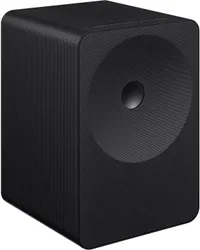
The Samsung Music Studio 7 is a good example of what wireless Dolby Atmos speakers can do. It's a multi-directional wireless speaker with both Wi-Fi and Bluetooth for maximum flexibility. Its multi-driver design enables it to deliver 3.1.1-channel sound from a single speaker cabinet and while it's very compact it's also very powerful, putting out 150W.
Where things get really clever is when you connect it — wirelessly, of course — to a compatible Samsung Q-Symphony TV. That makes the speaker an integral part of your Q-Symphony sound system, and the TV then optimizes the speaker's audio based on the speaker's location and its relationship to other speakers.
A soundbar can be included in the Q-Symphony setup too, but it's not required; the TV will take care of the center and let the Music Studio speakers handle the wider soundstage.
Flex for success
TCL was the first big-name TV brand to embrace Dolby Atmos FlexConnect, which is one of the most exciting things to hit home theater since the original launch of Dolby Atmos. It was soon followed by LG, and more manufacturers are getting on board.
Like Samsung's Q-Symphony, Dolby Atmos FlexConnect enables you to create a multi-channel surround system without requiring an AV receiver or soundbar. Simply put your speakers wherever you want and it'll calibrate them based on their location and the room acoustics. Room calibration has been a feature in high-end AV receivers for years, but having it in your actual speakers is a real game changer.

It's worth going into a bit of detail about that room calibration, because it's exceptionally clever. When you first set up your FlexConnect system, or add a new speaker, it will detect compatible speakers and then play audio tones through them.
The microphone in your TV listens to those tones and FlexConnect then does three things: it identifies the location of each speaker, it identifies what characteristics those speakers have — for example, whether they have height-firing drivers — and it analyzes the room's effect on their audio, such as how sound is reflected around the room. That data becomes a highly accurate acoustic model of your room that's used to optimize the audio from every speaker.
We've tested several FlexConnect setups now and we're very impressed — not just for movies and TV shows, but for games and watching sports, too.
Things get even more interesting when manufacturers add their own innovations. For example, LG's SoundSuite FlexConnect speakers can take advantage of a feature called Sound Follow that makes the audio follow you if you move while you're watching or listening to something.
With a traditional surround speaker system there's a sweet spot where you get the perfect positioning of every element, and if you move somewhere else you move out of the sweet spot. But with Sound Follow, the speakers know where you are via the ultrawideband (UWB) feature in your smartphone — so if you move (and you've got your phone on you), the sweet spot moves with you.
More ways to cut the cables
If you love Dolby Atmos and wireless convenience but don't need the clever calibration of Q-Symphony or FlexConnect there are plenty of more traditional options for impressive wire-free surround sound.
For example, Sony's Bravia Theater Trio may look like a normal LCR (left, center, right) three-speaker setup, but those three units create 360-degree spatial sound through what Sony calls "phantom speakers".

Those are speakers that you can hear, but that don't exist: the system uses spatial sound mapping, digital signal processing and psychoacoustic virtualization to create the effect of having many more speakers than you actually have. It does that by adjusting frequencies and audio timings for each speaker to replicate the way sound from additional surround speakers would reach your ears, and it can deliver up to 24 distinct channels.
We've heard the Trio in action and sound moves smoothly around the room without the sudden jumps from front to back that you often get in simple five-channel setups. It's very impressive.
Sony has another impressive option, the Bravia Theater Quad. That's Sony's surround sound flagship, and it features four wireless speakers that deliver 360-degree spatial sound. It can use your Bravia TV's speakers for the center channel, but you can also use it to create a virtual center using the same virtualization technology as the Bravia Theater Trio. We've heard the Theater Quad in action too, and also rate it very highly.
Hisense has a serious rival to the Sony Bravia Theater Quad in the form of its HT Saturn speaker system, which consists of four wireless speakers and a wireless subwoofer. It's a 4.1.2 system with two upfiring drivers for Atmos, and total power is a whopping 720W.
It sounds superb, no doubt because the speakers have been tuned by the French audiophile brand Devialet. Like the Bravia Theater Quad it creates a virtual center channel using virtualization, so there's no need for a center speaker under your TV.
Genuinely changing the game
We think Dolby Atmos FlexConnect is a real game changer, as are similar systems such as Samsung's Q-Symphony. Instead of having to think about dedicated speakers for every channel of audio and positioning them perfectly you can just put your speakers wherever suits and let your TV calibrate them properly. That's terrific for anyone who likes easy installations, but it also addresses issues with awkward rooms that aren't the right size, shape or layout for a more traditional set of surround speakers.
In the long term, FlexConnect should mean more choice, too: while the very first FlexConnect systems were made for their manufacturers' own TVs only, Dolby Atmos FlexConnect isn't proprietary to any one TV or audio equipment maker. As the standard becomes more widely supported that should enable you to mix and match speakers of different kinds, with different features and from different manufacturers.

Follow TechRadar on Google News and add us as a preferred source to get our expert news, reviews, and opinion in your feeds.
