


Sponsored by

I've finally found the right tool for my 3D printing workshop with LightMake's L4
In the past decade or so, makers have witnessed rapid change of landscape in non industrial-grade 3D printing. Now we have got more productive machines pumping out figurines for makers and enthusiasts quicker than ever, with equipment more accessible than ever for creators like me. Some of them are great gateway products designed for beginner to intermediate users, but when it comes to scaling up production for studios that take customization orders, options are not so abundant in a sense that consistency is always there.
If you've ever tried 3D printing on lower-end equipment, you sometimes would get frustrated by how often the output gets inaccurate because of material shrinkage, or how much purge waste is produced even in small volume projects. Let alone the daily struggle with the slicer, endless calibration, switching between filaments in different colors, and the belt on stepper motors... The list could go on.
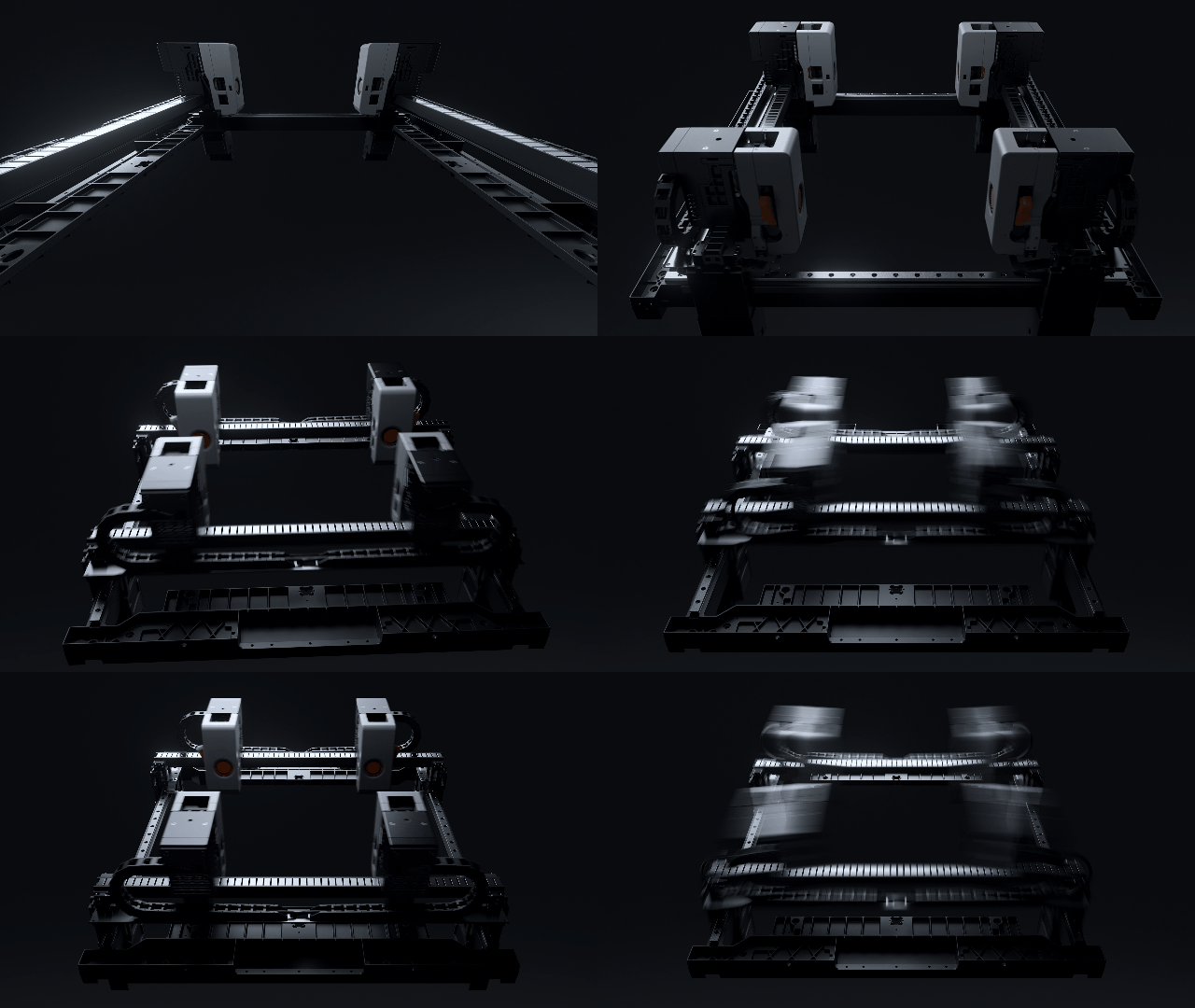
Recently I came across LightMake, a newly-launched 3D printer brand that is ambitious enough to tackle the common bottlenecks—particularly for design studios and print farms. Their flagship machine, the LightMake L4, is an independent 4-head 3D printer powered by linear motors, which sounds quite different from traditional ones controlled by steppers.
The 4-head hype: is it worth it?
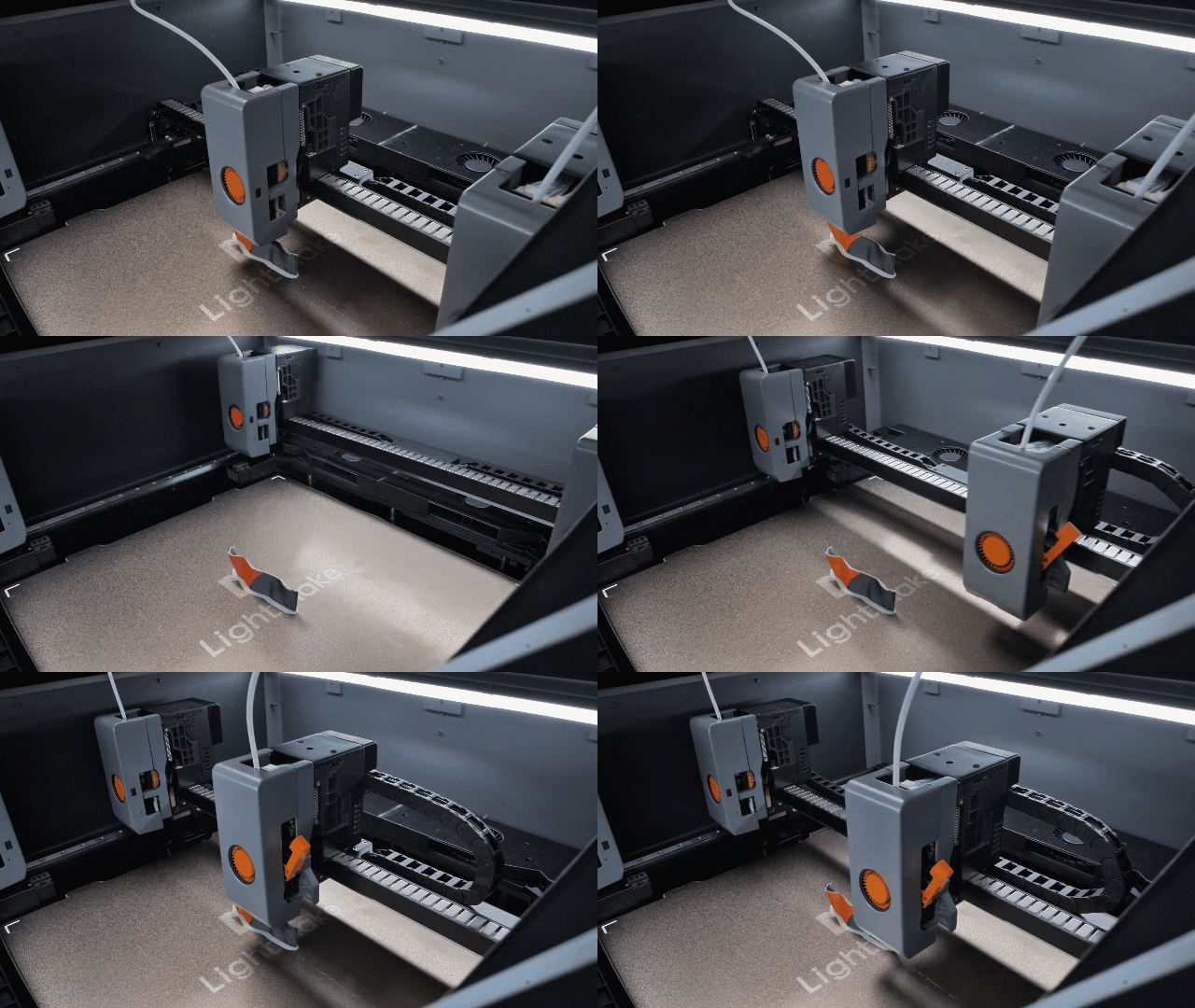
The most immediately striking feature of the L4 is its four independent print heads. This isn't simply four nozzles. Each toolhead is completely independent and ready to deploy. This architecture delivers something handy for anyone producing multi-colored or multi-material prints: simultaneous operation across four models or near-instantaneous color switching within a single model, and you won’t risk failing other three prints when one head is blocked – something a single-head machine can’t achieve.
The implications are staggering. With traditional single-nozzle machines fitted with filament changers, you're looking at 40-90 seconds of downtime for every color transition. The L4 achieves a one-second toolhead change. For a four-color print, I'm saving probably hours per print cycle. Over the course of a production day printing dozens of models, this translates into hours of recovered time.
But it's not just speed. While the system saves over 79% time on multi-color printing jobs, it reduces to nearly zero purge waste compared to conventional printers. Here's why: standard multi-color printing relies on extensive purge—sacrificial material used to clean the nozzle before switching colors. With four independent heads, each serving its own color from dedicated nozzles, there's no room for massive purge waste. Nearly every gram of filament becomes part of your final model.
The financial implications are significant. A design studio producing custom figurines could theoretically quadruple daily output using a single L4 while substantially reducing material waste. The company's ROI projections, based on their own testing scenarios, suggest relatively rapid capital recovery—though actual results would depend on production volume and pricing specifics of individual operations.

Linear motors: the foundation
What separates the L4 from being merely faster is how it achieves good and consistent performance without sacrificing precision or reliability. The machine employs linear motors, rather than the belt-and-pulley systems found in regular consumer 3D printer.
Why does it matter? Well, linear motors are contactless—magnetic propulsion with no mechanical friction. The L4 maintains ±1 micrometer motion precision, delivers 1,000mm/s travel speeds, and will theoretically operate for over 50,000 hours without substantial degradation. That's approximately 9 years of continuous operation at 14 hours per day.

For a print farm operator, this means something crucial: the machine is essentially low-maintenance. No belt tensioning. No pulley replacement. No stepper motor recalibration. The reliability advantage compounds when you're managing multiple machines simultaneously in a farm.
Building for precision and scale
The L4 offers an extra-large build volume: 354×370×386mm for single-color printing, and 354 × 350 × 386mm for full-color output. Scale that to simultaneous quad-printing, and you can produce four models of 177×195×386mm each—enough for complex figurines, functional components, and retail-ready products all in one session.

The machine incorporates architectural choices specifically designed to mitigate common hardware problems: A monolithic die-cast frame provides structural rigidity. Special vibration cancellation algorithm eliminates the ghosting and ringing artifacts that plague high-speed printing. The system even passes what LightMake calls the "coin-standing test"—literally maintaining enough stability that a coin placed on the print platform remains upright during operation.
For first-layer adhesion, the make-or-break moment for many prints, the L4 features independent liftable toolheads with 5mm height adjustment. Optical sensors achieve 30 micrometer absolute alignment, ensuring that multi-material transitions occur with zero gaps.
Adding the intelligent part: the software
A tool nowadays does little without intelligent software. The L4 connects to LightMake's ecosystem: a slicer application for desktop computers, mobile apps for remote monitoring, and cluster management software capable of coordinating over 1,000 machines simultaneously, which is essential for a large-scale production factory. It also has a conversational slicing feature which lowers the learning and operating barrier, significantly improving overall setup efficiency.
The system features Smart AutoQueue, which analyzes a farm's real-time status, and automatically allocates machines to meet delivery deadlines. For someone running a serious production operation, this can shift the entire workflow from manual juggling to algorithmic orchestration.
Perhaps most intriguingly, the system integrates with OpenClaw, allowing operation directly from WhatsApp. It's the kind of feature that sounds gimmicky until you imagine controlling your entire print farm via text messages while attending to other business matters.

Who is this for?
The L4 clearly targets three audiences: experienced 3D printing enthusiasts who are tired of slow color printing, excessive waste, and inconsistent quality, design studios committed to on-demand customization without outsourcing, and 3D printing entrepreneurs seeking to maximize output.
For the first group—3D printing makers looking beyond basic equipments—the L4 allows the users to get the multi-color result without compromising on speed, material waste, or product quality. For boutique studios, it can provide complex multi-color designs without post-processing assembly represents a tangible operational advantage. For the third group—people turning 3D printing into a business by producing hundreds of units each month—L4 offers the economics merit examination: the efficiency gains could translate to meaningful improvements in profit margins on high-volume orders.. L4 can work with PLA, ABS, PETG, TPU, ASA, PVA, PET, PLA-CF, and PETG-CF. It also supports filaments such as carbon, PA and PC, with a maximum nozzle temperature of 608 °F.
The LightMake L4 represents something worth paying attention to in the 3D printing space: through meaningful hardware and software innovation rather than incremental iteration, we are finally seeing a creative way for scalable printing tasks. The machine will also be seen at trade shows later this year, such as IFA Berlin and Formnext Frankfurt, to greet creators around the world. It is now crowdfunding on Kickstarter, and early patrons can get a few perks, including saving up to $1,100 compared to the standard price.