

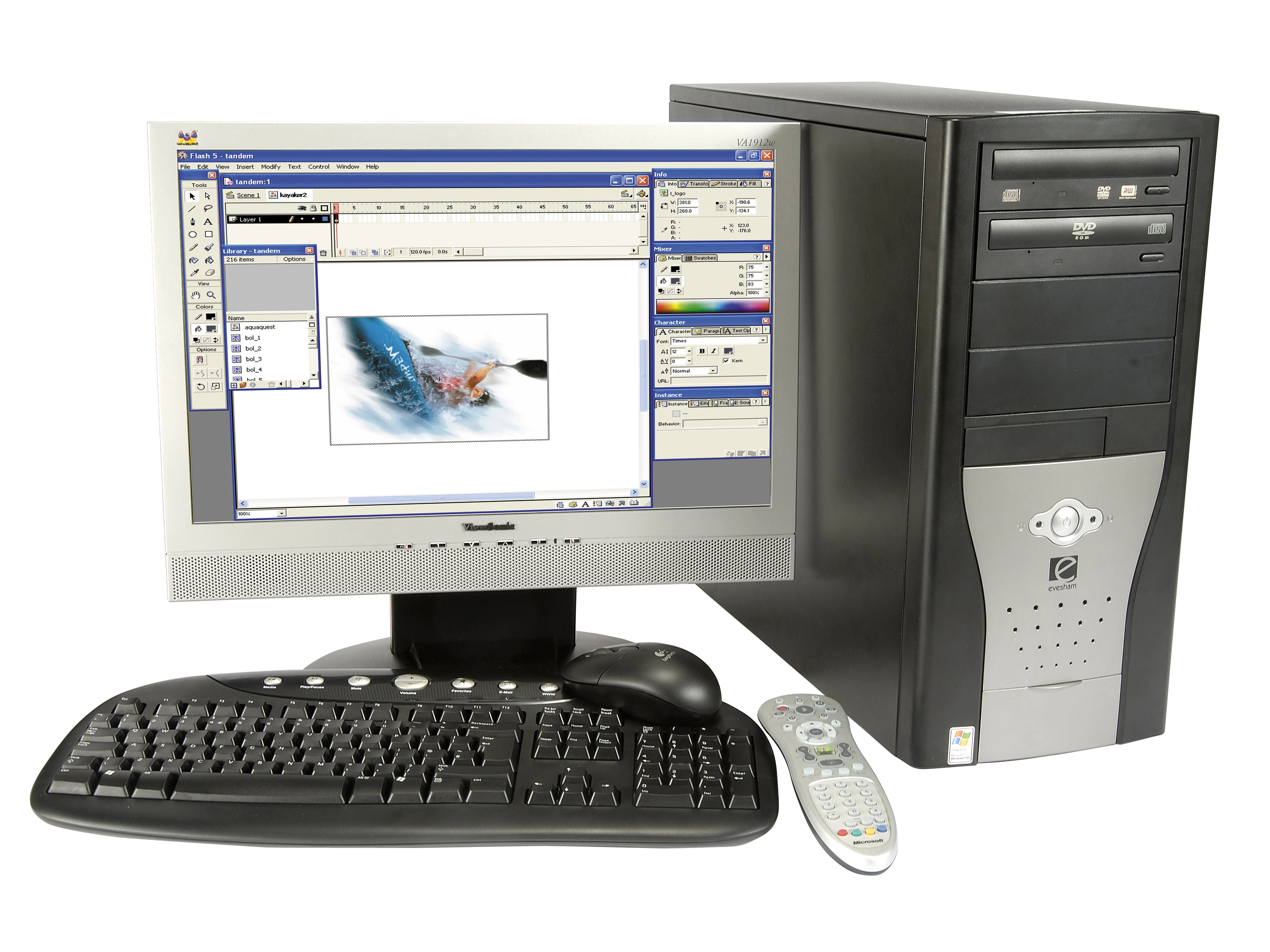
Who'd have thought a decade ago that portable music wouldn't mean a cassette Walkman or Discman? Or that the VCR would be all but obsolete? That nobody would use fax (or even dial-up modems) any more? Or CRT?
An awful lot has changed over the last 10 years, but what technology of today will become redundant over the next decade?
We got our future-gazing hat on and came up with these eight. Don't agree? Let us know in the comments below.

1. Keyboard and mouse
How quaint! The keyboard and mouse you use every day will not exist in ten years, replaced by highly-detailed touch interfaces – think: the iPhone on a big screen – multi-touch systems that support highly complex gestures, such as circling a group of photos, tossing them around, and clicking to remove smudges.
As Jon Peddie, a consumer analyst, notes, "you" will become the interface. The computer will respond to your movements, eye-tracking, head gestures, and -- one day – your very thoughts.

2. Public Wi-Fi
802.11n may have just been ratified (finally), but it's probably too late. WiMax networks that run in major cities will negate the need for a local hotspot.
More importantly, as cities develop smart grids that allow citizens to see their power usage in real-time, electric cars report mileage and traffic info over wireless, and streaming video systems replace telephone networks, a widespread wireless network won't just be an emerging tech idea – it will be a requirement.

3. Landline phone
Pundits have predicted the death of the landline phone for years, but – according to noted analyst Michael Gartenberg – in ten years they won't exist anymore, mostly because smartphones will finally take over.
Companies have already switched almost entirely to IP based telephony, so an analog line to the home will become a distant memory. Jon Peddie says even the cell phone might not exist in ten years, replaced by a personal heads-up display that actually works and doesn't make you feel sick – tied into the cloud, snapping a live stream of photos and videos.

4. Optical discs
It's amazing that current notebooks and desktops come with an optical drive, and that we're still buying Blu-ray discs. Yet, we can't blame Microsoft and Sony.
It's really the pathetic speed of broadband, running only about 3-5Mbps in most areas. In the future, more ubiquitous fiber networks – even in rural areas – will make broadband faster.
Companies such as Akamai and Limelight are figuring out how to route traffic more effectively, and we're relying more and more on web apps. The result: software video distribution networks will finally negate the need for optical discs.


Your comments (16) Click to add a new comment
mag7ue
December 18th 2009
16. I don't necessarily disagree that land line telephones will be gone, but to say "most companies have already adopted VoIP?" I think that's a bit presumptious.
Alert a moderator
troyguffey
November 7th 2009
15. 1. Keyboard and Mouse
They will probably still be used in the future, especially the keyboard! There's nothing like the tacticle feedback of a keyboard to help you type faster. As long as pure text is used, keyboards will still be around. The mouse movement might get replaced by eye-tracking, but then how do you decide clicking? When voice-understanding becomes mostly reliable, pure text input will decrease, but there are still environments you DON'T want to speak aloud.
2. Public Wi-Fi
Yes, I agree it might go down.
3. The Landline Phone
There's one big advantage a old-fashioned land-line phone has: it's powered by the phone company from THEIR end. If you have a power outage in a snowstorm that is killing your cell-phone, you can still call the power company up.
4. Optical Discs
Optical disks are still useful for private backups. They are longer-lived than present flash-drives, which would be the other technology for backups and software installs. Physcial storage is the ULTIMATE bandwidth. Relying TOTALLY on the Internet is for overconfident idiots.
5. Standrard Game Controls
These CAN'T really be replaced by anything less than a neural interface. What good is a body language reader when you want to sit back in your chair and play an old-style side-scroller arcade game? And there's a reason some games are called "Twitch-games"
6. The Beloved Desktop Computer
Possibly, but desktops will always have the advantage for enthusiasts who want to use fast custom hardware. Wireless technologies will ALWAYS lag behind a hard-wired in-box device.
7. Operating Systems
Computer-science-wise it's impossible as others have pointed out.
8. Blogging, the end of an era?
There's always going to be a place for the blog archive. A LOT of the forces that drive blogging today are the times that you DON'T WANT to have real-time two-way interaction with someone.
Alert a moderator
rnojonson
October 8th 2009
14. Let's re-adjust this vision a little. Keyboards will get thin like laptop keyboards, have finger/pen pads integrated into them, wireless mice will be standard.
ATX cases will become near extinct except for gamers and modders who tinker and like power. The laptop format will flourish even for desktops, but desktop displays will be detached. A desktop will have a laptop base and the display of your choice, also short range wireless video will happen. The portable laptop will be as it is now. The iphone style touch screen will replace the mouse pad and will incorporate pen pad functions.
Some voice control maybe akin to that Sync thing on car phones, no more than simple commands. I really don't want to talk to my machine. The cores of multi-core cpu's will be as separate computers so that real multi-tasking can happen. One can run the interface, another the computing, another the data management, the video, etc. I hope we don't soon see a single digital device that can swallow every digital device including the TV remote and garage door opener so if it breaks there are thousands of people standing in their driveways shouting why me at the same time, talk carbon footprints!
Alert a moderator
scottgilbert
October 5th 2009
13. last one, think about those who have no voice, can not speak, what are we supposed to do? fart?
Alert a moderator
awirthy
October 2nd 2009
12. First of all keyboards and mice are going anywhere, you can't everything with a touch screen that you can do with a keyboard and mouse. For certain areas and uses yeah, but it won't completely replace the keyboard and mouse.
As for optical disks, as long as there are bricks and mortar businesses there will be optical disks. Whether it be floppy disks or Blu-ray we have always had a physical storage medium, and there is no reason to stop now.
No 5 I find is complete ******** because the Xbox 360 aims toward a different demographic. It aims toward the more hardcore gamer, if they were to change their controller they would lose there advantage in that area and be challenging the Wii for the same audience in which Wii dominates.
As for the desktop PC as long as there are gamers, schools and tech savvy tinkerers around there will always be desktop PC although they might be a smaller market.
The quote "OS's will vanish and we'll have a monolithic browser that manages everything," is stupid because an OS is a browser that manages everything and there is no reason to replace it.
Alert a moderator
jbrandonbb
October 1st 2009
11. I am the author of the article. It is really hard to imagine not using a keyboard, esp. as you are typing on one. But, on smartphones, they are already starting to disappear with speech-to-text searches. The PC itself is changing -- smartphones are becoming computers, so the full size keyboard has already gone away. Now fast forward ten years. We're not even sure what a PC will look like then, but it will be closer to an iPhone than a Dell.
Alert a moderator
craiggrannell
October 1st 2009
10. We've come a long way over the years, but certain fundamentals remain, and that's the point. Keyboards may not be as clunky as typewriters of old, but, essentially, they're little different, and that's because they're (with the exception of the QWERTY layout) the best and most efficient means of entering text into applications and documents.
Even if speech recognition becomes commonplace, you'll still need editing, unless software becomes super-intelligent. Otherwise you'd end up with the first line of this very article looking something like this:
"Who'd have thought, er, a decade ago that... um... portable music wouldn't mean a tape... no, hang on, a cassette Walkman or, er, Discman?"
Alert a moderator
akfreak
October 1st 2009
9. Thing is your thinking like my dad did when he said vhs video is the future.
We have come leaps and bounds through 10 years.
Tech today is speeding/ smashing through anything created within the same time period.
Who said were going to be entering text through speech?
use your mind!
"do you think thats air your breathing?"
Alert a moderator
mpausyd
October 1st 2009
8. I always chortle when reading about speech recognition replacing the keyboard. People don't really think it through in practise. It's great for certain functions but isn't likely to replace the keyboard anytime soon for work purposes. Consider for a moment -- imagine an open plan office where everyone is composing/responding to emails, creating project reports, personnel assessments... and they all speaking aloud to do it... Talk about a noisy office. And besides, if you are writing a quick email to wife/girlfriend about plans for the night, do you really want to share it with everyone? Keyboards are extremely good for quick, accurate, confidential text input. I can't see speech recog. replacing it in most businesses anytime soon.
Alert a moderator
yoonssoo
October 1st 2009
7. Um, yeah, right, no keyboard and mouse? Try playing World of Warcraft with multi-touch monitor and your finger/arms... I don't think keyboard and mouse will ever go away.
Alert a moderator
dgerrold
October 1st 2009
6. While Mr. Brandon's predictions are certainly accurate from a technological point of view, I think he's leaving out one part of the equation -- the user.
While it is certainly possible to replace all of the technologies that he has listed, the real question is whether or not people will want to. Netbooks and Laptops will certainly become the computer of choice for most users, but the desktop PC will remain the industrial-strength unit for those who need to apply a lot of power for scientific calculations or video-processing or other CPU-intensive tasks. Desktop PCs are customizable and upgradeable like no other technology and that attracts a very large demographic of power-users.
I also expect keyboards and mice to remain a standard for a long time to come, simply because many people have trained themselves to think through these tools very efficiently. And quite frankly, keyboards allow a kind of fast and easy precision that speech recognition does not easily equal. Try speaking: <div ID="Box"; style="position:fixed; background-color:transparent; top:15px" class="textbox"></div> I can type it faster than I can speak it. Likewise, a mouse is a more precise tool for video and photo-work than a finger.
Optical storage? Maybe it won't be CD or DVD or Blu-Ray, maybe it'll be holographic phase-change quantum tectonics or some other tech still to be invented. But optical storage exists as a profitable technology because it fulfills a need for rugged and secure storage and distribution of large amounts of material. CDs and DVDs are routinely attached to all kinds of books and magazines now to provide demos of the material covered in the book/magazine. Plus, optical discs are still one of the best technologies for archival storage of materials. People understand them and trust them.
Will movies and music still be available on little plastic discs? I expect optical disc distribution of content to still be around in a decade. I've been hearing about the ubiquity of download-on-demand for ten years now, the market hasn't embraced it enthusiastically yet and it might be worth doing some research into why consumers aren't as excited by the possibility as the pundits think they should be.
Here's another case in point, video phones: five years ago, I was in Hong Kong for several months and most smart-phones there were capable of videophone conversations, but hardly anybody used it for regular use. Last year in Hong Kong, nothing had changed, people spoke on their phones, they didn't look at their screens while they talked. Why? Probably because a phone is about conversation with the other person, not looking at him/her. The audio channel is a focused channel of information.
Yes, it's easy to predict the extinction of landlines. It's already happening. The cellphone provides significantly more value. I shut off my landline years ago and never missed it.
Wimax replacing Wi-Fi? Probably. But the user won't really notice the difference. He'll just know that he's got universal access to the Internet. But that's an easy prediction, regardless of the technological avenue.
Blogging will not disappear. People like to share their views. Blogging is more likely to evolve into a citizen-journalism than it is to disappear. The average person will probably be happy sharing himself/herself on twitter or facebook, but there is a growing body of writers who provide in-depth explorations of science, technology, entertainment, fan-interests, news, politics, and whatever.
I also do not believe that operating systems will disappear. Operating systems started out as file-handling systems, doing little more than copying, moving, and deleting files. But in the thirty years since the first micro-computers were built, we've seen operating systems evolve into powerful interfaces that allow us access to an enormous body of software that gives users incredible power to work in areas far beyond anything that was imagined at the dawn of the computer age. As powerful as online computing may become, I don't see it replacing the OS -- certainly not for those of us who like to keep our work private.
My point is that just because a technology is possible, that doesn't make it inevitable. While it's fun to predict that every new technology will destroy the old, it doesn't always work that way, not when the old technology still provides a value that the new technology doesn't replace. Radio didn't kill records. TV didn't kill movies. Airplanes didn't destroy railroads. In all of those cases, the legacy technology evolved to meet the changing environment and provided a different menu of services, and in many cases a partnership with the new technology.
I think Brandon's predictions are not about extinction as much as they are about evolution. Things will be different in ten years. Ohell, they'll probably be different in three years. We'll see.
David Gerrold
Alert a moderator
duhshatz
September 30th 2009
5. I can't imagine the controller dieing out completely. Personally I think the new sensors sound cool and I've seen the new x-box thing that is coming out, but for some of the generation that grew up on the SNES and up I think a controller will feel better in our hand then something watching a finger move.
Alert a moderator
psilosybical
September 30th 2009
4. "OSes will vanish and we'll have a monolithic browser that manages everything," he says. "We talk to it, it sees us and recognises our moods, clothes, and those around us to deliver the appropriate information."
Terrifying.
Alert a moderator
craiggrannell
September 30th 2009
3. Some of these are likely, but technology never moves as fast as we'd like. I suspect optical discs, landlines and PCs will still be around, although they'll be rarer.
Some of the other choices I totally disagree with, however. Keyboards aren't going anywhere, simply because they're the best device for certain kinds of interaction. They'll be used less, but typing isn't going anywhere fast.
Videogame systems are another case in point where the best device for the job is sometimes over-ridden, in this case by the most cost-effective device for the job - a standard controller. The joystick may have rolled over and almost died, but the gamepad isn't going anywhere, because it's the best way of interactive with a huge range of games. Again, other types of controllers will gain traction, but they won't entirely replace the gamepad, nor come close to doing so.
As for the OS, that looks like someone's championing Linux/Chrome. I can't argue with the fact more things will end up online, but over-reliance on the internet for work isn't a great idea, as anyone who's been affected by Google apps downtime will attest to.
Alert a moderator
grannelle
September 30th 2009
2. Wanna make a mint as far as an investment? Buy up all the VCR tapes and machines you can right now. Remember what happened with vinyl when CD's first came out? You couldn't give vinyl away. Now, it costs an arm and a leg. The same will happen with VCR tape. People of the next gen always enjoy retro.
Alert a moderator
sirspoon
September 30th 2009
1. I think we'll still have keyboards and mouses... would you really want to be waving your arms around all day getting tired, smudging your display, and shouting out what you want to type. I'm sure it all has its place but not in most office/home environments.
Alert a moderator
Tell us what you think
You need to Log in or register to post comments