


It's not hard to see what iFi's doing at this most prestigious London unveiling event. I'm in the North Tower Lounge inside Tower Bridge (the beautiful 1886 Thames suspension overpass often mistaken for London Bridge – which is thoroughly dreary in comparison). I have a beautiful, aerial view of the Capital. And I'm holding a martini.
Around me, iFi's core team are wearing what Londoners might call 'the full whistle', short for 'whistle and flute' in cockney rhyming slang, or 'suit' – in this case, black tuxedoes. Add to this a poster on the feature wall reading 'Phantom', and it feels as if Daniel Craig's 007 (or the villain Auric Goldfinger from 1964's Goldfinger) could drop in at any minute.
And once I understand fully what's being unveiled tonight, this heightened sense of drama feels justified. iFi has never been a simple black box company, even with its budget friendly efforts – this is, after all, the company that brought us DACs shaped like hip-flasks. And the all-new Phantom is every last millimeter a singular, unique and hugely specified machine.
So, if I'm reminded of the Rolls-Royce Phantom while gazing upon this piece of hi-fi tonight, that's very much intentional on iFi's part. The iFi iDSD is a formidable headphone amp, streamer and DAC, with 7000W of power. It is, the men in formal wear assure me, the pinnacle of what iFi can achieve – and I'm proud to say, they let me listen to it for a long time.


The world is not enough
Top of the headline-grabbers (although it must be said, there are plenty here) is an all-new custom DSD2048 remastering engine: iFi’s Chrysopoeia FPGA-based solution. Essentially it's the first of its kind to upscale like this to a consumer product, using a bespoke algorithm 18 months in the making.
Make no mistake, everything has been reworked for the Phantom. As iFi Chief Engineer Colin Farch tells us: “Each stage of development involved re-examining the circuit, measuring performance, and making improvements to cement it as the most accomplished iFi listening experience to date.”
The iDSD Phantom is still built on iFi's continuing love affair with K2 and K2HD tech. This a mastering system is based on the human ear – it was conceived by JVC Kenwood many years ago in Japan, and iFi is the only company outside out JVC Kenwood to have access to the tech. Here, its particular studio-grade guise is unique for the iDSD Phantom.
iFi fan favorites such as XBass Pro and XSpace Pro are here in three iterations, but you also get five more digital filters and – in possibly my favorite feature – you can select between tube or solid-state outputs via a little switcher on the chassis, using NOS GE56870s or discrete circuitry. Again, iFi suggests the iDSD Phantom is perhaps the only product to offer this, and I've certainly never before had the option of flicking between solid-state or two different tube solutions.
When we experiment with it later, in a hands-on listening session using headphones, my colleague (an esteemed member of the audio press) proclaims of the solid-state variant: "It's like a sushi knife!"


A sort of licensed troubleshooter
Extra marks if you get the quote, from Bond in Thunderball (1965). So, the Phantom brings studio-grade DSD2048 conversion into your living room, with 768kHz PCM/DSD512 and full support for Qobuz Connect, Tidal and Spotify Connect and AirPlay 2. It also boasts a 7,477mW peak output and real-time, user-switchable, solid-state, tube and Tube+ output stages.
But what else can it do? As a streamer, iFi tells us the iDSD Phantom works on a heavily modified version of Volumio 3, and has integrated steamer controls inside the Nexus mobile app. A weighty remote comes with your purchase, but for me, this product is all about getting hands-on.
I switch it on and the buttery-smooth volume dial on the right of the unit starts cruising silently all on its own. Already I'm in love. I use the left hand dial to scroll away from the digital VU meter on the circular screen and through the options: K2 Technology, Operation modes, Gains, Remaster, Filters, iEMatch (another iFi favorite that will help you match your in-ears' or cans' sensitivity to the iDSD Phantom), XBass, XSpace and a further Settings tab.
What of the actual digital-analog conversion? You're getting four custom-interleaved Burr-Brown DSD1793 DAC chips, built on iFi's strong ties to what the team calls the "legendary multi-bit Philips TDA1541A" – adding, "we're obsessed with it; it's the king of DACs".
In ‘Normal’ mode, DSD signals pass directly to the DAC, while PCM signals go through a user-selected digital filter. In ‘Remastered’ mode, each DAC chipset processes up to DSD1024, and in their custom configuration they achieve native decoding that allows for DSD512, DSD1024, or the new pinnacle of DSD2048. So that's me told – that's how it's done folks. Oh and at DSD2048, the 1-bit stream is sampled ~90 million times per second.
Want to listen to it? Of course you do – let's go.


Like listening to the Beatles without earmuffs? Yes, but more
I'll stop with the Bond references now (that one, as I'm sure you remember, is from 1964's Goldfinger) and concentrate on the serious business of enjoying music – although I must tell you that to kick off our listening session, we also hear the iDSD Phantom used in a system involving PMC Active Twenty5 23i floorstanders.
Brit Award winner and celebrated British record producer Steve Levine takes the mic, telling us, "Using this, it was like I'd taken a tea towel off my own speakers – and they're good Neumann speakers too!"

I understand it's a simile, but the idea of Culture Club's celebrated record producer casually slinging a tea towel over his expensive speakers (and possibly this very expensive DAC) while doing the washing up makes me guffaw awkwardly, nearly spilling whatever's left in my martini glass over my notes.
Thankfully, music comes to my aid and Pharrell Williams' Come Get It Bae does indeed thump, slap and bang, then stop just as abruptly. Distortion or saturation? Not a bit of it. Bass is full-bodied, the top-end has miles of room and thus of course, vocals (including Miley Cyrus') are expertly textured and layered. The fact that such a beautiful product's job is to just get out of the way and let the music through is something I'll be thinking about for a while.
On to personal listening then, and I quickly scooch in quick for a spot with the Sennheiser HD 800 S open-back headphones and my very own Phantom. Yes please. As I scroll through my listening options, I'm told the circular screen between the dials can also be used to display album artwork, which would be a lovely touch as I deploy FKA twigs' Girl Feels Good.
And I do feel good. The prowl at the top of the track skulks just above my right ear; the central vocal is more opened out and somehow breathier than I've ever heard before. Guitars at the outset of R.E.M's Man on the Moon are textured and three-dimensional, and there's extra melancholy to be unearthed in Michael Stipe's incomparable timbre.


Now there's a name to die for
Sorry, I couldn't stop myself (Die Another Day, 2002). Anyway, I keep listening: Gaga, Goldfrapp, Lana del ray, Jessie Ware… it's all more than I'm used to hearing; more information, greater intensity, a more notable dynamic rise and fall, sharper leading edges to notes I'd only ever registered as just there before.
So let's talk money. The iFi iDSD Phantom is available to purchase from today, January 20th, from ifi-audio.com and select elite dealers, priced $4,499 (before tax) / £4,499 / €4,695 EUR / $6,999 CAD (so around AU$8,997).
I can't afford it. I know… I know (well spotted again, No Time to Die, 2021) but nevertheless, the iFi team let me sit and enjoy the iDSD Phantom for some time, in my little corner of the North Tower, Tower Bridge, London. Hi-fi appreciation should, I think, always involve a comprehension of the stats alongside actual listening. Well, I do like to do some things the old-fashioned way (Skyfall, 2012)…
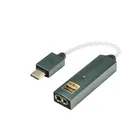
➡️ Read our full guide to the best headphone DACs
1. Best budget USB-C portable DAC:
iFi GO Link Max
2. Best budget desktop DAC:
iFi Uno
3. Best premium portable DAC:
iFi xDSD Gryphon
4. Best wireless DAC:
Fiio BTR17
Follow TechRadar on Google News and add us as a preferred source to get our expert news, reviews, and opinion in your feeds. Make sure to click the Follow button!
And of course, you can also follow TechRadar on YouTube and TikTok for news, reviews, unboxings in video form, and get regular updates from us on WhatsApp too.
