





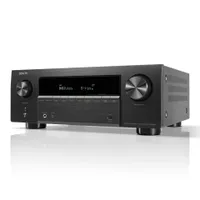
Here at TechRadar, we recently upgraded our in-house sound system from a soundbar surround setup to a full AV receiver and separate speakers system, consisting of the Denon AVC-X3900H AV receiver and Bowers & Wilkins 600 series 5.1 surround speakers.
It was a great upgrade over our previous soundbar surround system, providing more power, more detail and more finesse. You can check out my full thoughts, as well as a quick guide on setting up said system here.
But upgrading to an AV receiver isn't just about getting super-powerful sound, it also fixes other common gripes people have with TV and soundbar setups, including not having enough ports and poor dialogue quality. Here are three that I’ve experienced since making the change.
1. You'll never run out of HDMI ports again (probably)


If you’re like me, you’re using every HDMI port that’s available on your TV at home… and still needing more. I’ve got a sound system, PS5 and Roku streaming stick all in constant use in three of the four HDMI ports I have available (four is the maximum for nearly every TV available today). My fourth acts as a do-everything-else port which I have to switch out between my Xbox One, Nintendo Switch 2 and 4K Blu-ray player, which is obviously quite annoying.
With an AV receiver, this won't be a problem any more. AV receivers generally offer more HDMI ports than a TV ever could: even the more budget AVR options will have plenty more inputs than a TV (and you'll still have use of three of your TV ports as well, since only one connects to the AVR).
The Denon AVC-X3900H we’re using even has HDMI 2.1 support on all of its six HDMI input ports, meaning I can connect every single current-gen gaming system that supports 4K 120Hz and variable refresh rate at once.
Having it all connected into one device makes a difference too. If I want to switch inputs, I can simply select it on the Denon’s remote, where all the inputs are clearly labelled, and instantly access the different sources. Easy.
The only TV that offers the same kind of connection flexibility as an AVR is the Samsung S95H/S99H OLED (this model is called the S95H in the US, but is the S99H in the UK). This has four HDMI 2.1 ports built-in and you can buy Samsung's optional Wireless One Connect Box to pair with it, which adds an additional four HDMI 2.1 ports, meaning eight in total.
2. Fix dialogue clarity once and for all

It’s fair to say that even premium TVs can struggle to deliver well-balanced sound, especially when it comes to the clarity of speech in today's infamous movie mixes, where dialogue often isn't very prominent compared to the rest of the soundtrack. Most TV don’t have a center channel built-in, and this is the channel that delivers dialogue and speech — having dedicated speakers for it massively helps you to hear what people are saying.
While most soundbars will improve this issue, and do deliver clearer speech than a TV’s built-in sound can, their speakers are still relatively small, and many cheap soundbars still won’t have a dedicated center channel.
With a 5.1 system, this isn’t a problem. Each speaker handles a different channel of sound and that means the center speaker can handle all the dialogue, using a bigger and clearer set of speaker drivers than you get in a soundbar.
Watching The Batman, where characters have a nasty habit of mumbling in certain scenes, the speech is crystal clear. From Penguin’s aggressive New-York style accent to Batman’s gravelly delivery, it’s all clearly presented while the other speakers handle the other effects. Watching Speed Racer, the speech of the commentators during the chaotic opening race is clearly rendered without sacrificing other elements.
3. Sound that feels wide enough for today's giant-screens

Thanks to the arrival of huge TVs, from 75 to 115 inches, the full home theater experience with a giant screen is easier to build than ever. Unfortunately, TV speakers and even soundbars rarely provide enough width to really feel like they match the scale of giant TVs, struggling to push the sound past the edges of the frame when connected to a larger TV. With separate front speakers placed to the side of the screen, you don’t get that issue — they always match the scale of your screen.
Watching Speed Racer, the beefy front 603 S3 speakers I’m using give me that cinematic width I’m looking for, making me feel like I’m in the cockpit of the Mach 5 during the races. I can hear the movement of the cars as they swerve around the track, the crunching impacts, and swirling winds mapped to the action on-screen, but the stadium-sized atmosphere of the race, including the roaring crowd, comes from beyond the edges of the frame and out into the room, even before it connects with the surround speakers.
Instead of sounding like there's a bunch of speakers right at the TV and then also behind me, the feeling of the sound just bleeding into the room and surround me survives even with a really big screen.
I've tested TVs and soundbars that can get close to this kind of spread of sound, but nothing has given me the same level of home theater-feel as the separates setup. And the beauty of these AVR setups is you don’t need to spend big: even more affordable AVRs and moderately sized speakers will still provide the same width advantage, because it's all about the placement.

Follow TechRadar on Google News and add us as a preferred source to get our expert news, reviews, and opinion in your feeds.
