



 Become a TechRadar Insider


TechRadar Verdict
Its Full HD credentials make the XV-Z21000 a good option for anyone with an eye on the future
Pros
- +
Excellent picture
Features
Remote control
Cons
- -
Sizeable unit
Some picture noise
Why you can trust TechRadar We spend hours testing every product or service we review, so you can be sure you're buying the best. Find out more about how we test.
As LCD and plasma flat screens advance in leaps and bounds, video projectors progress in tandem. High-definition has become the new measuring point for picture quality, and it now takes something a bit special to stand out from the pack.
Sharp's XV-Z21000 could be just that - an over-engineered DLP projector that can deliver a stunning two-million pixel Full HD picture. Of course, this comes at a price - a cool £7,000 - but Sharp would argue is actually relatively affordable for a 1080p DLP model.
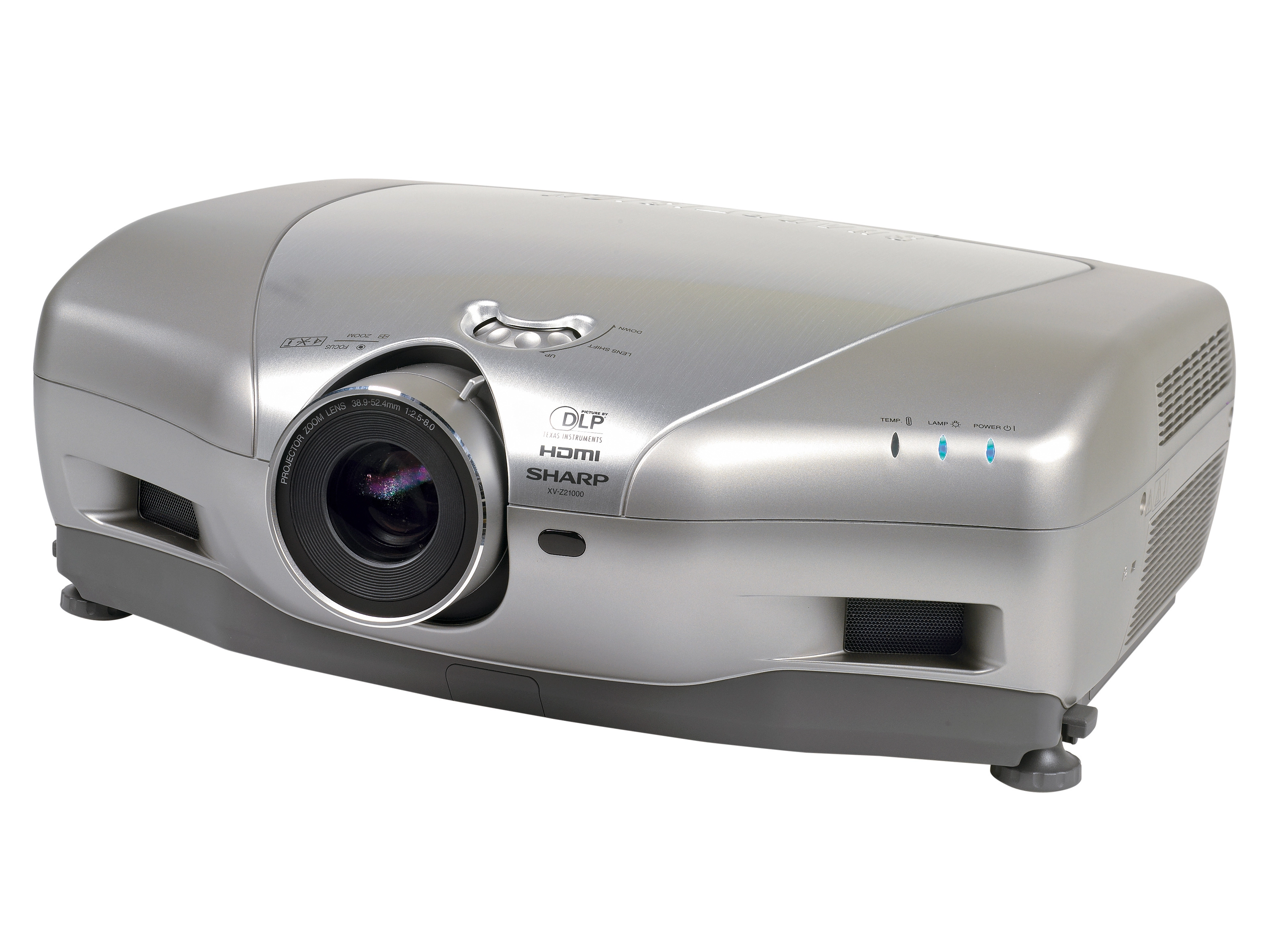
This Sharp is certainly substantial - so much so that it might present installation problems in some settings. It's a big hunk of kit, though its silvery sheen and rounded shape do a good deal to make it more acceptable in the larger living room.

Though it has manual vertical lens adjustment, an active digital keystone adjustment system, and a sealed lens assembly to save on maintenance, this isn't the sort of unit you would want to be moving around a lot.
The smooth lines of the front, with its 1:1.35 manual zoom lens, are complemented by a well-specified rear panel. Connections are comprehensive; you get S-video, composite video, two component video (one of which doubles as a PC input), as well as two HDMI sockets, a DVI socket and a 12V trigger socket which would normally be used to activate a roll-down projection screen on power-up. There's also a serial port for system control. The backlit remote control is comfortable and comprehensive.
The Sharp is fitted with the latest 1080- line DLP chips from Texas Instruments, and is compatible with 1080p sources in 50Hz, 60Hz and 24fps forms.
Recommended projection size is 40-300in at a distance of 4.1-5.5m. It normally operates in 16:9 mode, though it has a 4:3 option for viewing old Star Trek episodes. Most importantly, there's an overscan option which can be set from 0-10 per cent; this gives you the option of showing 1080-line sources in 1:1 pixel-matched format, without any image scaling.
The pictures projected by DLP lack the visible grid of LCD models, but the 'rainbow' effect caused by the rotating DLP colour wheel can take some viewers time to overcome. The Z21000 has a 5 x 7-segment colour wheel which should does suppress the rainbow effect quite effectively, as well as motion dither problems.
As for brightness and contrast, it has an output of 1,000 lumens, which is average for this sort of device; and its iris is Sharp's first dual, multi-step design. The advantage of DLP over LCD is normally that it can deliver high levels of detail when there are both light and dark picture elements; LCD projectors with dynamic irises tend to work better when the picture is either all dark or all light.
The Sharp's claimed contrast ratio is 12000:1, but this can only be achieved by measuring the contrast levels at either extreme of the iris setting; you won't see the deepest blacks and the brightest whites simultaneously.
Colour handling is enhanced by DLP's BrilliantColour system, an image processing routine which filters colour signals to improve the efficiency of the RGB colour wheel.
The operating system features adjustments for manual iris, lamp intensity, six gamma presets, and noise reduction for standard and 'mosquito' noise.
With 1080 content, the XV2-2100 delivers an amazingly full, rounded and believable image. Detail is high, so much so that it reveals problems with the source image in poorly mastered DVDs. On the other hand, it brings hitherto unsuspected levels of sharpness and detail to HD material.
Rich colours and deep blacks make for an engrossing picture. While BrilliantColour can make colours livelier, I thought they seemed less realistic, so I preferred it switched off. Colour gradations are excellent; you won't see the sort of 'colour striping' which can be experienced on less expensive models.
In comparison with a Sony SXRD projector - even one like the Pearl which is half the Sharp's price - the picture's perhaps not as bright. You may get better results, though, with a reduced viewing range, by using a high-gain projection screen. Still, the Sharp gives better contrast and richer colours than the Sony.
Brightness uniformity is excellent, with only very slight variation at the picture edges.
Noise reduction works well with dot crawl in dark images and 'fizzing' on horizontal motion kept to a minimum.
As for rainbow effect, it was certainly visible during some scenes of extreme contrast, but as some viewers are more sensitive to it than others; it may not trouble you at all.
Using a standard DVD with an upscaling DVD player, results are reasonable, but there's no doubt that this projector is at its best with HD source material, or an external upscaler. Operation is relatively quiet for a unit of this size, with the fan operating at 33dB, or 31dB in power saving mode.
Although outgunned by SIM2's Domino D80 1080p model, there's no doubt this is an outstanding projector. For black level, colour fidelity and detail, it's comparable with other single-chip Full HD solutions. It's well equipped, looks good and is relatively easy to use.
With HD DVD and Blu-ray making progress in the market, it would be a short-sighted buyer who didn't consider the advantages of this model when budgeting for a future-proofed prestige cinema.