


If there was one site that would change the world for ever, it would be the first ever website, created by internet pioneer Tim Berners-Lee.
It went online on 6 August 1991 offering people help with using the brand new 'World Wide Web', rather modestly described as a "wide-area hypermedia information retrieval initiative aiming to give universal access to a large universe of documents".
If Berners-Lee had known what was to come, he might have added: "This is going to be awesome!"
2. GeoCities
Fascinating as it was back then, the web wasn't a whole lot of fun and after four years of pages created by scientists and academics, David Bohnett and John Rezner, who ran a web directory called Beverly Hills Internet, turned their company into GeoCities, giving anyone the ability to create their own site for free.
"There was a time when half the internet seemed to be on GeoCities and I don't think that this can be underestimated," says Rob 'CmdrTaco' Malda, founder of Slashdot. "GeoCities made it possible for anyone to put something online for nothing. This was a huge deal."
3. Blogger
GeoCities made it easy for anyone to build their own site, but in August 1999, Blogger made it even easier. Now anyone could post a diary of what they had for dinner or why they hated their parents. Acquired by Google in 2003, Blogger continues to enable everyone to document their lives without needing to get their hands dirty with HTML. As does WordPress, TypePad, Tumblr and a million other services that have since appeared. GeoCities was purchased by Yahoo! in 1999 and lives on as Yahoo! GeoCities, though we've never heard anyone say "Check out my Yahoo! GeoCities page."
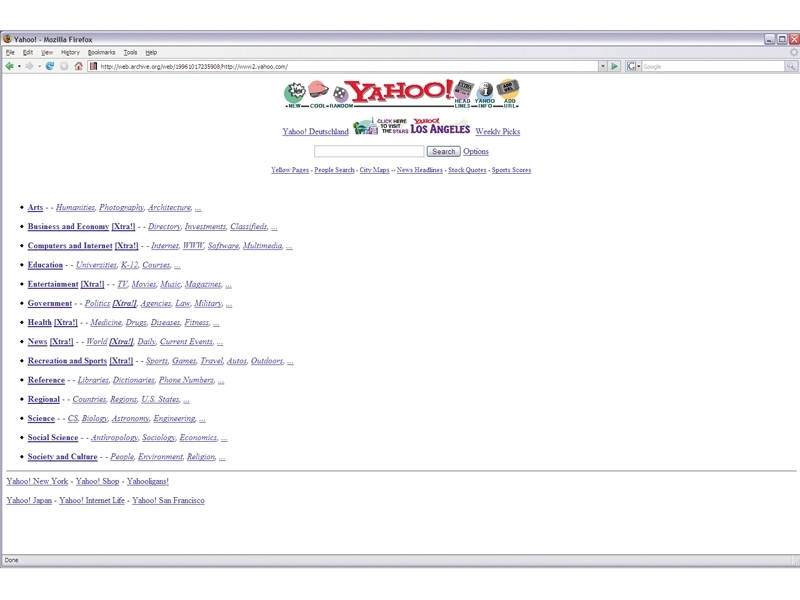
4. Yahoo!
One thing that Yahoo! will be remembered for, though, is its search directory, without which most of us would never have found GeoCities in the first place. Founded by Stanford University graduate students Jerry Yang and David Filo in January 1994, Yahoo! was a manually compiled directory of sites. "Remember when you bookmarked Yahoo! indexes because they were actually comprehensive sources on a subject?" says Rob Malda. "Good times."
But those good times weren't to last. Computer-compiled search listings from AltaVista and, later, Google, were to rise in popularity, leaving Yahoo! behind, perhaps distracted with building its community features such as chat rooms, email and message boards. "They were an early leader but went down a path of being more marketing- oriented than technology-oriented," says Wikipedia co-founder Jimmy Wales. "I hope they recapture the idea of pushing the forefront of technology."
5. The internet-connected coffee machine
When you're chatting with friends on your webcam, who'd have thought you owe all that to a coffee pot? The internet-connected coffee machine from Cambridge University went online in November 1993, so university staff could check on whether there was coffee in the pot before walking down several flights of stairs.
A year later, student Jennifer Ringley installed a webcam in her dorm, giving viewers a regularly updated window into her life on the JenniCam. Usually mundane, but not shying away from appearing nude or having sex, Ringley attracted an estimated three to four million viewers, some of whom were paid subscribers. But on 31 December 2003 Ringley shut her site down to lead a quieter life, out of the public eye.
Cambridge University's coffee machine is also living a more private life these days, but you can read more on its history at www.cl.cam.ac.uk/coffee/coffee.html.
6. Danni's Hard Drive
So the early 90s were an innocent time, but that all changed when, in the spring of 1995, model Danni Ashe created Danni's Hard Drive. Ashe started out in newsgroups after hearing her pictures were being posted there and soon after that she hired some programmers to build her site.
Not satisfied with the result, Ashe studied HTML and built her own site, which she ran single-handedly for over a year before bringing in extra staff. Ashe went on to become the Guinness World Record holder of the title 'Most downloaded woman on the Internet', in December 2000, when it was confirmed that her image had been downloaded over a billion times.
7. MP3.com
It wasn't just photos that we'd be downloading, though. In 1998, along came MP3.com, without which there would have been no Napster, and no iTunes. MP3.com was to popularise the MP3 format of digital music, offering downloads of unsigned bands, which people would have downloaded and transferred to their iPods, had the iPod actually been around at the time.
"I remember downloading my first few MP3s from MP3.com while ripping my own CDs. It took something like eight hours to rip and encode a single CD," says Slashdot's Rob Malda. "A year or two later, tiny devices like the Rio paved the way for the iPod. I can't tell you how powerful it felt to browse what felt like an infinite number of songs."
8. eBay
In September 1995, programmer Pierre Omidyar founded AuctionWeb, later renamed eBay. It's been responsible for turning stay-at-home mums into successful businesswoman, and lists Damon Albarn, Gordon Ramsay and Meg Matthews among its sellers. It's also known for a decommissioned nuclear bunker and the image of the Virgin Mary in a decade-old toasted cheese sandwich.
Brian Groth, product manager for Windows Live at Microsoft is a fan: "Not many sites can claim to have created and ridden their own zeitgeist, but eBay did – and it still is! Its simplicity is its genius and the feedback system is a shining example of how seamlessly self-regulating internet communities can work. A further testament to its success is that it's the only website on this list that's created a viable new career choice – the professional eBay trader." eBay was ahead of its time, adds Wikipedia's Jimmy Wales. "It really was Web 2.0 before Web 2.0 was cool. eBay is all about having ordinary people contributing the vast majority of what's going on at the website."
9. Amazon
Another company that was Web 2.0 before the term was coined is Amazon, founded by Jeff Bezos in 1994. Bezos had originally planned to call the site Cadabra, until in a moment of clarity he realised it sounded uncannily close to 'cadaver'. And so Amazon was born, initially offering books but now selling everything from watches to lawnmowers. Not only did it popularise online shopping but its focus on user reviews paved the way for sites such as TripAdvisor and Epinions.
Match.com's Jason Stockwood says of Amazon: "Many people had huge reservations about using the internet, and even more about ecommerce. Amazon led the charge, and continues to play a crucial role in encouraging a wider demographic to feel comfortable surfing."
10. Boo.com
Not every site was as successful. Boo.com was set up at the end of 1999 selling branded fashion clothes, but went into receivership just six months later, after burning through more than £100 million. The site was big on Flash, with its 3D views of clothes and virtual shop assistant Miss Boo. 56k modems weren't ready for it and shoppers stayed away in their droves. But perhaps Boo was just before its time: does a 3D view of the product you're browsing really sound so ridiculous now?