


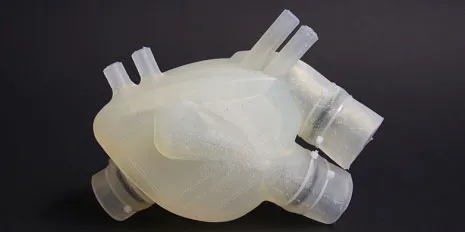
A team from the ETH university in Zurich has managed to create a soft silicone heart that pumps in a way similar to its organic counterpart. This could one day lead to a working replacement to this most vital organ.
The heart is an incredibly complex muscle. With its numerous chambers, pumps and valves, it is notoriously difficult to engineer an alternative. And that’s before you take into consideration the way that the human body rejects materials placed into it.
One material that has proven to be accepted by bodies, that can also be 3D printed, is silicone. With advancements in 3D printing, it has become easier to print soft shapes, an essential thing when thinking about replacing organs.
Feel the beat
Nicholas Cohrs, a doctoral student at ETH created the heart using an organic heart as a template, adding an extra chamber where the central wall of the heart would usually be that can be filled with air, in order to ‘pump’ the heart. To see the ‘heart’ in action, check out the video from ETH below:
There are currently blood pumps that exist that can stand in while a patient is waiting for a donor heart to arrive, but the artificial nature of the pumping mechanism means the patient lacks a physiological pulse which: “is assumed to have some consequences for the patient”.
Being able to create a functional artificial heart would be revolutionary. According to ETH: “about 26 million people worldwide suffer from heart failure while there is a shortage of donor hearts.”
This heart is definitely a step in the right direction, but is still a long way off being a working model. Under test conditions, the heart was only able to maintain 80 BPM (beats per minute, a slightly elevated average heart rate) for 3,000 pumps. This would mean at present, the heart would only last between half an hour to three quarters of an hour.
Repetition is one of the greatest demands on the heart, if you factor 80 BPM as an average, by the age of 80 your heart will have performed over 3 billion beats. Creating a pump that has the structural integrity that it can perform this many pumps without needing continuous maintenance is going to be a big hurdle.
- Want to read more about 3D printed organs? Check out our piece: 3D printed organ tech just took a giant leap forward
Via ETH
