





“What on earth do you see in the best turntables and vinyl?!” is a question I’ve been asked too many times to count. It’s the feel of the record in your fingers, the act of dropping the stylus.
There’s something a little pretentious about it, of course, but it's the antithesis to streaming and the ever-present proliferation of screens in our daily lives. And, as we all work to become more connected to the music we listen to both emotionally and physically, the return of record players makes perfect sense.
But which model should you be buying, and why? We’ve tested hundreds of turntables over the years so that we can find the model to suit your specific needs, whether that’s an all-in-one system or a beginner turntable to get you started on your vinyl journey. Our top pick right now is the Rega Planar PL1. It’s perfect for beginners and seasoned listeners alike, with great sound and loads of customization features.

I’ve been the Audio Editor at Tom’s Guide, where I oversaw the site's audio content and reviewed hundreds of devices that make your life sound better. Now I’ve taken that expertise to the Buying Guide team, where I focus on helping buyers find the best audio gear for their money. Turntables and vinyl records are a passion of mine, as I spin my favorite black discs on my HiFi system — and annoy the neighbours by cranking them far too loud.
Best turntables of 2026
Why you can trust TechRadar We spend hours testing every product or service we review, so you can be sure you're buying the best. Find out more about how we test.
Best overall turntable


Look, there’s no denying that the Rega PL1 is on the slightly older side compared to what’s been released recently. It’s a 2021 model, and there have been some excellent models released since then. But the PL1 has proved its staying power with a great price and an extensive range of features that should make a tinkerer's ears prick up. Oh, and it happens to sound really, really good. Which is kind of important.
There are more expensive and more impressive decks in the Planar range, but the PL1 offers incredible value for money. Whilst it looks simple and the finishes lack the “pizazz” of some of the competition, Rega has focused on the important bits; top-notch engineering in the pursuit of the best sound possible. And at the end of the day, that’s far more important than glossy paint and fancy-looking feet.
A combination of Rega’s home-grown Carbon cartridge and RB110 tonearm and a range of other technologies that have been brought from more expensive models means you’ve a turntable that sounds triple the cost of the PL1. There’s even a cryogenically frozen belt drive that goes through a lengthy process to ensure it’s as perfectly round as possible. That’s cool.
And it sounds sublime, as you might expect. The soundstage is light and airy, with our reviewer calling it “well-defined and easy to understand” in their five-star review. Bass is “robust,” treble is “detailed,” and the sound is “smooth and convincing.” There’s a tendency to focus on warmer sounds, but that’s hardly a critique in the long run, even considering the price. The value here simply cannot be overstated — and that’s why it's our pick for the best turntable.
Read more about the Rega Planar PL1
Setting up the Rega PL1
As with most turntables, there’s some setup required with the Planar PL1. You’ll be putting the belt onto the spindle pulley, and you’ll need to move that belt when you want to change from 33 to 45 rpm. You’ll be balancing the tonearm and putting the platter onto the spindle. You’ll also need to put the dust cover on and make sure it's properly in place.
Does the PL1 need a phono pre-amp?
The standard model of the PL1 will need a pre-amp, as there isn’t one in the box or built into the turntable itself. You’ll have to buy one of the best pre-amps separately. You can buy a version with a built-in pre-amp, the Rega Planar 1 Plus, though the pre-amp can’t be turned off. For our money, you’d be better off buying the standard model and getting a separate unit so that you can upgrade in the future should you want even better sound.
Can I upgrade the Rega PL1?
Yes, you can — almost everything is replaceable in some way or another. If you want a better cartridge, you can replace the Carbon model at the end of the tonearm. Similarly, you could use a different platter, perhaps one made of acrylic or glass. You can even replace the feet, should you want some extra vibration dampening. You can Ship of Theseus your Planar PL1 to your heart's content.
What other devices will my PL1 need?
This turntable doesn’t come with an amplifier or speakers, and there is no Bluetooth connection on board to connect to a wireless speaker. You’ll need either an amplifier and speakers or powered speakers to use the turntable.
- Read the full Rega Planar PL1 review
Best budget turntable


Sony has been in the turntable game for a long time, and its current lineup are as smart-looking as they are forward facing. The entry-level model, the PS-LX310BT, offers a whole range of cool features for a price that undercuts just about everything else. There’s Bluetooth on board, for example, so you can wirelessly listen to your vinyl.
Even better for beginners is the totally automatic operation. Instead of raising the tone arm and lowering it over the record with a cueing lever, the Sony does everything for you. Press play, and the tonearm moves over the record and lowers it into place. Press stop and the tonearm moves back to its rest position, and stops the platter spinning. It’s all very hands off.
Sound quality is energetic and fairly precise, with our reviewer noting that it “reveals the singer’s vocal range and zest well,” with more elements than if you were to head to Spotify. There are better-sounding turntables, but those cost more — and that’s to be expected. For the price, the Sony sounds very solid indeed.
The Bluetooth connection is a nice extra, but it’s not going to do the sound any favors. It has a habit of clipping, we found, something we’ve not experienced with other more expensive Bluetooth speakers. Still, it's a nice way to get listening without spending extra money on some speakers and an amplifier. The PS-X310BT is a fantastic turntable for the price, and our pick for the best budget turntable.
Read more about the Sony PS-LX310BT
Setting up the Sony PS-LX310BT
This turntable is one of the simplest on the list to set up, mostly because it’s got fewer user-changeable parts. You do have to put in some work, however. You have to fit the belt, drop the platter onto the spindle, and attach the dust cover. You also won’t have to adjust anything once it's all set up either, because it has handily got electronic speed control.
Does the Sony PS-LX310BT need a phono pre-amp?
No, the turntable does not need a phono pre-amp; you can just plug it into an amplifier and use the “line out” setting. You can use your own phono pre-amp too, if you attach one with the RCA connector and then turn it to the “phono” setting. This is a nice way to make sure you can keep using the turntable. Don’t forget the Bluetooth function as well, which lets you play your records with a Bluetooth speaker.
Can I upgrade the Sony PS-LX310BT?
There’s not much here you can upgrade, apart from the stylus. The cartridge is built into the tonearm, the counterweight is permanently pre-adjusted and the platter is specific to this model. Thankfully, you can swap the pre-amp for a more high-quality model if you’d like. Otherwise, this is a set-and-forget turntable that’s great if you don’t want any extra fiddling.
What other devices will my PS-LX310BT need?
There’s very little your turntable will need — a pair of speakers with Bluetooth or even one of the best Bluetooth speakers will suffice. You’re going to get much better sound using a separate HiFi system plugged in with RCA connectors, of course, and note there’s no way to plug your headphones in without some form of adapter. I wouldn’t do this anyway, as there’s no volume control on the turntable.
- Read the full Sony PS-LX310BT review
Best sounding turntable


Just have a gander at this sonic monster. The Technics SL-1300G is an absolute stunner of a deck, featuring some of the best hardware that money can buy. That does come with a price-based caveat: This is not for the faint of wallet, with a price tag that tickles the toes of a £3,000 purchase. That’s a price worth paying if you’ve got it, and you can justify it. You’ll want some very special gear to pair it with.
We say that because it’s actually quite picky about the kind of system you plug it into. Our reviewer said that “the top end here is provokable — inserted into a system that’s similarly uninhibited where treble sounds are concerned, it’s possible that high frequencies could become a little edgy or strident.” So you’re going to need to be very careful what components you share with it; no treble-happy speakers for you, potential Technics buyer.
Thankfully, the rest of the sound is almost faultless. There’s energetic and dynamic bass, hitting hard at the bottom of the frequency range. It demonstrates control and never feels overstressed — this is an audio experience that sounds as good as it costs. We didn’t find any real problems to complain about throughout the entirety of our testing.
Of course, if you’re spending this much, you’ll want it to look and work well, too. And boy, does it look and feel the part. It feels like it's made out of granite, and weighs about as much. It looks very nice as well, with a retro style that never feels like it's trying too hard. Yes, it’s very expensive, but when it sounds this good, you’re unlikely to care.
Read more about the Technics SL-1300G
Setting up the Technics SL-1300G
You’re going to need to do some work when your SL-1300G arrives in the post. There’s no belt because it’s direct drive, but you will find that you need to place the platter and adjust the tonearm suitably. Once you’re all done, though, you won’t have to worry about changing belts or adjusting tonearms — it’s an automatic turntable that does all the hard work for you.
Does the Technics SL-1300G need a phono pre-amp?
Yes, the SL-1300G does not have a built-in pre-amp, which means you need to add a separate one if you want to listen to your records. You’ll want something more premium for this model that really makes the most of the incredible signal that your turntable is providing. You can also use pre-amps built into some HiFi amplifiers.
Can I upgrade the Technics SL-1300G?
There are some key upgrade points in the SL-1300G for even better performance. You can buy a new cartridge, for example, to up the sound quality further, and you can get attachments for the feet. The main tonearm assembly cannot be removed, however, so you’re stuck with the (excellent) model that comes in the box. You can choose a premium pre-amp as well.
What other devices will my Technics SL-1300G need?
First things first — a HiFi system. Then you’ll need to be careful pairing your turntable with the components that live in your system. Thanks to its treble-forward presentation, you’ll want speakers that don’t bring similarly exacting high-end sound. You’ll also want an amplifier that complements this sound profile. Don’t forget that crucial phono pre-amp as well.
- Read the full Technics SL-1300G review
Best system in a box


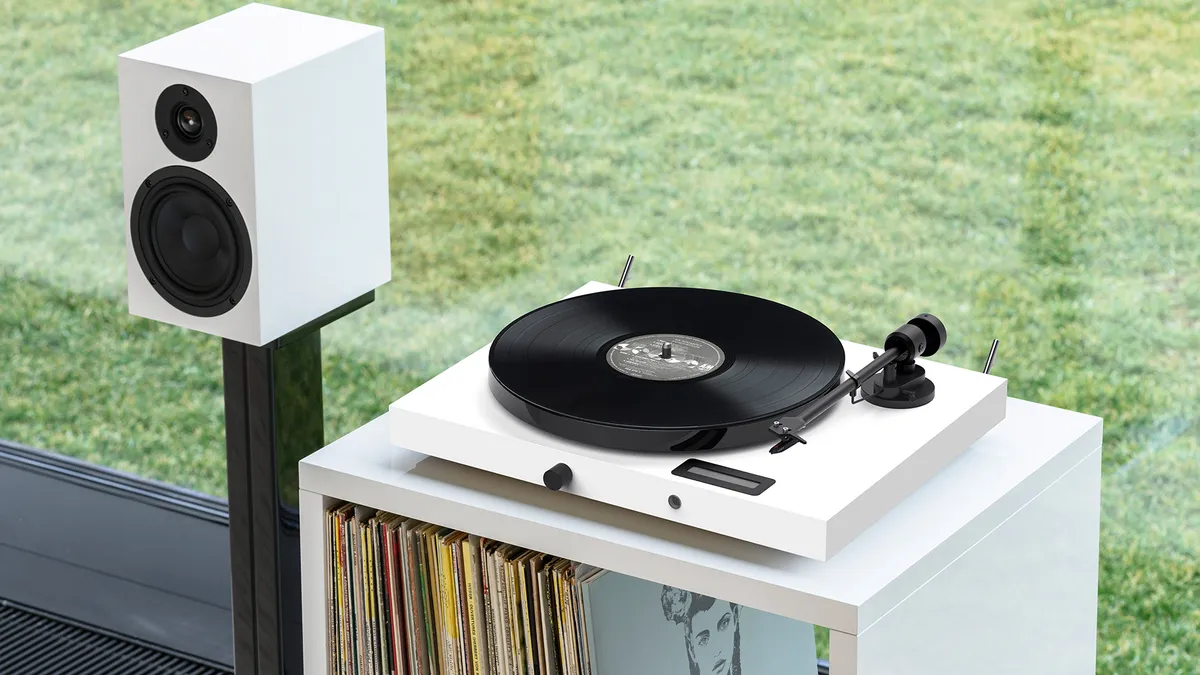
Don’t want to worry about finding an entire system, working out what component pairs best with what? Worry not — veteran turntable makers Pro-Ject sell everything all in one box so that you don’t have to worry about any of that. The Juke Box E1 is a masterstroke of turntable design, packing a fairly powerful amplifier into one of Pro-Ject’s excellent turntables. Even better, you can buy the whole thing in a bundle straight from Pro-Ject.
Why don’t we recommend one of those all-in-one units like you’ll find from… certain brands? They’re inherently flawed — introduce bass to a turntable chassis with speakers, and you’ll soon find too many vibrations. That generally means the speakers sound bad, and, as a result, so does your vinyl. Queue sadness and pain, and an itching feeling that things could be better.
The package deal you get with Pro-Ject’s Juke Box E1 nets you a very solid turntable that sounds great already, and pairs it with the Speaker Box 5E. There’s a built-in Bluetooth receiver as well, so you can even listen to tunes wirelessly. It really does do just about everything. It won’t clean your dishes, though. Believe me, I’ve asked.
The turntable sounds great and offers some great features alongside the amplifier. The speed control is electronic, so you don’t have to keep swapping the belt on the pulley. If you want to get something that just works out of the box and love the idea of HiFi but not the extra work you might have to put in, this is a great option.
Read more about the Pro-Ject Juke Box E1
Setting up the Pro-Ject Juke Box E1
There’s actually a fair amount of work that you’re going to need to do to get everything working here, although thanks to electronic speed control you’ll only need to do it once. First, you’ll need to attach the drive belt, balance the tone arm, and attach the anti-skate weight. Then you need to put the platter on. That’s the turntable done. Now you need to fix the speaker cables into the binding posts on the back of the turntable and the speakers. This all comes in the box, so you don’t have to add anything.
Does the Pro-Ject Juke Box E1 need a phono pre-amp?
The Juke Box E1 has a pre-amp built into the amplifier section that cannot be bypassed if you want to use the speakers in the box. Because it's an all-in-one unit, the only flexibility here is the speakers that you can plug in. You can use a separate pre-amp if you tire of the amplification quality, although then you’re missing out on the main draw of the turntable. If you want to use a different pre-amp, save some money and buy the standard Pro-Ject E1, which lacks the amplifier.
Can I upgrade the Pro-Ject Juke Box E1?
You can upgrade certain parts of the Juke Box E1. You can swap the platter out for one made of a different material, for example, and change the cartridge and stylus. You can also use different speakers if you want another boost in sound quality. You can even skip out the amplifier portion of the amp and go straight into a separate unit further down the line, which is always a nice extra.
What other devices will my Pro-Ject Juke Box E1 need?
Nothing! Everything you need comes included in the box, including an amplifier, speakers, and even a Bluetooth receiver. There’s even an input in the back if you want to attach a separate music streamer, or something like a CD player. Otherwise, though, you won’t need to pick anything else up to use the turntable.
- Read the full Pro-Ject Juke Box E1 review
Your turntable questions: Answered

Not sure what you should be looking for in a turntable? Working out a budget? Wondering what an amplifier is, or why you shouldn’t buy a turntable with built-in speakers? I'm going to answer your questions below and give you a better picture of what you should be looking for when shopping for a new turntable.
What’s a stylus, and why does it need replacing?
The stylus is the bit that actually makes contact with the record, reading the grooves and sending them down the arm to be amplified into sweet, sweet music. As the stylus (sometimes wrongly called a needle — but we won’t tell) is dragged through grooves, it is worn out over time. That causes your turntable to not sound as good as it does with a fresh stylus — so you’ll need to buy a new one.
Make sure you match your stylus to the cartridge. If you’re not sure what you need to buy, take a quick snap of your cartridge, or bring the old stylus to your local HiFi shop to find out.
Should I upgrade my turntable?
If you’re happy out of the box, there’s no need to! You’re better off buying a new amplifier or new speakers if you’re not pleased with the overall sound of your system. If you’re looking for more subtle changes, then you can look at fitting a new cartridge, or replacing your tonearm amongst other things. It can give new life to an old turntable, or change the sound just enough so that you’ve got your dream listening experience.

Should I upgrade my turntable?
This entirely depends on where you see your vinyl obsession going in the future. If you want something that’s plug-and-play, look for something that has a built-in model. That leaves you with little to worry about when getting set up, and fewer things that you have to spend money on.
If you want some personalisation in the future, think about a model that either has a built-in pre-amp that can be turned off, or no pre-amp at all. That leaves you with a better upgrade path down the line, so you can up your sound game as you save up more moolah. If you’ve not spent it all on new vinyl.
How much should you spend on your first turntable?
This is a slightly tricky question, and it will slightly depend on what you’re looking for. If you’re looking for something you’re going to use forever, the world is your oyster. There are great options for beginners out there at a range of different prices.
If you’re not sure if vinyl is for you yet, I’d say budget about £100 - £200. If you buy a bad one from the off, then you might never understand why people rant and rave about it. Equally, you don’t want to spend loads of money on something that’s not going to last very long if you decide you don’t like the format after all.

How much should you spend on your first turntable?
Suitcase players. Straight in the bin. Those built in speakers are going to cause to many vibrations while listening, and they generall don’t sound very good. Some say that can cause record damage as well, although there’s very little (if any) evidence backing that statement up. Still, they’re best off not on your list.