Isn’t it funny that we take the flexible screen so for granted that we complain over a crease and lack of flatness? The screen folds to become half its size and unfolds to about the size of a mini-tablet, and we’re still not satisfied. I guess that’s what makes us — or maybe Samsung — human. You see, it wasn’t satisfied, either, at least with the already quite thin and pretty remarkable Samsung Galaxy Z Fold 7.
That 4.2mm thick device that features two displays and yet is somehow lighter than the Galaxy S26 Ultra was close to flat and did have a less noticeable crease at the bend, but apparently Samsung thought it could do better, which is how we got the Samsung Galaxy Z Fold 8 Ultra, unveiled at Galaxy Unpacked on July 22.
That’s right, it’s now an Ultra device, though that has more to do with the other new entry in the folding lineup: the 4:3 ratio Samsung Galaxy Z Fold 8. This new Galaxy Z Fold 8 Ultra is not, after all, a full-scale redesign and is, instead, a refinement that brings better cameras (an upgraded 200MP camera with an f-stop adjustment, a new 50MP ultra-wide that matches the Galaxy S26 Ultra), a new 5,000mAh silicon-carbon battery, an anti-reflective coating on the display, and, somehow, a thinner body.


The slimming
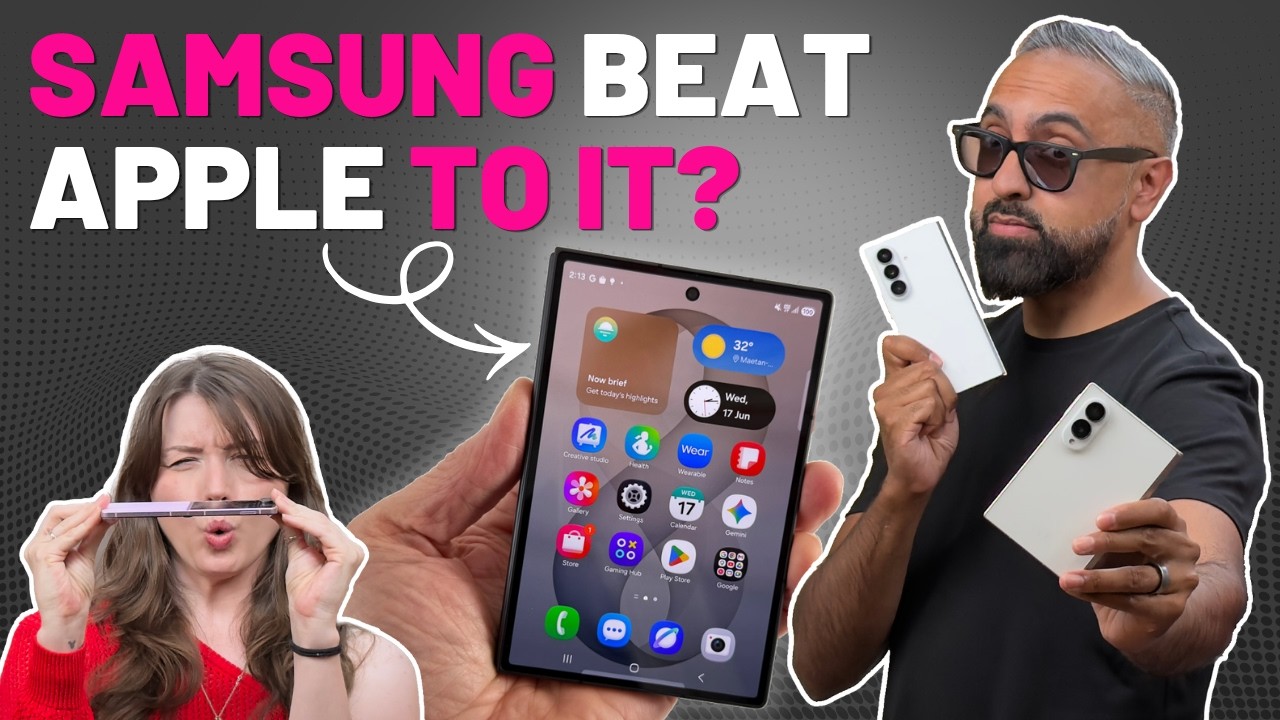
At 4.1mm, you might be hard-pressed to notice the difference between Samsung's two most recent foldable flagships, though I can tell you that the chassis is now so thin, it barely squeezes in a USB-C port.
What is noticeable, though, is that the Galaxy Z Fold 8 Ultra unfolds its 8.1-inch OLED display effectively flat, and the crease is all but gone. (The phone actually almost snaps to flat and is somewhat less adjustable between flat and folded modes.)
That’s due to the lightweight but also very strong titanium architecture behind that OLED panel. There has been a rigid titanium backplate behind the OLED panel since the Galaxy Z Fold 7, but the lattice work along the crease — in the center of the panel — has been totally redesigned from a seemingly infinite series of parallel holes to holes that start narrow on top but open up on the opposite side (it’s sort of an “A” shape). Stacked on top of that panel now is another far more flexible titanium alloy sheet (a mix of titanium and other metals like aluminum and chrome). It’s about as flexible as a sheet of paper (I touched it, I know) but with infinitely more strength.

The combination of these two panels, which are sandwiched and glued together along with the OLED panel, an ultra-thin glass pane, and a plastic screen protector, all work in concert to allow the panel to be both 30% easier to open (a new chamfered display frame edge also assists here) and more inclined to pop out flat. And that makes the crease almost invisible.
I know all this because I met with Samsung Electronics and Samsung Display engineers in South Korea who worked together to bring the Z Fold 8 Ultra to life.

Even though I sort of understood how these elements worked together to make a flatter whole, I couldn’t entirely figure out how the rigid back plane was flexible enough to make the folding and unfolding possible, but Byung Duk Yang, EVP at Core Component Technology Team, Samsung Electronics, put a finer point on it for me.
Sitting next to a specially designed flexible display blow-out diorama featuring all those aforementioned panels hanging inside like so many curtains, Yang explained, “You’re right. Titanium is basically not flexible. We use a titanium plate already, but there are micro-holes to get the stretchability — so that is basic titanium. But this time we used the new titanium alloy — we needed some stretchability. That’s why it is not 100% titanium; it’s titanium alloy.”
The switch to the titanium alloy, which replaced a thicker polymer layer, is key because, with titanium’s ability to better withstand long-term deformation, it’s less likely that the now mostly hidden crease will grow more prominent over time.
As I noted, people tend to, with these foldables, fixate on the crease, but Yang explained that in designing these panels, Samsung Display has many considerations. “The crease itself is not our only top priority. We have to consider durability and surface quality.”
Stress tests


I also traveled to Samsung’s Gumi Factory City in South Korea, where I witnessed the new Galaxy Z Fold 8 Ultra and its new sibling, the Galaxy Z Fold 8, undergo rigorous stress tests that included extreme heating and cooling, folding and unfolding tens of thousands of times, and ball-drop tests in which metal balls are repeatedly dropped on the screens from various heights.
From what I could tell, the Z Fold 8 and Z Fold 8 Ultra are quite resilient and, in the Z Fold 8 Ultras I saw, less reflective.
The new antireflective coating appears to do its part in helping the flexible display hide the crease. After all, less light is bouncing back to your eyes. And when I visited the Gumi testing lab, I saw how they used a special box with a dome of brilliant white light and a spectrometer to test display reflectivity. The light robotically moved around the Z Fold 8 Ultra panel to assess general reflectivity but also how the light might bounce off the crease. Results are gathered by a computer in a lab that runs 24 hours a day. We were, by the way, the first reporters ever to see it in person.


I’ve been pondering, though, what comes next for the Galaxy Z Fold lineup. Unless Samsung removes the USB-C port, it really can’t get any thinner. But the display could get at least one cool improvement; Samsung confirmed to me that they are thinking about how the Privacy Display on the Galaxy S26 Ultra might come to a future folding device. As you may recall, that privacy technology works at a pixel level to hide your screen from prying eyes, so it would require a very specific update to the flexible OLED panel.
In the meantime, though, consumers will have to consider this new Galaxy Z Fold 8 Ultra, perhaps the thinnest, flattest, and fullest expression of Samsung’s foldable ambitions.
Do you own a lot of Samsung devices? If so, why not test yourself to see how well you know the brand's products and services by taking the quiz below.

Follow TechRadar on Google News and add us as a preferred source to get our expert news, reviews, and opinion in your feeds. Make sure to click the Follow button!
And of course you can also follow TechRadar on TikTok for news, reviews, unboxings in video form, and get regular updates from us on WhatsApp too.