TechRadar Verdict
If you want to be beguiled by your music collection rather than impressed by its trouser-flapping potential, then this attractive player takes you right to the heart of the matter with an impressive overall performance standard
Pros
- +
Natural and engaging sound that brings analogue to the digital world
- +
Combines superb tonal rendering with excellent timing
Cons
- -
Lacks the power and three dimensionality of the competition
- -
It pays to give ancillaries careful consideration
Why you can trust TechRadar We spend hours testing every product or service we review, so you can be sure you're buying the best. Find out more about how we test.
The AMR CD-777 not only uses old school valves, it also employs a technology that became obsolete back in the nineties – genuine multi-bit DACs.
It's also AMR's most affordable disc spinner yet and comes from a brand that has quickly established itself as the most interesting new player on the hybrid electronics scene.
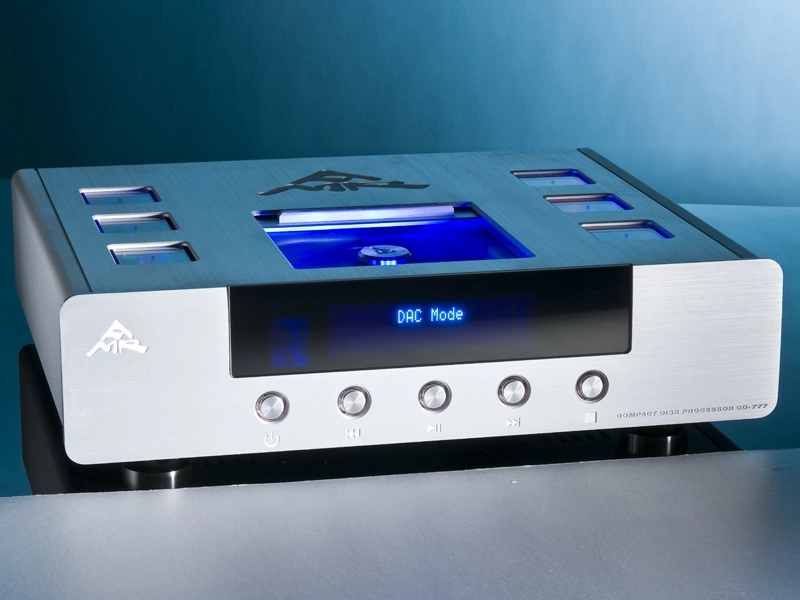
A spawn of the CD-77 it even looks very similar, if not more compact. For example, it has the same fabulous finish and top-loading transport and it earns its processor credentials thanks to USB and S/PDIF inputs for external digital sources.
The unusual suspects
AMR's decision to discard contemporary upsampling DACs and use NOS (new old stock) Philips multi-bit devices in their place is rather unusual. The CD-77 has a valve output stage built around NOS 6H1N-EV tubes and offers two variants of non-oversampled output among its array of processing options.
At the digital heart of the CD-777 is a Philips multi-bit chipset (UDA1305AT). That AMR refers to as 'Son of TDA1541A', its favourite converter. AMR also claim that it's never been used in a CD player before.
The CD-777 lets you choose from six Optisample filter settings with the remote control, the first two being non-oversampled purist settings called Digital Master I and II. The latter is the default filter and adds an analogue filter to balance the slight treble roll-off produced by the totally unfiltered Digital Master I setting. These settings are clearly AMR's favourites and you are encouraged to use them according to taste.
There are four over/upsampled filters offering 2x, 4x, 96Khz and 192Khz, but the manual suggests that all of these are a compromise that introduce one form of coloration or another to the result.
AMR has equipped the CD-777 with a USB input, as is the fashion in these days of PC audio, and it's keen to point out that this is not just something that's been tacked on at the last moment.
In its favour, I recall seeing such a socket on the CD-77 three years ago, so there may be something in OptiUSB as it's dubbed. OptiUSB's angle is that jitter is kept to a minimum by the associated circuitry, something that usefully also applies to the coaxial S/PDIF input.
Among the cherry-picked components inside the casework are hand-made transformers in the power supply and NOS valves called 6H1N-EV in the analogue stage. Even the transport is custom built, using a high-torque motor, Sony K-Series laser pick-up and a Philips CD-18 servo system.

The supplied remote is a touch screen variety of the old school, insofar as there is only one screen set. It seems to be reasonably sensitive, but the player itself is not very responsive, unless you make a point of aiming the handset. I also had a couple of occasions where the unit seemed to seize and required a reboot to get it going, it's clearly a lives a little closer to the edge than most.
The back panel is not too cluttered, the analogue outputs are on either side of the chassis and come in balanced and single-ended flavours. Slightly confusing is the red/white colour coding of the coaxial digital in/out sockets, these impersonate traditional analogue outputs well enough to fool the casual installer/reviewer!
Out of this world
By using aircraft-grade aluminium to build the CD-777 casework, AMR has produced a stunning piece of kit. It's enhanced by windows that let you see the electronics within (including the glow of the valves), while letting the heat out.
The player emits an orangey blue glow which gives it a slightly otherworldly appearance and this and the heat output does rather discourage leaving it powered up at all times.
The door that slides over the disc drive is manually operated and allows a change of disc without pressing stop. You'll need the puck of course, but it's not as if you're likely to forget it.
Tears of joy
This is one of the most natural-sounding digital sources I have heard in ages, it is tonally delightful and that's not something you often read about a CD player. You get so used to the dry and tight sound of digital sources that there's a tendency to assume it will always be that way, but this AMR shows things in a whole new light.

It could be the valves – in fact it almost certainly is – but I've had glass-powered players before and they've never sounded quite like this.
Usually there's an obvious softening of frequency extremes and an increase in tonal warmth and here there are bits of the latter – the midband is a little cosy but it's only apparent by comparison. On its own terms it's easy to accept the CD-777's presentation as realistic. Especially when an acoustic instrument comes along and reveals its timbre.
I've not known the cello on Antonio Forcione's Tears of Joy to be so real and woody before, nor Keith Jarrett's piano to have such depth. Up against the Leema Antila II, there is a loss of solidity and depth of image and the solid state player has a lower noise floor with greater bass definition.
But, there's no doubt that the AMR has a strong sense of timing, as well as the fact that tonal beauty is just as appealing, if not more so, than image scale and depth. Audiophiles traditionally crave deeper bass and more physical soundstaging, but these are not necessarily the qualities that make music alluring outside of the demo room.
Having read the spiel, I had to hear what the digital inputs could do and started with the coaxial S/PDIF. With a DVD-A player connected I achieved superb results, cleaner and more real than could be achieved with CD thanks to remarkable integrity of sound.
Plugging a laptop into the USB input yielded a positive, detailed result as well. Not one that could compete with the onboard Detail transport, but inspiring enough to look into ways of getting a better signal out of the PC.
Hearts and minds
Like the Rega Isis, this is a CD player for the heart more than the head, it isn't as bone crunching nor spatially capable as its rivals, but it does get to the parts that other players so often miss.
The combination of superb tonal rendering with fine timing allows music to float free of the mechanics of reproduction. You need to be reasonably careful with ancillary amplification, speakers and even cables – van den Hul's carbon interconnects are just too soft for instance.
But give it a revealing window to play through and you will forget about the hi-fi and be carried away by the artistry and emotions of the musicians on the disc. That is what living is all about, don't let anyone tell you otherwise.
Follow TechRadar Reviews on Twitter: http://twitter.com/techradarreview