TechRadar Verdict
At its best, when used with a sympathetically chosen partner, the Atilla has an unusual poise and exceptional subtlety and definition. It has more than enough power and grunt to cope with just about anything musical
Pros
- +
Delicate, articulate and refined-sounding
- +
Distinctive voicing
- +
Very comfortable to listen to over a long period of time
Cons
- -
Some issues arose over system synergy
- -
The matching Gryphon CD player may well be its best partner
Why you can trust TechRadar We spend hours testing every product or service we review, so you can be sure you're buying the best. Find out more about how we test.
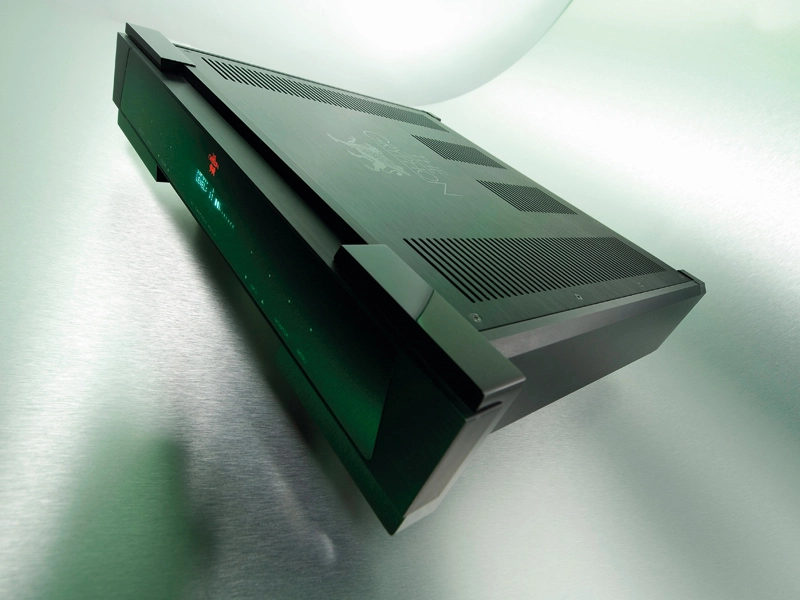
Cheap it isn't? Gryphon's Atilla costs practically £7,000, for what at first sight looks like a modestly equipped 100-watt integrated amplifier.
And this is the entry-level model, which is a long, long way from the top of the company's range.

When under power, the front panel shows the volume level and input status. The amplifier is configured internally as a dual mono amplifier, based around two high-current independent transformers from the prestigious Holmgren stable.
The independence of the two channels internally is intended to minimise crosstalk and the product information supplied, makes the claim that the Atilla is a no feedback amplifier, though the usual point should be made that there is almost no such thing as a true feedback-free amplifier.
That form of words usually serves to describe an amplifier with no global, overall feedback, even where local feedback around individual gain stages is used.
The Atilla was designed lock, stock and barrel in its Danish home and it has many powerful qualities. The operating firmware is upgradable, as and when the manufacturer gets around to adding new features, but the feature set already includes a programmable start-up volume level and a maximum level.
The amplifier can also be configured to provide a fixed-level output, bypassing the volume control, so that this function is supplied externally. This is for those who have a multichannel amplifier or processor and are are not willing to accept the usual compromises.
We recently heard some of Gryphon's equipment on a visit to The Audio Salon in Glasgow and were surprised by how musical this relatively unfamiliar brand proved to be – not as individual products, which there wasn't the time to explore, but as complete working systems.
In the context of a review like this, which involves a single component mixed and matched with 'foreign' equipment we had to hand, there was no opportunity to explore this element of Atilla's makeup, though at the time, we were surprised and impressed by what we heard as a very strong impression of system synergy.
In fact, we were able to test the Atilla with another Gryphon component, namely the Mikado CD player, but this is a much more costly product, almost twice as expensive as the Atilla and not really intended as a cost effective partner for this amplifier.
However a lower cost CD player is apparently in the works, so there may be an opportunity to try out this entry-level Gryphon pairing at some point in the future.
So for test purposes, the Atilla was used with the Mikado and also with some other players, including an EMM Labs XDS1 SACD player. We also had access to a Denon DCD-SA1 SACD player and various speakers, though much of the work involved Mordant-Short's Performance 6LE.
The amplifier and speakers give every indication of being a completely natural match, they speak with one voice and ditto the Mikado CD player when used with the Atilla, notwithstanding the large price disparity.
Sound quality
There was no suggestion that the other disc players were in any way lacking in system synergy when used with the Atilla, at least not directly, but nevertheless, we can only report that there is something not quite convincing about the combination, which didn't quite live up to what we had experienced back in Glasgow on three different systems.
If we were asked to name the factor responsible, it would be difficult to put a finger on what it is, but somehow the two Gryphon components do have a remarkable similarity in their responses to musical stimulae, which the Atilla doesn't quite live up to when the Denon DSD-A1 and (particularly) the EMM Labs player are used as signal sources, even though the disc players, the EMM Labs especially, clearly outperforms the Mikado in most respects when used in their best case form, as SACD players.
The Atilla has a distinctive quality of its own, but in the context of this test we were unable to completely nail down its character.
The evident synergy of the two Gryphon components tends to reinforce this suggestion. This is nevertheless, a first-rate amplifier.
Without suggesting it is as muscular as some similarly rated amplifiers, it has more than enough grunt and authority to cope with just about anything during the test period. But the Atilla is far from being defined by its power output. It just doesn't lay it on with a trowel.

It also has lightning reflexes plus a treble, which is not quite silky in the valve amplifier sense, but is clearly articulated and very finely detailed. It makes the amplifier very comfortable to listen to, even for extended periods.
The Atilla is a very special amplifier, that works well with a wide gamut of recordings, and which preserves what is so special about particular recordings. It does have voicing, which is slightly unusual and suggests that care should be taken when choosing a partnering source component.
This makes the Atilla harder than usual to sum up, but at the end we're convinced this is one of the very finest integrated amplifiers available.
Follow TechRadar Reviews on Twitter: http://twitter.com/techradarreview