





The best architecture software and CAD tools are designed to help engineers, designers and architects create digital 2D drawings and 3D models. The financial and technological barrier of entry has gone down a lot since the early days, and now, anyone, with a modicum of skill, can get in on the action.
With that in mind, I’ve compiled a list of apps that are capable or giving you the control you need over the creation of your digital world, that bring forth a feature-rich intuitive interface.
Pros will very much be aware of Autodesk and its vast high-end CAD portfolio, with AutoCAD being the top choice. It boasts everything you'll need for almost every architectural design you'll ever create. If that seems like too much, then it's worth checking out Chief Architect Home Designer Suite, which is well-suited to indoor and outdoor projects, and full of customisable options across the board.
Just like in our round-ups of the best interior design software and the best landscape design software, we've compared all the features on offer, the overall design process, and looked how each app suits its audience, whether you need BIM tools for professionals, or a simple app for architectural inspiration.
Best architecture software overall

Through the inclusion of specific building design and architecture toolkits, Autodesk had tailored AutoCAD to be the staple of construction engineers and architects, leading to it being one of the best architecture software tools professional architects can get.
Through the use of AutoCAD, architecture professionals can expect greater efficiencies. The program speeds up the design process with the addition of automated object generation and pre-built objects. This lets you quickly place walls, doors and windows. Further, you’ll find mechanisms for creating elevations, sections, and plans from model geometry.
So ubiquitous is this application, that many other architectural programs on this list are compatible with standard AutoCAD files. There’s a major caveat to this software though, aside from its steep financial barrier to entry ($260 monthly, or $2095 per year): AutoCAD is most commonly used as a 2D architecture tool, even as many in the building design trade are shifting towards true BIM applications. For BIM-oriented customers, Autodesk offers Revit instead
Best architecture software for homes
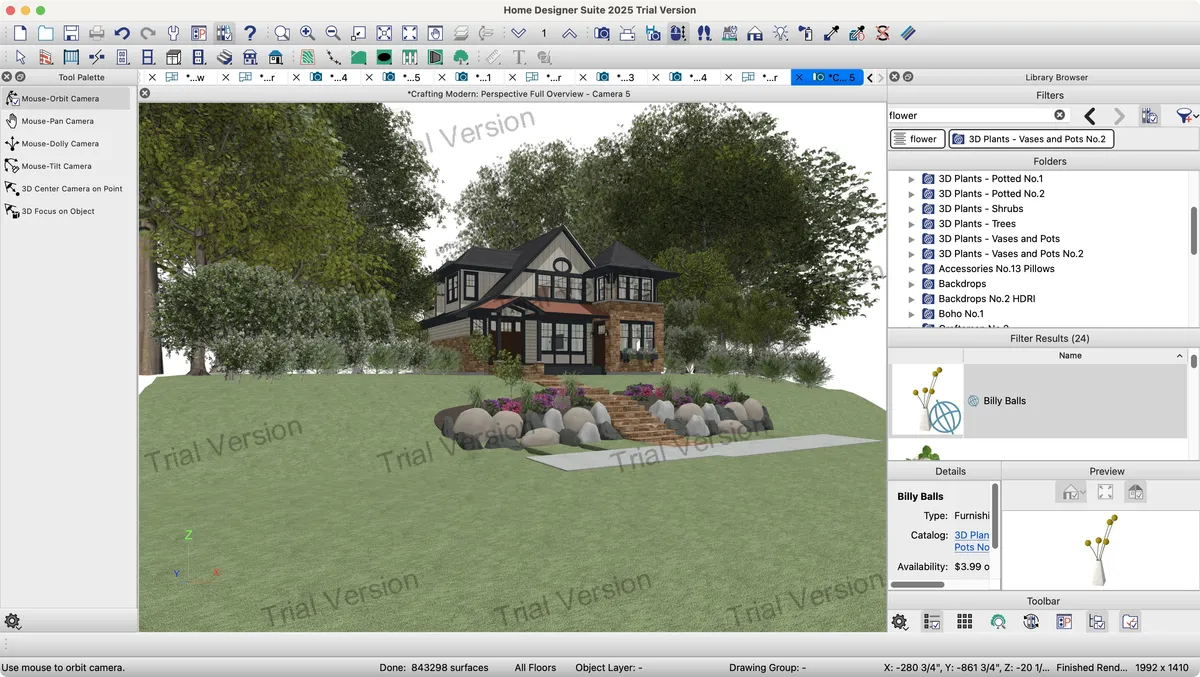


Contrary to AutoCAD, Chief Architect Home Designer Suite is specifically designed to help you create interior and exterior spaces, from rooms and offices, to buildings and landscapes. I found the software to be relatively easy to use.
We found beginners may be daunted at first , but this software is impressively feature-rich, and thanks to an intuitive interface and a selection of tutorials, it becomes very straightforward. You'll be building up 2D and 3D plans in no time. You’ll find that most of the tools you need to create and design are present and correct, whether you’re an architect, or a keen amateur.
In terms of design, your options are vast. I had no trouble designing and customising homes and landscaping with professional-level precision - from fittings to furnishings, and everything in between. One of the stand-out features here is the option to track the materials you use during digital construction. This is a great way to see what you'll need once it’s time to turn the design into a reality.
There's a free trial available for either Mac or Windows, giving you a good idea how the design process works, and if you do buy, you have a choice of either a subscription and a perpetual licence.
Read our full Chief Architect Home Designer Suite 2025 review
Best architecture software for CAD beginners

If you like the idea of being able to create anything large or small, then you’ll likely love SketchUp. It’s about as easy as CAD can get, which also makes it a great entry point if you’re new to 3D modelling.
After a few simple tutorials, designers should be able to work rapidly to construct complex solid geometry with it. It might not be suitable for designing a building entirely, but it’s an excellent tool for rapidly prototyping a design while it’s still at a conceptual stage.
But what really makes SketchUp stand out, is the offer of genuinely free 3D architecture software. It’s limited of course, and with that in mind, is more targeted at casual users for personal projects, but it also offers professionals a feel for the product before committing to a commercial license. If that isn’t enough, there’s also a 7-day free trial of the full product, before having to start paying for a subscription, which ranges from $10.75 to $68.25 per month and per user, billed annually (monthly costs are considerably more expensive).
The complete freedom when designing anything has made SketchUp one of the best architecture software tools, generating a large and active community of users on hand to help the inexperienced. That community spirit continues with an extensive user-generated object library; a vast resource of pre-constructed parts to drop into any project.
Read our full SketchUp review
Best architecture software for 3D modeling

3ds Max is another one of Autodesk’s offerings, and one of the best building design tools for 3D modelling, especially for architects looking to create photorealistic open spaces. Unfortunately, unlike AutoCAD, there's no Mac support for 3ds Max.
This creative tool was one of the first to offer hardware-accelerated rendering of 3D images. Today, its value lies in creating stunning visuals and fly-through animations, making it one of the best architectural rendering software programs to promote your project. On top of that, it’s packed with automation features to keep the design process on track.
Alongside the base 3ds Max subscription package ($255 a month, or $2,010 every year), you can choose between three ‘Industry Collections’ to match your use: 'Product Design’, ‘Media & Entertainment’, and ‘Architecture, Engineering and Construction’.
This last collection bundles top architect software like AutoCAD, Civil 3D, and Revit. It also has tools for structural analysis, steel detailing, building performance analysis, and even vehicle path calculations.
That level of control and capability means a steeper learning curve than other architecture software on the list. But once mastered, it’s the ideal software for architects crafting rich environments in 3D.
Best architecture software for civil engineering

Civil 3D - another top architecture program from Autodesk’s vast portfolio - goes beyond modelling and drawing CAD functionalities demanded by most architects and builders.
Giving the platform a civil engineering twist, Civil 3D lets you create 3D model-based designs and environments. If you work with BIM workflows, you’ll find the software also offers a streamlined, design-driven documentation pipeline to keep collaborative projects on course.
The civil engineering design tool is designed to work with other Autodesk products - particularly AutoCAD, Revit, and 3ds Max. This makes it one of the best architecture software programs for professionals devoted to the Autodesk ecosphere, but like all Autodesk software, it ain’t cheap: you can subscribe to it for $360 each month, or $2,870 annually.
One useful ability is the integration of survey images with terrain modelling, roads, service schematics, and constructional geometry. All these elements are placed into a single, highly annotated package. This allows engineers to focus on a specific location, while monitoring how design changes might impact other areas.
Best architecture software for precision modeling

CATIA started life as a tool for precision modelling military hardware. The particular set of tools makes it more than capable at handling complex architectural needs and generating finely detailed models.
Since its launch thirty years ago, the software has proved to be a bit of a trailblazer. While plenty of architecture software programs have added collaboration features and security-controlled distribution, CATIA had these tools from the beginning.
And it continues to move with the times, receiving performance-enhancing updates that expand on existing coordination features and embrace cloud functionality.
The program’s interface is pleasingly clean. If you’re broadly familiar with other software for architects, you should find CATIA easy enough to dive into, even if the learning curve is steeper than others (that’s the trade-off you need to accept for military-grade precision modelling).
If this hasn’t been clear up to now, be aware this fully featured architect software isn’t for everybody, and this is no more obvious than when checking out its pricing: none is listed. Instead, you’ll need to request a quote tailored to your needs and usage.
Best architecture software for BIM

Revit, another Autodesk design tool for architects, is the company’s BIM-oriented offering. If you like AutoCAD, but need Building Information Modelling capabilities, this is one of the best architect software programs available, and it comes at a hefty price: $380 a month or $3,005 a year.
It has industry utility beyond architecture alone. Structural and MEP engineers, and those in construction will also benefit from this 3D architectural software, which enables building design, modelling, including coordination and collaboration features when the team is working on the same scheme.
Designers using Revit work with objects, not a vector between two points. That means they can work quickly and with confidence. And, just like Autodesk’s Civil 3D, documentation can be streamlined to ease BIM workflows.
However, if you’re graduating from AutoCAD to Revit, you may find the transition a little overwhelming at first. But once you’ve scaled the steeper learning curve, this architecture software unlocks a serious competitive edge over traditional design applications.
Best architecture software for curved surfaces

Rhino is a powerful 3D rendering program for those modelling curved surfaces and softening a building’s image.
While most CAD programs are great at rectilineal architecture, Rhino was designed from the start to handle curved lines, meshes, and NURBS surfaces of high complexity, like those in the features of a human face or the sweeping curves of a super-car.
For architectural design, Rhino can easily model the complex intersections of curved roofing or any part of the structure that isn’t inherently straight.
As a platform, it isn’t a specialised tool. Instead, it uses add-ons, like the one for BIM functionality, and the Grasshopper visual programming system, to tailor the program for specific users and tasks. This makes Rhino a highly flexible tool that can be tweaked to automate complex modelling and detailing operations for those projects that need them.
There's a one-off cost to get Rhino - just under $1,000 for a single user, for either Mac or Windows - which is great if you don't want to pay a subscription, and don't mind the upfront cost. Licenses are permanent and don't expire, so the software is yours forever - like it used to be. Unusually for CAD architecture software, you aren’t forced to upgrade to the next release, and upgrades generally cost half that of a new license.
Best free architecture software
Architecture software is a specialised type of CAD (Computer Aided Design) software, and although you can certainly use any CAD software for your projects, specialised apps tailored for this specific task, such as Chief Architect’s portfolio (including the entry level version featured in this list), are a great starting point. Although considerably cheaper than others on this list, you still have to fork out some money to use them long term.
Thankfully, there are a few free programs out there, including the following two:
FreeCAD is an open-source, free architecture software and 3D modeller. It’s especially good for reverse engineering models to examine how changing parameters affects the whole design. While it's not as feature-rich as professional, paid-for programs, it’s a well-supported platform with complex features to explore. Best of all, it offers cross-platform support across Windows, Macs, and Linux.
Tinkercad is a free 3D design tool tailored to beginners. If you feel you’re not quite ready to tackle grand projects, this software will help you develop your skills. Treat it like a design sandbox until you’re ready to move on to more complex programs.
Best architecture software: FAQs
What is architecture software?
As its name implies, Architecture software is there to help you design buildings virtually. It’s a wide field, which caters for professional architects and enthusiastic amateurs alike, although the type of tools available and the cost will vary greatly depending on who the target audience actually is.
Features can include an automated list of needed materials to bring your concept to life, to being able to stress-test your designs, before unleashing your creation onto the real world.
Will the best architecture software run on my computer?
Like all high-end software, architecture programs can be seriously resource-hungry. Be aware that the system requirements you’ll see on the developer’s website, as minimum specs - they need to draw in as many customers as possible, right? In order to make the most of pro-level software, you need a decent CPU, a competent GPU, and as much RAM as you can afford.
You also need to find software that’s compatible with your OS, as many of them are only available for Windows.
How to choose the best architecture software for you
As is often the case, this is a question that will greatly depend on your needs, abilities, and circumstances. For instance, if you merely need software to sketch out ideas, one of the best drawing apps might be a better fit.
You could be tempted to select AutoCAD, one of the most renowned titles. And why not? It’s an amazing CAD tool for pros. But the steep learning curve may well put you off, not to mention the fact you’ll need a beefy computer to run it on, especially if you’re thinking of working from a laptop; our best laptops for AutoCAD may help you in that regard. If all of this feels too daunting, maybe focusing your attention on Chief Architect’s portfolio might be a better starting point. Their entry level product is much more affordable and easier to use, and once you’ve outgrown it, Chief Architect’s more high-end (and pricier) programs aren’t far away.
Not all software are alike: some may lack tools you need, such as BIM capabilities, and 3D modelling for instance. If your projects are versatile and often venture outside a building’s traditional four walls, keep an eye out for software that will also allow you to design landscapes. Our list of best 3D modeling software could offer you some useful pointers.
Then of course, there’s your wallet. Do you prefer to pay for software outright (like Chief Architect and Rhino), or are you comfortable renting programs through subscription (like Autodesk’s portfolio)? The initial investment for the former will be higher, but once it’s bought, it’s yours for as long as you need it (or until it’s time to upgrade). Subscription might look cheaper at first, but will drag you down over time, when you have to pay the piper month after month.
Finally, make sure you grab a free version or a time-limited trial to test the software out. As professional-grade architecture software, costs can be high, and we recommend checking the app's workflow matches yours and has the features you need.
How we test the best architecture software
We've extensively tested a range of design apps for professionals and consumers, including the best DTP software, best logo makers, and best free logo makers.
When testing the very best architecture software, we judge the tool on interface, performance, power, and available tools. Users rightly expect premium computer-aided design software to be powerful, feature-rich, and easy to use (if not easy to learn - comprehensive architecture software is naturally more complex).
There are different grades of architecture software, with professionals and consumer products to fit a range of needs. In reviewing CAD software for architects, we don’t expect all tools to mirror functionalities, but we test to see how well each one performs for its intended audience and its intended use.
Get in touch
- Want to find out about commercial or marketing opportunities? Click here
- Out of date info, errors, complaints or broken links? Give us a nudge
- Got a suggestion for a product or service provider? Message us directly
- You've reached the end of the page. Jump back up to the top ^
