





Welcome to our guide to the best phone gimbals you can buy right now – a regularly updated rundown of the finest stabilizers for shooting smooth, steady, and level content on your smartphone.
Our top pick remains the Hohem iSteady M7. This heavyweight champion delivers features that set it apart from the competition – most notably a removable touchscreen remote control that gives you unprecedented shooting flexibility. Its robust motors can wrangle larger, heavier smartphones that would overwhelm other stabilizers, while AI-assisted tracking keeps moving subjects locked in frame with impressive accuracy.
That said, the iSteady M7 won't suit every user: its premium price tag and non-folding design make it less practical for casual creators or those prioritizing portability.
Our ranked list below caters to diverse needs – you'll find outstanding budget options that punch well above their price point, gimbals with particularly smart capabilities like sophisticated tracking systems and wireless remote controls, plus our pick for the absolute best subject tracking performance.

Sam has been writing about consumer electronics for over 20 years, contributing to titles including Stuff, Wired, T3 and GQ while covering everything from vintage cameras to video games. He now specialises in photo and video gear, and has become well acquainted with the kind of products promising to turn amateur dabblers into professional content creators – of which mobile gimbals are a prime example.
The best phone gimbals
Why you can trust TechRadar We spend hours testing every product or service we review, so you can be sure you're buying the best. Find out more about how we test.
Below you'll find full write-ups for each of the best phone gimbals in our list. Each one has been tested extensively, so you can be sure that our recommendations can be trusted.
The best overall phone gimbal

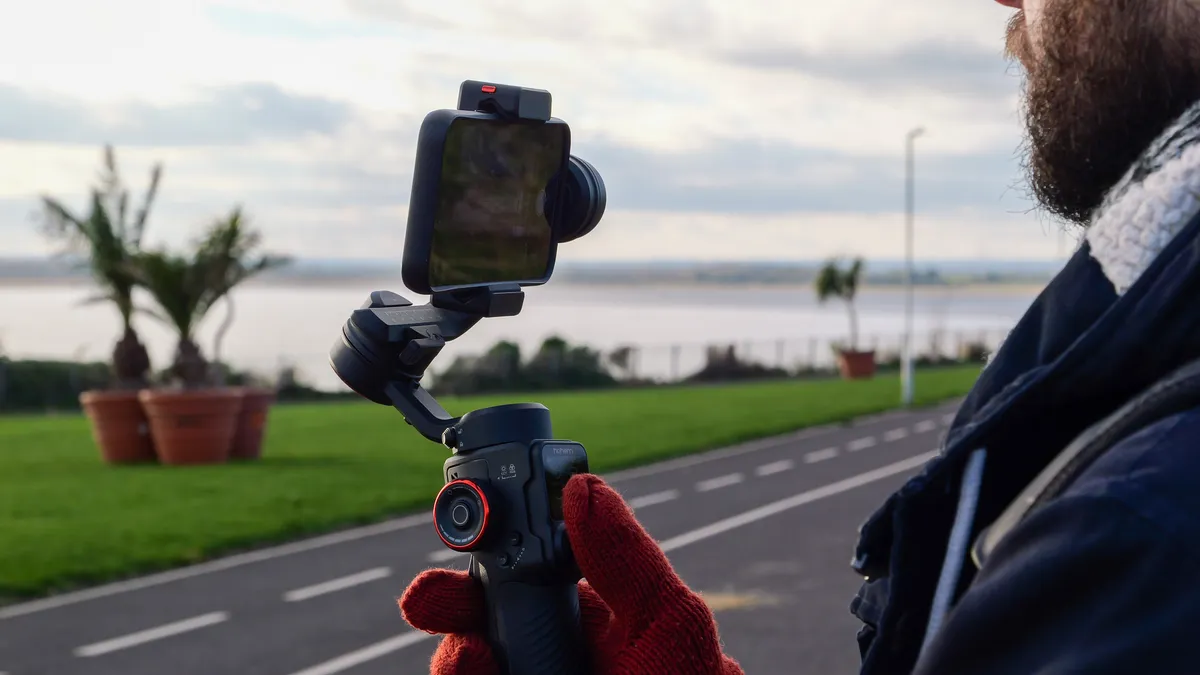


✅ You own a heavy, bulky smartphone: With its 500g weight capacity and ability to grip devices as thick as 12.5mm, this is the go-to stabilizer for anyone owning a large and heavy smartphone. Most rivals don’t come close to its payload limits.
✅ You want a highly flexible gimbal: Thanks to app-agnostic tracking, the built-in extension rod, the touchscreen remote control and its fully customizable pan, tilt and follow settings, the iSteady M7 is probably the most versatile smartphone stabilizer on the market.
❌ You need a compact, portable stabilizer: There are lots of smartphone stabilizers that fold down small enough to fit into a small bag or even a coat pocket. This is not one of them. While it’s not especially large or heavy, you’ll need at least a small backpack or similar to carry the iSteady M7.
❌ You’re on a tight budget: You can pick up effective, well-equipped stabilizers for half the asking price of the iSteady M7, so check if you need all of its features and payload capacity before shelling out your hard-earned cash.
In our opinion, the best overall phone gimbal available right now is the Hohem iSteady M7, which combines reliable, heavily customizable stabilization with advanced features and compatibility with bulkier handsets up to 500g in weight and 12.5mm in thickness. Most mobile gimbals can accommodate phones up to around 300g in weight and 10mm in thickness, making the iSteady M7 the go-to gimbal for anyone with a larger (or even a folding) handset, or a phone fitted with a bulky case or weighty modifications.
Accordingly, this is one of the more rugged, powerfully built gimbals mentioned in this buying guide, which means it can’t fold down to the same ultra-compact size as the likes of the Insta360 Flow 2 Pro or DJI OM 6. The iSteady M7 can be locked into a ‘flat’ position and placed inside the (included) zip-up hard case for storage and transportation, but you’ll still need a backpack or similar to carry it around; pocketable, it certainly isn’t.
With its comfortable grip, extensive control setup and effective, easy to grasp phone movement modes, the iSteady M7 excels at the basics of stabilization, and with almost every aspect of gimbal movement open to user customization it’s great for perfectionists. But it’s perhaps its more advanced features that make it stand out from the pack. A removable AI tracking module, for instance, supports full subject tracking when using any app, and doubles up as a powerful LED fill light with fully adjustable brightness and color settings.
Then there’s the secret weapon – a touchscreen control module that detaches from the handle to function as a remote with up to 10m range. This is something you won’t find on any other gimbal out there right now, and a truly impressive innovation on Hohem’s part.
Read our in-depth Hohem iSteady M7 review
The best cheap phone gimbal


✅ Your budget is tight: This is one of the cheapest usable phone gimbals we’ve come across but performs well for the price.
✅ You need a workhorse: With its tough carry case and hard plastic build, this feels like one of the sturdier low-price options available.
❌ You need something portable: The non-folding design of the Smart Stabilizer means it requires a fair bit of bag space. Pocketable it certainly is not.
❌ You own a larger phone: With a carrying capacity of just 210g, Joby’s gimbal and motor will struggle to properly stabilize heavier handsets.
Disclaimer: The Joby Smart Stabilizer is the only phone gimbal on this list that doesn't currently have an accompanying review live on TechRadar. We have, however, spent enough hands-on time with the product to know that it's a competent budget option.
Joby’s flexible GorillaPod mini tripod is a staple of many a vlogger, but the company’s phone gimbal isn’t quite so iconic: with its Micro USB port and bulky, non-folding design, the Smart Stabilizer feels very much behind the times compared to the other models here. It does come supplied with its own hard carry case, which is impressive considering the ultra-cheap price point but, while some of the other gimbals mentioned here will fit in a large pocket, this one requires something in the backpack or camera bag range.
Decked out in tough, hard-wearing plastic, the gimbal does look the part and performs well as a stabilizer, with the companion app offering some effective and smooth object tracking. However, do note that despite the Smart Stabilizer’s size and weight, the motor can only stabilize phones up to 210g – a fair bit lighter than the DJI, Insta360 and Zhiyun gimbals can manage. It all adds up to the feeling that Joby is lagging well behind the curve – even if the inclusion of a built-in extension rod may be useful to some. But we suppose that’s acceptable given the budget-friendly nature of this device – and, if you can find stock at third-party retailers, it is significantly cheaper than all of the other phone gimbals on this list.
The best phone gimbal for iPhone


✅ You need a remote control: The Osmo Mobile 8P addresses its predecessor's weakness by having a remote control.
✅ You're after a compact premium gimbal at a great price: Like the Mobile 8, the Mobile 8P's launch price is very affordable for the features it offers.
❌ You want immediate response in controls: WIth a lot of functions now controlled via a touchscreen, the Mobile 8P cna feel less rapidly responsive compared to the Mobile 8.
❌ You own a heavy phone: If your smartphone is heavier than 300g or is more than 11mm thick, the Osmo Mobile 8P won't be able to grip it.
The DJI Osmo Mobile 8P replaces the Mobile 8 as the best gimbal for subject tracking. It offers the same excellent abilities as its predecessor, with tracking through DJI's Mimo app that enables advanced features like group tracking and off-center positioning.
It also includes the second-generation Multifunctional Module, which uses its built-in camera to track people, dogs and cats with any app on both iPhone and Android. And there's compatibility with Apple DockKit for enabling tracking with masses of third-party iPhone apps.
And like the Mobile 8, the Mobile 8P can fold down to a compact size that can just about be pocketable; it will neatly fit into a bag. Yet it can still hold phones coming in at 300g and 11mm thick.
But it's over to reviewer Sam Kieldsen to extoll the biggest virtue of the Mobile 8P over its predecessor and former holder of this spot: "The headline addition is the Osmo FrameTap, a detachable remote that snaps magnetically onto the gimbal handle for close-up work and slides off for remote shooting (with a range of up to 25m). Its 1.4-inch touchscreen can mirror your phone's camera view — directly on Android, via the Mimo app on iOS — so you can frame shots, trigger tracking, and adjust the gimbal's pan and tilt without having to peer at your phone's screen. It's a feature that the Osmo Mobile 8 was crying out for."
So with that in mind the price of £195 / AU$329 is also compelling, just bear in mind if you're in the US a lack of availability means you'll have to go down the import route. But at this price that's arguably not terrible; in fact, the 8P is arguably the best value phone gimbal as well as excelling at subject tracking.
Read our in-depth DJI Osmo Mobile 8P review
The smartest phone stabilizer


✅ You like to shoot from a distance: Its tracking talent combined with the remote control unit make this a great gimbal for remote shooting.
✅ You own a heavier phone: The iSteady V3 Ultra can accommodate handsets up to 400g in weight – that's 100g heavier than DJI rivals.
❌ You want a quick-release clamp: Hohem eschews the magnet-based quick-release setups of its main rivals, which makes setup a little slower.
❌ You don't want to use an external mic: If you don't want unwanted gimbal motor noise in your videos, you'll need some kind of external microphone.
The Hohem iSteady V3 Ultra is the best smart smartphone stabilizer available, combining excellent AI-assisted tracking with a brilliant removable touchscreen remote control that makes shooting from a distance an absolute breeze. What sets this gimbal apart is how these two features work together to create something genuinely special for content creators.
The V3 Ultra's 360-degree handle motion means it can track subjects even if they circle completely around it multiple times. Crucially, it tracks not just human faces and bodies, but other objects too, and works with any camera app – whether that's your phone's native camera, Zoom, TikTok, or Instagram. I was particularly impressed by how I could manually adjust my position in the frame using the joystick, and the module would continue tracking while keeping me in that new position rather than just dead center, which is perfect for rule-of-thirds composition. The module also doubles as an adjustable fill light with cool, warm and neutral tones.
But the real game-changer is that removable 1.22-inch touchscreen remote control. With a wireless range up to 10m / 30ft, it lets you adjust gimbal angles, change settings and start/stop recording from a distance. The screen even provides a live view from the tracking module's camera, so you can set tracking subjects remotely. It's essentially a pocket-sized camera operator.
The compact folding design includes a sturdy built-in mini tripod and a concealed 20cm extension rod for extra reach. The major caveat is that gimbal motor noise gets picked up by your phone's mic, so you'll want an external microphone for clean audio.
Read our in-depth Hohem iSteady V3 Ultra review
The best gimbal camera


✅ You want something truly pocketable: It's much smaller and faster to deploy than a phone gimbal, thanks to its built-in camera.
✅ You shoot a lot of slow-mo: The Pocket 3 delivers 4K footage at 120fps. This is an impressive resolution, and enables footage to be slowed down by four times.
❌ You need all-day battery life: With only around 160 minutes of recording time on a full charge, the Osmo Pocket 3 doesn't last as long as a phone gimbal.
❌ You're on a tight budget: At almost £500, it costs far more than any phone gimbal. If your phone camera's already great, it's cheaper to pair it with a gimbal.
Taking a slightly different approach, the DJI Osmo Pocket 3 is a 4K video camera that comes with its own integrated gimbal. That makes it a fully self-contained setup and, as such, it's lighter, more compact, better balanced and much faster to deploy than a phone gimbal. It even comes with its own crisp 2-inch OLED display.
Image quality from the 1-inch sensor is excellent, and really elevates the Pocket line from an interesting gadget to something that serious vloggers and creators might use. The 4K footage looks superb, and supports frame rates all the way up to 120p for 4x slo-mo playback (or 8x slo-mo if you're willing to knock the resolution down to Full HD).
It comes with the same ActiveTrack 6.0 face-tracking technology as the Osmo Mobile 6, which works superbly for keeping yourself centred in the frame during vlog recordings or other to-camera pieces, and the stabilization is superb – as you'd expect from something that only has to balance a small lightweight camera unit rather than a whole smartphone.
On the down side, battery life is rather short (although recharge times are also fast) and overheating can be an issue. But the Osmo Pocket 3 makes an interesting all-in-one alternative to pairing your smartphone up with a gimbal.
Read our in-depth DJI Osmo Pocket 3 review
Also consider
We've reviewed a whole range of phone gimbals, including plenty that almost made it into this list. Here are the honorable mentions you may also want to consider.
Best affordable iPhone gimbal – Insta360 Flow Pro: Much like its successor, the Flow 2 Pro (see above), the original Insta360 Flow Pro leverages Apple DockKit compatibility, allowing it to track subjects using hundreds of iPhone camera apps. While now replaced as Insta360's top gimbal, it remains a good performer with great portability, a quick-deploy folding design, and effective stabilization. And it's now cheaper than ever.
How to choose the best phone gimbal

What are the best phone gimbal features?
All phone gimbals will hold and automatically stabilize a smartphone, allowing it to remain steady and level while the user is walking or panning. Most also support some form of subject tracking, whereby the gimbal arm will move the phone in order to follow the movements of a human subject.
Sometimes these tracking systems are software-based, relying on a particular app's algorithm to recognize and track a subject. Other gimbals can track using third-party apps, making them more flexible and versatile. Portability is also a key feature to consider: do you need your gimbal to fold up to a very small size for transport, or are you happy to carry it in a larger bag?
What’s the best phone gimbal for me?
Before buying a phone gimbal, it's important to consider your requirements. How big or heavy is your phone? Do you plan on lengthy days of shooting where good battery life will be key? Are you a solo vlogger who needs effective subject tracking built into the device?
For some, a budget phone gimbal like the Joby Smart Stabilizer is more than sufficient, while those who need to use subject tracking with all their favorite camera apps will value the Zhiyun Smooth 5S AI's hardware-based tracking module. For most people, though, we think the DJI Osmo Mobile 8P represents the best balance between price, performance, and usability.
How we test phone gimbals
☑️ 15 years of product testing
☑️ Over 16,000 products reviewed in total
☑️ Nearly 200,000 hours testing tech
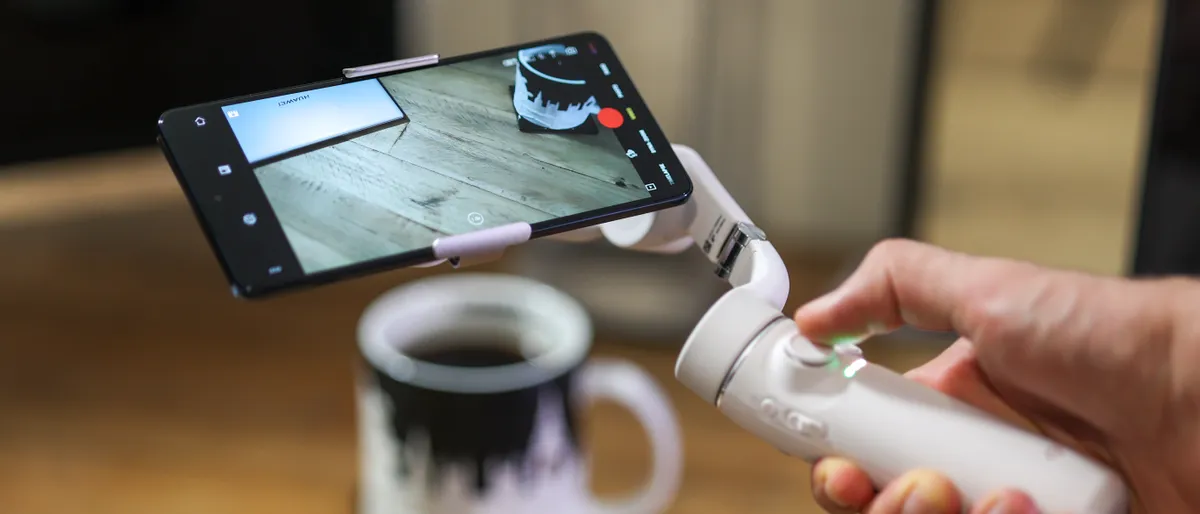
Firstly, it's helpful to nail down what a phone gimbal actually is: a handheld device that removes undesirable shake and wobble from videos captured on your smartphone. It does this by detecting unwanted movements using sensors and immediately counteracting them using motors.
For us, then, the main thing we look for during testing is how effectively the gimbal stabilizes: how quickly and accurately it responds to movement and how smoothly it counteracts it. A jerky gimbal is not much use to anyone.
We also look at the setup process: how easy it is to mount (and unmount) a smartphone on the gimbal, and how easy it is to pair the two devices up so that they work properly. Does the gimbal offer physical controls to ensure we don’t need to touch the phone, and how long does its battery last?
Then we look at any addition functions the gimbal may possess: the ability to track moving subjects, capture eye-catching trick shots, wide panoramic photos or long time-lapse sequences.