





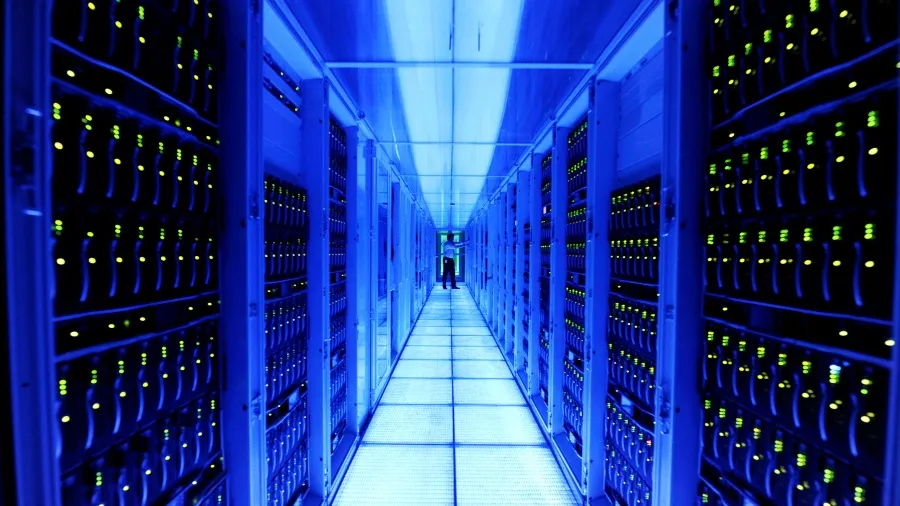
The global demand for technologies such as AI, high-performance computing (HPC) and cloud services is accelerating, and the efficiency of the cooling systems used in the data centers behind such technologies are becoming ever more important.
Today, data centers account for around 1.5% of worldwide electricity use: by 2030, technologies such as AI mean that the energy demands will double worldwide, according to the International Energy Agency.
Data centers can use as much as half of their total energy on their cooling systems, so the efficiency of such systems is becoming a vital consideration for any organizations using AI, HPC or cloud services.
Director for EMEA HPC/AI at Lenovo.
The conventional approach to cooling data centres is air cooling, with large fans inside data centres and inside devices. As power demands grow, air cooling is struggling to keep up with the demands of today’s data centers and tomorrow’s.
Liquid cooling, which uses warm water to cool components, is emerging as an important alternative, with key advantages in terms of efficiency and sustainability.
With AI workloads demanding ever higher energy densities, and sustainability moving to the forefront of infrastructure strategy, it’s key that data center leaders make informed choices about cooling. The following are the key advantages and disadvantages of the two approaches, considered across multiple factors.
Thermal efficiency
One of the key advantages of liquid cooling systems is in terms of efficiency, where water is able to deliver much higher efficiency air. Water is more than 3,000 times more efficient at removing heat than air, meaning that data center operators have to use less electricity to keep equipment and data centers cool.
Liquid cooling techniques such as direct-to-node cooling can remove up to 98% of heat from servers, and the warm water can also be reused to heat facilities such as buildings and even swimming pools. Overall, liquid cooling can reduce power consumption by up to 40%.
Sustainability
Liquid cooling and air cooling have advantages and disadvantages in terms of sustainability, although the technology of liquid cooling is evolving rapidly. Air cooling is highly energy-intensive, but conserves water.
Liquid cooling is more energy efficient, but older systems that run on evaporative cooling, where hot water is sprayed onto pads to be cooled, have to be replenished from external sources.
Warm water cooling systems curbs water loss, and newer systems can accept high inlet temperatures meaning less energy is wasted on chilling water.
Organizations are also moving from open-loop systems for heat management (where water is cooled through evaporation) to closed-loop systems (which remove heat through a closed-loop liquid-to-air heat exchanger) to make liquid cooling more efficient and more scalable.
Space density
Air-cooled systems require larger physical space to operate, with air cooled systems able to support up to roughly 70 kilowatts per rack, but there is a physical limit known as ‘specific heat capacity’ beyond which they cannot operate.
The GPUs that power AI platforms require up to 10 times more energy than traditional CPUs, holding a larger number of transistors: other design features such as 3D silicon stacking are allowing GPU manufacturers to pack more components into smaller footprints.
This increases the power density of data centers, which is pushing air cooling beyond the threshold at which it is viable. With data centers becoming more and more energy-dense, air limits scalability, meaning that less compute power can be put into the same amount of space.
Liquid cooling enables components to run faster, meaning that data centres can run more intense AI and HPC workloads, enabling higher compute density.
Future readiness
By the end of this decade, the energy demands of technologies such as AI will have driven an 160% rise in data center power demands, according to Goldman Sachs. This means that the greater efficiency of liquid cooling will become more and more important.
Measured in power usage effectiveness (PUE), the efficiency of data centers is the power required to run the whole data center, divided by the power requirements of the IT equipment.
Some liquid optimized data centers are already achieving PUE of 1.1 or even 1.04, and customers will also be able to use hot water to warm office buildings, which is becoming even easier with the latest systems. As demand for compute grows around the world, such efficiencies will become more and more important.
Reliability and maintenance
Air cooling systems have distinct disadvantages when it comes to reliability and maintenance: the fans used can mean that hardware is exposed to dust, and temperature is more likely to fluctuate in air-cooled data centers, both of which have implications in terms of maintenance.
Broadly speaking, liquid cooling systems require more expertise to maintain. But that is changing. Modern liquid cooling systems are serviceable and safe and are highly practical in a wide variety of environments.
The latest water-cooled systems can work in multiple configurations to make adoption easier, including hybrid systems using both air and water.
We've featured the best green web hosting.
This article was produced as part of TechRadarPro's Expert Insights channel where we feature the best and brightest minds in the technology industry today. The views expressed here are those of the author and are not necessarily those of TechRadarPro or Future plc. If you are interested in contributing find out more here: https://www.techradar.com/news/submit-your-story-to-techradar-pro
