





TechRadar Verdict
Crimson Desert manages to capture the essence of pure open-world exploration and delivers incredible combat that is unlike anything you've played previously, while offering an engaging story that keeps you engaged as you progress through its massive map. It's not perfect due to some of its quality of life issues and unfair boss encounters, but this is a game that deserves very high praise.
Pros
- +
Phenomenal combat
- +
Spectacular visuals, rivalling some of the best-looking games
- +
Open-world feels alive
- +
Fantastic set pieces
- +
Amazing motion-capture and soundtrack
- +
Exceptional native PC performance
Cons
- -
Some quality of life issues and bugs
- -
Inventory management is tedious
- -
Aggressive boss AI needs tuning
Why you can trust TechRadar We spend hours testing every product or service we review, so you can be sure you're buying the best. Find out more about how we test.
Crimson Desert is easily one of the best action-adventure games of this generation. Developer Pearl Abyss provides stylish, remarkable combat in an exceptional open-world experience with spectacular visuals that make it a must-play.
It provides little to no guidance, giving players total freedom to think outside the box in both exploration and combat encounters, utilizing unique mechanics to overcome puzzles, enemy ambushes, and the other obstacles that await you.
Platform reviewed: PC
Available on: PS5, Xbox Series X|S, PC
Release date: March 19, 2026
Despite initial fears of a 'catch', Crimson Desert ticks all the important boxes for a game that will keep you coming back for more, with moments of distraction during discovery, large-scale battles, fantastic voice acting, and a strong original soundtrack to accompany players throughout their journey.
After 80 hours of playing, I still have the same smile from my first hour of diving in, as there's still so much more that awaits me in the continent of Pywel.
Getting lost in Pywel

Crimson Desert's map is absolutely massive, so much so that I had only seen eight per cent of it by the 60-hour mark. The continent of Pywel is filled with so much to discover, and I often found myself getting sidetracked and distracted on the path to main story quests in this well-crafted open world.
Whether it's a cave you've stumbled upon, full of traps to complete a puzzle, or an ambush led by a non-playable character (NPC) who fools you into believing they need your help, Crimson Desert is constantly keeping you engrossed and curious to uncover what lies beyond its main path.
As Kliff Macduff, you lead the Greymanes after a sudden ambush by fierce rivals, the Black Bears, leaving Kliff and his comrades left for dead. Your job is to find and reunite the surviving Greymanes and avenge all that was lost, but there's more than what meets the eye here.
It's important to note that Crimson Desert is not a narrative-driven game, and there's a heavier focus on the open-world sandbox and its immersive nature. Having said that, I was quite surprised to see that Pearl Abyss constructed an interesting story that not only helps you grow attached to characters among the Greymanes but also leaves you constantly wondering what lies ahead on your journey.
Following the game's grand opening, Crimson Desert gives you important starter tools and essentially allows you to freely explore any region you choose. You effectively pick your own difficulty by either seeking out gear via boss battles or finding Abyss Artifacts to unlock new skills, all early on, or head into quests or large-scale battles without them for a challenge.
Finding those Abyss Artifacts is no easy feat, as many require solving puzzles across the map. Remember when I said there was no hand-holding? You're not getting anything but a few hints with Crimson Desert's puzzles, and it felt so rewarding to complete them, as I was consistently excited to see how each new skill I unlocked would change my playstyle.
For example, you might find a puzzle with stone slabs and symbols that must follow a particular pattern for each phase. While there are potentially clues for what that pattern is in another hidden location on the map, chances are you haven't found it. Once you finally succeed through trial and error, the sense of relief is profoundly cathartic.
That applies to both puzzles in casual exploration, side quests, and main quests, so it's best to be patient with each of them. The scale of Crimson Desert's open world is something I've not seen in any game until now, and that means most players will easily pass the 50-hour mark, and still be in the game's starting region, Hernand.
Now, that doesn't mean you can't travel to any region you want; you can. However, I offer you the best of luck in doing so without finding the right gear, and levelling up accordingly, as the enemies and bosses in Crimson Desert are very unforgiving - sometimes to the game's detriment.
Suplex city


Combat in Crimson Desert is a wrestling fan's dream and more, easily standing out as the strongest aspect of the game. While there's plenty to enjoy in terms of spectacle, especially when mounting dragons, using jetpacks, or simply deploying tools like Axiom Force to traverse the map, Pearl Abyss has done a phenomenal job at making the battlefield your playground.
Once you've equipped enough Abyss Artifacts, you can either choose a build dedicated to unarmed combat, with stylish combos that reminded me of Devil May Cry 5, or one that focuses on special attacks like Force Palm.
The great thing is you can dip into both, and blend multiple styles, but you'll need to master combat and the game's controls to do so. You'll know you're beginning to grip combat when you run into formidable base enemies who can pull off some of the same moves you can, and you're able to time your dodges and parries and execute your counters before shifting back into defence, as they're quite hard to pull off consistently.
It also has you stringing particular combos together promptly, especially since certain special attacks and combos can only be executed on stunned enemies and bosses. For example, Kliff can clothesline enemies, pull off a Randy Keith Orton (RKO) — yes, I'm not kidding — a suplex, and an elbow drop all in one string if timed well, and may even save you from an ambush as their impact can push other enemies back away from you.
Fortunately, it didn't take me long to become well accustomed to the controls, which can be slightly confusing at first, especially if you're not used to intense action games. Once you can grab enemies using Axiom Force, and use the game's fundamental mechanics (which are usually ideal for puzzles) in combat, the experience excels, particularly when coming across aggressive foes.
All three playable characters in Kliff, Damiane, and Oongka have their own skill trees and weapons, and most importantly, diverse fighting styles. Using Damiane, I could grab an enemy for a ground-slamming attack, but then hit the same combination again, only for her to inflict multiple knee attacks mid-air on an enemy's face, or send them crashing into the ground again.
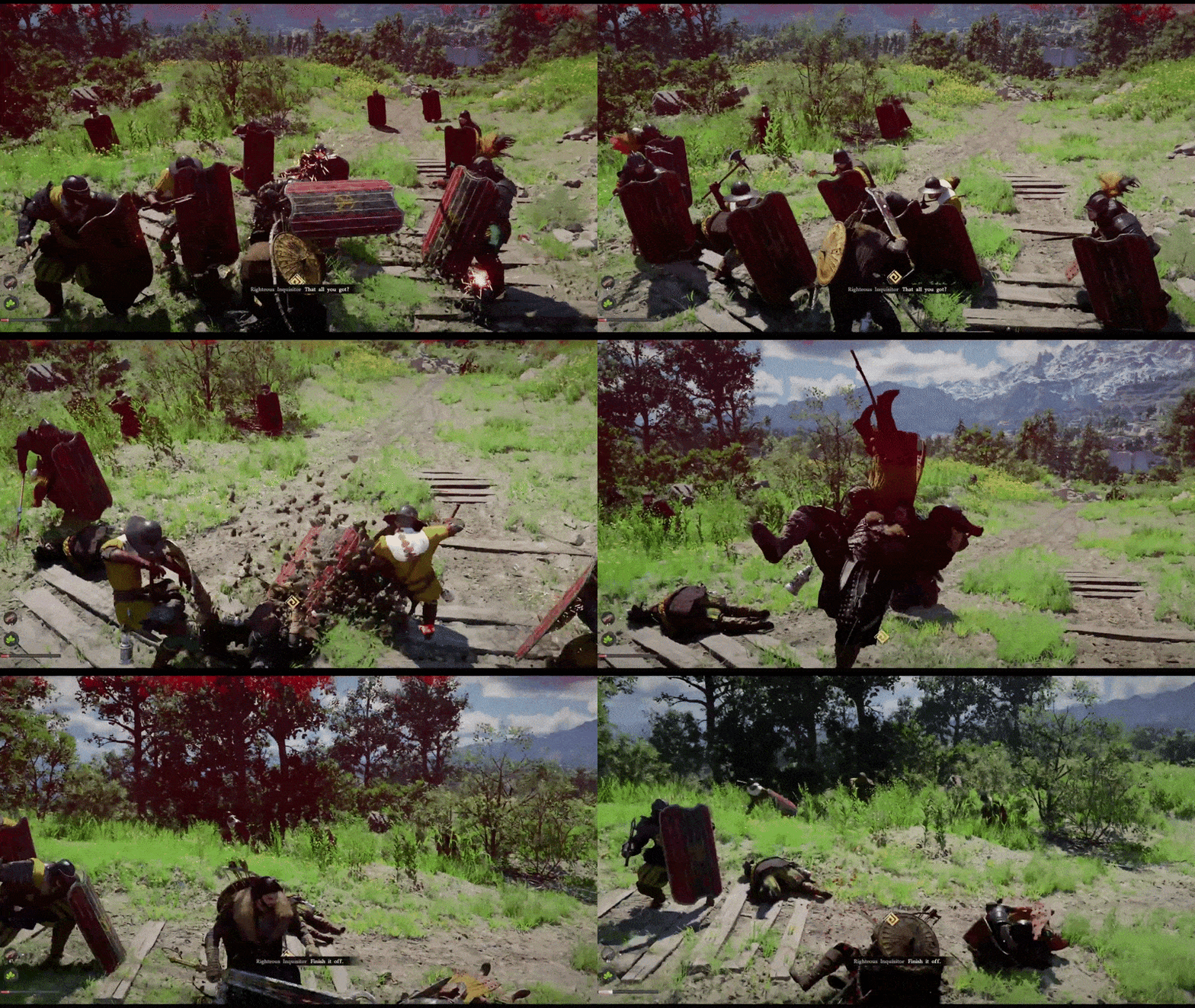
Enemies won't give you any waiting time either, often working by ambushing you and attacking all at once, making you stay on your toes to come out of encounters alive. It flows incredibly well, and the difficulty within normal enemy and faction encounters feels very well-balanced.
Unfortunately, that isn't the same case with some of Crimson Desert's boss battles. Two of the worst offenders have already been showcased in marketing: Kearush the Slayer and the Reed Devil.
Bosses in the game often trigger special and large-scale attacks that are capable of killing you in one hit, and there should be a fair chance to evade these attacks.
However, Kearush the Slayer has a special attack that is almost impossible to dodge, parry, or even run away from — and the only solution for me was to desperately Force Palm myself into the ceiling of the hall the fight takes place in. Kearush is also incredibly aggressive, to an unfair degree, leaving little time for you to react.
It's much worse in the Reed Devil encounter, specifically a second phase that has you destroying certain objects to continue, but you can hardly move due to the ferocious attacks that easily break through your defence.
You'll find yourself hard-pressed to defeat bosses without entering each encounter with tons of food or other healing items, because each boss gets far more aggressive through each phase, and there's no checkpoint in between each of them.

Going from challenging but fair enemy ambushes, casual open-world exploration, and fun mini-game activities, to overly aggressive boss battles in the main story made it feel like I was playing two different games at times.
I'm sure there'll be players who have a better time during these encounters, especially if care is taken to use most Abyss Artifacts on stamina and health upgrades (and perhaps if Pearl Abyss does tweak some of these encounters post-launch), but they were frustrating for me.
It's not all doom and gloom, though, as I ran into a few epic and engaging boss battles that gave me a fair opportunity to come out victorious without feeling hard done by. I just hope that, at the very least, Pearl Abyss can include checkpoints for those that feature multiple phases.
Let's get technical


I'll admit, I was worried about Crimson Desert's performance before getting my hands on it, but fortunately, those fears were quelled instantly. PC players will be glad to know that Crimson Desert runs like an absolute charm, and the BlackSpace Engine from Pearl Abyss is exceptional.
I ran Crimson Desert on an RTX 4080 Super, with 32GB of DDR4 RAM, and an AMD Ryzen 5700X3D processor. At a native 3440x1440 resolution, on the maximum 'Cinematic' graphics preset without any upscaling, I was able to hit around 70 frames per second (fps) and more in multiple graphically intense scenarios.
The optimization from Pearl Abyss here is exceptional, and as I speculated previously, it's the first title on PC I've seen in years that doesn't need to use any form of upscaling for good performance. Bear in mind, on the Cinematic preset, only 6GB of VRAM was being utilized.
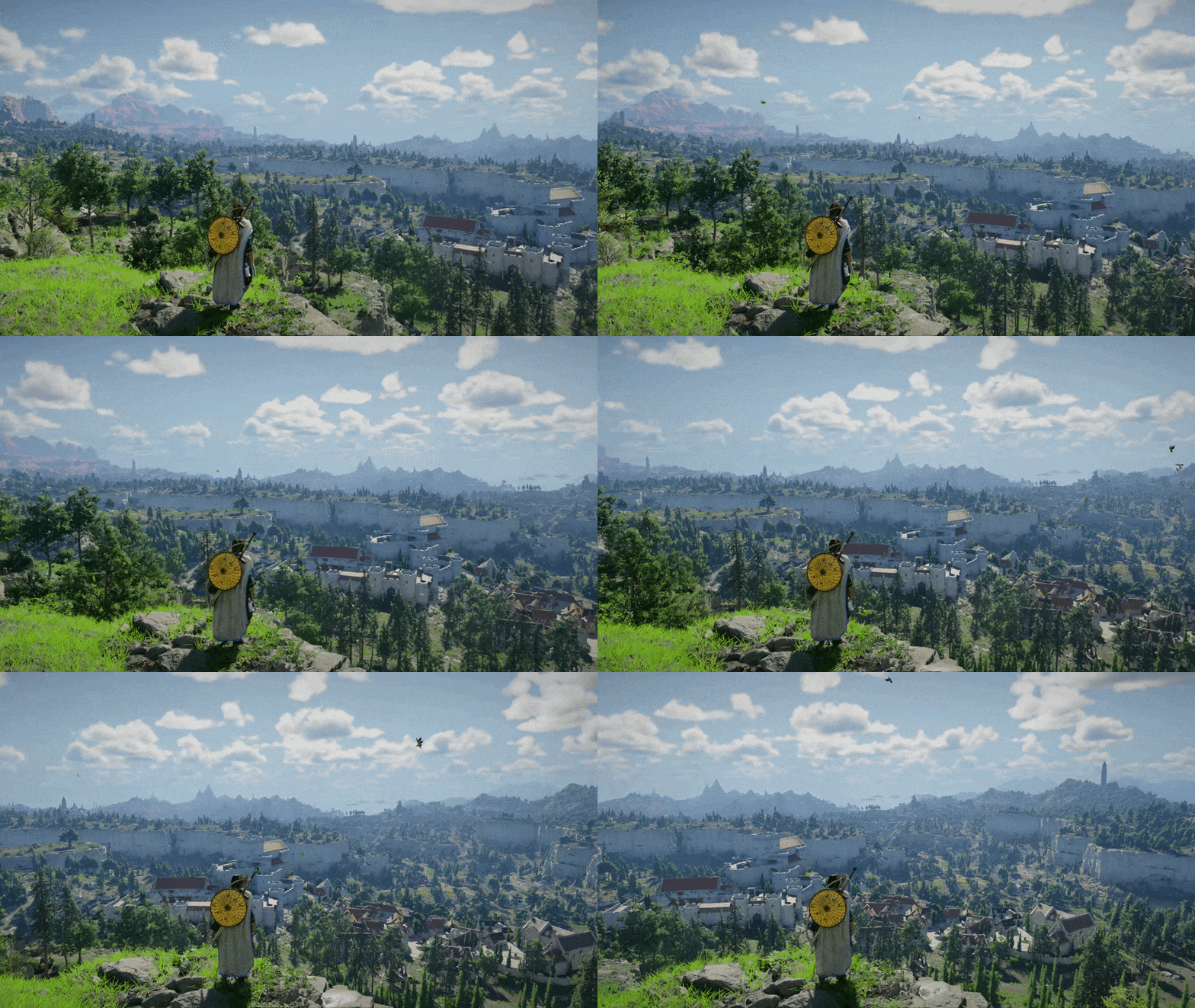
It's also easily one of the best-looking games of this generation, with amazing vistas alongside cloth physics and water simulation that leave me stunned each time I take a breather while exploring.
The only issues I ran into were quality-of-life annoyances and game-breaking bugs. Reading the latter might make you panic, but don't. These were softlocks that occurred when resetting skills, which removed ones that were fundamental to game progression, and another that locked the game's camera in place after a boss battle, without any way of progressing.

I've never been a fan of constant inventory management, and unfortunately, it's at its worst here in Crimson Desert. You find yourself discarding items to free up space, and since there is no storage at the Greymane camp, it was a constant interruption to the flow of gameplay for me.
Pearl Abyss has already made improvements by fixing those softlock issues, and were very quick to respond to feedback regarding quality-of-life. The day one patch should fix many of the issues I came across in my review period, and the developers have promised a housing update for additional storage at a later date after launch.
Overall, I had an absolute blast playing Crimson Desert, and while it's not a perfect game, it's a few tweaks and updates away from being a mastercraft, and is already a strong game of the year contender.
Should you play Crimson Desert?
Play it if...
Don't play if...
Accessibility features
Crimson Desert doesn't feature any difficulty options, unlike other action-adventure games, but rather relies on player exploration and finding the right gear, effectively leaving them to form their own difficulty.
There isn't a wide range of settings available in terms of accessibility, with no colorblind options, no controller configuration options, and the inability to completely remove the game's HUD.
Fortunately, the game includes particle effects, blur intensity, and camera shake sliders, suitable for those sensitive to flashing lights during combat, and who prefer a less intense visual experience, including the choice to reduce HUD and cutscene subtitle size.
There are options to not display all three characters' accessories, but this option doesn't seem to apply to headgear, and there isn't a transmog system in Crimson Desert.
Blood can be disabled entirely, but there isn't too much on display when the setting is enabled.
Pearl Abyss has also included an option that allows you to preview the game while changing graphics settings, which is ideal for quick adjustments. DLSS and FSR Frame Generation can also be enabled or disabled without the game requiring a restart.

How I reviewed Crimson Desert
I tested both 3440x1440 (ultrawide) and 3840x2160 (4K) display resolutions, using an RTX 4080 Super, Corsair Vengeance 32GB DDR4 RAM, and an AMD Ryzen 7 5700X3D, and had no performance issues throughout my time playing.
The monitor I used was the LG UltraGear 45GS95QE OLED ultrawide, similar to the LG UltraGear GX9 45GX950A we've reviewed, thanks to its immersive 800R curvature, but it doesn't feature the 45GX950A's 5K display resolution. As for the 4K TV, it was the TCL QM8 55-inch mini-LED, taking advantage of the game's incredible lighting with high brightness.
I also tested Crimson Desert on my Lenovo Legion Go S Z1 Extreme handheld using SteamOS, and managed to achieve around 30 to 40 frames per second on the medium graphics preset with AMD FSR 3.1 balanced enabled.
My handheld testing was done early into receiving my review copy, and would barely run without using 'Proton Experimental' — without it, an error message would state that the graphics device isn't supported. I suspect performance and visuals will be much sharper after launch, and drivers are updated and suitable for the game on SteamOS.
First reviewed March 2026
