


Whether you're heading back to school, on a business trip, or looking for a productivity screen for the office, these are the best portable monitors you can get right now based on our tests.
For most people, the MSI Pro MP165 E6 is the best pick overall. It's got a brilliantly low price tag. And I love the clear 15.6-inch display, lightweight design with VESA mountings. For business and school work, it does everything you'll ever need from a portable monitor that performed well on Windows, Mac, and gaming devices throughout our review.
I've included a range of ultra-portable displays right here, from tablet-thin 16-inch screens and 4K models to the best portable gaming monitor we've ever played on.
Best portable monitor overall


Buy it if…
✅ You want to mount your monitor: Not all portable monitors have VESA mount support, but this one does, and it works brilliantly.
✅ You want a portable monitor for travel: We used the MSI display as our second screen on a host of different jobs, and it's perfectly sized and weighted for business travel.
Don’t buy it if…
❌ You’re a creator: One of the weakest parts here is the color gamut, which is very low compared to other displays we’ve tested. Definitely not one for accurate content creation.
❌ You work in a brighter environment: Brightness isn't winning any awards here. At 250 nits, we found it can be an issue if you're in very bright workspaces or in direct sunlight.
Why we chose the MSI Pro MP165 E6
Why you can trust TechRadar We spend hours testing every product or service we review, so you can be sure you're buying the best. Find out more about how we test.
There's something very pleasing about the MSI Pro MP165 E6. This 15.6-inch budget portable monitor proved exceptional when we tested it, deploying it as a second screen while working on mobile IT projects, creating music on a Mac mini, and even gaming on a Nintendo Switch.
It's lightweight, thin, has a built-in kickstand, and the USB-C connectivity made it a versatile pick for everything from Windows and macOS desktops and laptops to Chromebooks and Apple TVs. We experienced no issues using any of them.
Notably, the MP165 E6 supports VESA mounting, which we hardly ever see on even more expensive portable monitors. In other words, it's perfect for business travel, the office, or wherever you find yourself working.
Now, while we did use it as a secondary monitor for lining up photography shots, this isn't a display we'd recommend for creative professionals. The color accuracy is pretty low, and it's not ultra-bright either.
Still, considering the price, which runs at around the $90 / £90 mark, this portable monitor does everything most people need from a lightweight second display.
Read our full MSI Pro MP165 E6 review
Best portable monitor for Mac


Buy it if...
✅ You're hooking up a Mac device: While you can use this portable monitor with a range of Windows, macOS, and gaming devices, the 2.5K resolution means you get greater clarity on a Mac than you would with a 1080p display.
✅ You're a gamer that wants an affordable display: I tested this out on the Switch, Switch 2, and Xbox Series X, and it worked brilliantly (just turn off HDR on the Switch 2). Bonus points for hitting up to 180Hz refresh rates.
Don't buy it if...
❌ You're a professional content creator: The color coverage is 107% sRGB, which is fine for editing photos for online, but colors won't look accurate in print or video.
❌ You need a built-in battery: While it'll draw power from your laptop, it won't do the same if you're connected to a games console as there's no built-in battery. A USB power cable is included in the box, though, and I hooked up a power bank with no trouble while playing games.
Why we chose the Arzopa Z3FC
I was strongly impressed with the Arzopa Z3FC, which the company bills as its flagship model. It's tablet-thin, extremely lightweight, and costs around $150. I found it a particularly compelling choice for business travelers and gamers, but honestly, anyone who needs a second screen will get along with this well-sized, high-resolution display.
Despite its thinness and lightness, I found it felt pretty durable thanks to the aluminum alloy construction. It also with a protective case in the box for the commute - although it's relatively thin, so I'd give it some extra padding to keep the actual panel extra-secure.
Specs-wise, it's a 2.5K IPS panel capable of hitting 180Hz via DisplayPort and 144Hz with HDMI. Contrast, at 1000:1 and a 400 nit brightness feel fair, but it's not out-of-this-world good. Saying that, I had no issues using this in a brightly lit home office. What really holds it back is the 107% sRGB color gamut, which prevents it being used for pro-grade content creation - although using it as a second screen to edit photos for social media proved fine to my eye.
In use, I thoroughly enjoyed using the Z3FC - for both work and play. I became a master of productivity with this sitting alongside my ThinkPad. Then using it as a gaming monitor, it showed superb performance when hooked up to the Switch 1 and 2, and an Xbox Series X. The only real problem I had here was just how washed-out the HDR was when connected to the Nintendo Switch 2. Turn this off, though, and the issue is resolved.
Overall, an exceptional screen for the price, that does everything you'd want from a portable monitor for Mac, Windows, and gaming that doesn't break the bank.
Read our full Arzopa Z3FC review
Best touchscreen portable monitor for business



Buy it if…
✅ You travel for business or school: This is one of the sleekest, lightest portable monitors designed for business travel and daily commutes that we've tested.
✅ You want a touchscreen display: One of the defining hallmarks of this display is the touchscreen, which is ideal for signing documents, handwritten notes, and even drawing.
Don’t buy it if…
❌ You need true color coverage: 100% sRGB isn’t bad for a portable display, but it won’t suit professional photographers and designers.
❌ You need a budget portable display: It may be cheaper than the Gen 1 was, but the Lenovo ThinkVision M14t Gen 2 is still about $400 / £400 new.
Why we chose the Lenovo ThinkVision M14t Gen 2
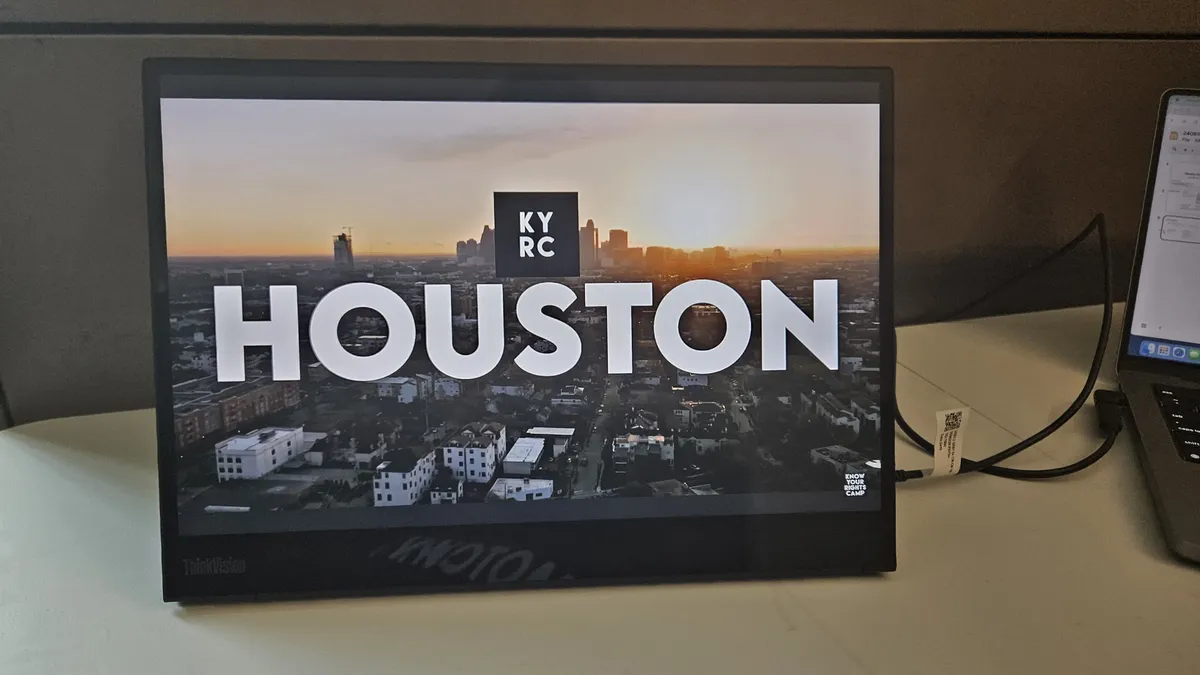
Part of Lenovo’s Think series, the M14t Gen 2 is a 14in touchscreen portable computer monitor that’s optimal for working, studying, watching, and light creative tasks.
The M14t Gen 2 boasts 2.2K resolution, 16:10 aspect ratio, 100% sRGB color gamut, and 1500:1 contrast ratio. Power button and ports are located on the full fold-out stand, which like the Dell Pro 14 Plus, we found offers greater stability. We felt the whole package was well-protected by the included carry case, neatly slipping into our bag without any fuss. For business travel, this is a must, so we liked to see it bundled together. As a touchscreen device, there was a tendency for the screen to show smudges, though.
Image quality is excellent, text appeared crisp, colors were accurate and vibrant, while blacks retained their depth. We like the design, with the display hinge able to offer additional height when lifted - but the real stand-out feature is the automatic orientation, which seamlessly switches between portrait and landscape modes. And yes, it’s VESA-mountable, too.
We had no issues performing office tasks, signing documents and drawing with the included stylus, editing videos and photos, and watching YouTube videos. A good all-rounder tailored for varied business and creative use.
Editor's note: Don't need touchscreen? See our Dell Pro 14 Plus review for a delightful 14-inch business portable monitor.
Read our full Lenovo ThinkVision M14t Gen 2 review
Best portable monitor for gaming


Buy it if…
✅ You want to play games: With a future-proof 240Hz refresh rate, this Asus portable screen is geared towards gamers.
✅ You want a large portable monitor with built-in battery: The Asus ROG Strix XG17AHPE boasts a 7,800 mAh battery built in, lasting up to four hours at 240Hz on a single charge.
Don’t buy it if…
❌ You want to watch or work: If you’ll mostly be watching YouTube and Netflix, or using office apps, this monitor is probably overkill.
❌ You need a cheap portable monitor: As you’d expect with specs like this, the portable monitor isn’t as cheap as the sub-$100 displays you’ll find on Amazon.
Why we chose the Asus ROG Strix XG17AHPE
While we enjoyed playing games with the cheaper Arzopa Z3FC, with its 180Hz refresh rates, if you want a true portable gaming monitor, the Asus ROG Strix XG17AHPE has the edge in every way imaginable.
This is a a 17.3in full HD display with a 240Hz refresh rate, and it's easily the best portable gaming monitor we’ve tried. This device is focused, offers no compromises, and suitable for the most dedicated players.
Even with its broad screen and built-in battery, the device is just 0.4in thin, weighing just 2.3 lb,. A USB-C and mini HDMI port runs along the side. In our hands, the well-built ROG Strix XG17AHPE showed no signs of bend or flex. It comes packages with a case and compact tripod, which is a thoughtful touch.
In use, the large portable display is vivid, crisp. When we tried games like Overwatch, Valorant, and Call of Duty, colors popped off the screen without oversaturation, remaining distinct even in darker areas of the game. And we loved the smoothness that came with a higher refresh rate, with no ghosting and blur. Audio is loud and clear, too.
Yes, it’s a bit overkill if you’re presenting or Netflix-ing the night away (although it’s perfectly capable of doing it). Also, while current-gen consoles are only capable of 120Hz, the refresh rate here offers in-built future-proofing, and the Switch and PlayStation still felt smooth during our gameplay tests.
Read our full Asus ROG Strix XG17AHPE review
Best large portable monitor


Buy it if…
✅ You want a big screen: At 27in, this is one of the largest portable monitors we’ve reviewed, offering plenty of screen real estate for work, collaboration, or presenting.
✅ You want high resolutions: Most traditional portable displays hover around the 1080p mark, which is fine for smaller screens, but this one boasts 2.5K QHD resolution.
Don’t buy it if…
❌ You want actual portability: Yes, it’s slim and fairly lightweight, but this isn’t a monitor you’ll want to cart around with you regularly.
❌ You just want a standard portable monitor: With these specs, the screen is likely overpowered if all you want to do is hook up a second screen to your laptop.
Why we chose the Asus ZenScreen MB27ACF
If you’re looking for a large portable monitor for collaboration in the office (or you just need a massive amount of screen-space alongside your laptop), we really liked what the 27in Asus ZenScreen MB27ACF offers.
Despite its size, which pushes the term “portable” to the max, we found the ZenScreen MB27ACF surprisingly slim and relatively lightweight. The screen is clear, with a matte anti-glare covering but no touchscreen capabilities. Specs-wise, you’re looking at 2.5K resolution, 1500:1 contrast ratio, 300 nits brightness (so about average), and 99% sRGB. We would've loved to see a wider color gamut, though, so creators could benefit from the large-screen portability, too. Around the back is a fold-out kick-stand, but what really seals the deal here is that in the box is a monitor arm and hooks for hanging the display wherever you work. Port selection is standard - HDMI, USB-C with 70W DP Alt Mode, and an audio jack.
Right now, this is a solid pick for anyone who needs a large-sized portable monitor for a single-station set-up or use across an office where you need to key into the details or collaborate with others.
Read our full Asus ZenScreen MB27ACF review
Best 4K OLED portable monitor

Buy it if...
✅ You're a creator: One of the stand-out features of this ViewSonic portable display is the color performance, which is bright and vibrant with 99% DCI-P3 coverage.
✅ You need an ultra-portable high-resolution screen: There aren't a lot of genuinely good 4K OLED portable monitors of this size and weight, but the ViewSonic is one of them.
Don't buy it if...
❌ You need a portable gaming display: It'll function fine for gaming, but the 60Hz refresh rate is the trade-off here for the 4K res.
❌ You're on a budget: It's a pricey display - although relatively well-priced compared to similar 4K portable monitors we've seen.
Why we chose the ViewSonic VX1655-4K-OLED
There aren't many 4K OLED portable monitors out there that impress us, but the ViewSonic VX1655-4K-OLED is worth checking out if you need a high-res display in a smaller form.
Our sister site Tom's Hardware awarded this 4 stars in its review, calling it "a great portable monitor', full of "4K OLED goodness in a slim package."
Beyond that eye-catchingly high resolution, color performance is what really stands out here. They pop off the screen, looking bright and vivid and realistic, with excellent color saturation and deep blacks. On top of that, it reaches 99% DCI-P3, 100% sRGB, and 98% AdobeRGB. If you're planning on using this for creating content, that ticks all the boxes.
Where it falls down is the audio. The built-in speakers are some of the worst in its class, and we recommend hooking up external ones or using the 3.5mm audio jack if you're using it for streaming TV, film, and music.
Price is another issue. At around the $500 / £500, you're paying for a brilliant display that delivers exceptional colors. But compared to other 4K portable monitors like the espressoDisplay 17 we reviewed, which costs around $800, ViewSonic's screen is fairly well priced.
With a tablet-thin and lightweight design, this is an easy recommendation for those who need a 4K OLED display.
See what our sister site Tom's Hardware said in its ViewSonic VX1655-4K-OLED review
Best wireless portable monitor


Buy it if...
✅ You want an easy set up: The monitor uses a USB-C transmitter to cast your screen wirelessly, with no drivers or pairing process.
✅ You travel light and need a second screen: The screen alone is only 788g and will last around four hours.
Don't buy it if...
❌ You need color accuracy: This monitor only provides a limited color gamut.
❌ You work in direct sunlight: The limited brightness means the display quality is not that high in bright environments.
Why we chose the UPerfect UFree V
I picked the UPerfect UFree V portable monitor because of its simple approach to wireless connectivity. You don't need to install drivers or configure anything. You only need to connect a USB-C wireless hub and you're good to go.
The other reason is the internal battery. A battery that gives you around four hours of use before it needs a power source makes it a totally wireless option that can be used almost anywhere without any cables.
I say almost because the brightness doesn't make it that suitable for use in direct sunlight. There are other downsides- the cable placement is awkward when you do use them but that's easily forgotten about when you remember the price.
If you need a wireless portable monitor that can be used almost anywhere on almost any device you'll be hard pressed to find one that's more versatile and affordable. I tried to find an alternative that was higher in display quality and price but couldn't.
Read our full UPerfect UFree V review
Best portable monitors compared
Model |
Our rating |
Screen size |
Resolution |
Brightness (nits) |
Weight (lbs) |
|---|---|---|---|---|---|
★★★★☆ |
15.6in |
1920 x 1080 |
250 |
1.72 |
|
★★★★⯪ |
16.1in |
2560 x 1440 |
400 |
1.72 |
|
★★★★☆ |
14in |
2240 x 1400 |
300 |
1.54 |
|
★★★★⯪ |
17.3in |
1920 x 1080 |
350 |
2.3 |
|
★★★★⯪ |
27in |
2560 x 1440 |
300 |
10.6 |
|
★★★★☆ |
15.6in |
3840 x 2160 |
400 |
1.5 |
|
★★★★⯪ |
15.6in |
1920 x 1080 |
350 |
1.73 |
Best portable monitor: FAQs
Do I need a portable gaming monitor to play games?
No - you don't need a dedicated portable monitor for gaming.
Most standard portable displays will hook up to your console via HDMI (or mini HDMI) and let you play games.
However, if you play competitively you'll want fast refresh rates and higher resolutions. For this, I'd recommend a true portable gaming monitor for a better experience.
How do I connect a portable monitor to my device?
In general, portable monitors connect to devices via USB-C - a single cable carrying output and power, making it better-suited for portability.
Plug one end into your device, the other end into the display, and head into your operating system's display settings for further configurations like mirroring.
Some portable monitors also connect to devices via USB-A, mini-HDMI, micro-HDMI, and VGA. Check your manual for full details.
Are portable monitors compatible with all devices?
You'll find the best portable monitors are compatible with laptops, tablets and gaming consoles like the Nintendo Switch. If the display sports a USB-C and HDMI or mini HDMI port, you should have no issues connecting it to your device.
Do portable monitors have built-in speakers?
Some of the best portable monitor models do feature built-in speakers. However, when it comes to internal speakers, we find audio quality varies greatly. Lower-priced portable monitors often having a shallow, tinny sound to them, lacking in bass. These speakers will be fine for presentations or in a pinch, but in my experience, these pale in comparison to displays with dedicated audio systems or external speakers.
Do all portable monitors have a built-in battery?
No - not every portable monitor comes with a battery.
This keeps the price and the weight lower, with the portable display drawing power from the connected device, like your laptop.
You can find portable monitors with a battery, which is great for working away from a mains outlet, but these devices will be heavier and more expensive.
Tips for choosing the best portable monitor for you
This is the key specs I always look for in a portable monitor and what I recommend checking when choosing the model that’s right for your needs.
Screen size
For most people, one sized between 14in and 16in (like most laptops) offer the best balance for portability. But portable displays come in a range of sizes, so there's no right or wrong here. Raspberry Pi screens tend to be around 7in, while I've tested a 27in display designed to be lightweight and easy to carry despite being as big as a standard computer monitor.
Ports
The most common ports I see on portable monitors are USB-C and HDMI (or mini HDMI). These are standard, letting you connect the display to a wide range of laptops, computers, or consoles - but check your device to ensure compatibility. On most monitors, you'll find two types of USB-C - one for extending your screen via DisplayPort and one for power delivery (PD) if there's no mains adapter or built-in battery. If you're lucky, there may also be an audio jack.
Resolution
Resolution isn't as important on smaller screen sizes as it is with full-sized monitors or TVs. I expect a minimum of 1920x1080 (Full HD), however, some of my top picks here boast 2.2K and 2.5K resolutions (and there are a number of 4K OLED portable displays now). Unless you're playing modern games, it's not necessary, but it can be nice to have.
Power
Most cheap portable monitors won't have a built-in battery, but draws power from the connected device. This makes them lighter and lower-priced, but will drain the connected device faster via the USB-C PD.
Price
Everyone's budget is different, and you can spend pennies or hundreds for a portable monitor. For me, the sweet spot is somewhere between $100 to $300. Displays at this price usually have all the core features most people need. But I have seen some basic screens selling for as low as $50 - I'd recommend choosing one of these only from a known budget brand like KYY, MNN, or Arzopa.
Gaming
If you plan to use your portable monitor for gaming, a standard 1080p/60Hz screen will be fine for general play. However, you may want a display with higher resolution and refresh rates - I'd opt for at least 1440p and 120Hz respectively. In my experience, none of this is necessary for business or streaming use.
How we test the best portable monitors
We've tested a range of professional displays, including the best monitors for video editing, the best monitors for MacBook Pro, and the best monitors for photo editing. We've also reviewed the best monitors and best business monitors. So, we know what to look out for when you need a second screen to take with you.
All devices featured in this round-up have been tested by us. We evaluate these displays across many aspects, starting with the design and dimensions, exploring weight and overall portability. Build quality is essential for the best portable monitors, and we're looking for robust devices that are designed for travel, the commute, and multi-location set-ups.
For screens, we look at size, avoiding - and noting - any signs of glossiness and reflectiveness when used in bright rooms or outdoors in sunlight. We also compare each display's resolution, and whether it's capable for the use. For example, we'd expect higher resolutions for photo editing than for streaming movies or presentations at work.
We also check brightness and viewing angles - and we always test the manufacturer's claims of brightness. In many cases, peak luminance in a real-world setting is lower than the stated specs, and we'll note this in our review. Where available or relevant, we'll evaluate color accuracy and color coverage to identify the screens with the best image quality.
For more, see our guide How we test, review and rate professional and business monitors on TechRadar Pro.
We also tested the best monitors for graphic design - and these are the ones we recommend
Get in touch
- Want to find out about commercial or marketing opportunities? Click here
- Out of date info, errors, complaints or broken links? Give us a nudge
- Got a suggestion for a product or service provider? Message us directly
Portable monitor deals
