





Nvidia’s GDC event has been showcasing some pretty cool stuff coming to future games, and one of the announcements that's got me the most excited is that Nvidia is teaming up with CD Projekt Red to bring its RTX Mega Geometry foliage tech to The Witcher 4.
Now, there’s no denying that ‘Mega Geometry foliage’ is an awesome name, but the ambition behind it is even more exciting: more believable trees, forests and environments.
As Nvidia explains in a blog post, RTX Mega Geometry foliage introduces a “new level-of-detail system for foliage", thanks to technology that "selectively updates scenes, reducing memory usage and accelerating performance in a visually seamless manner.”
Essentially, it means that advanced path-tracing lighting effects — which take a big toll on the hardware — can be implemented in complex clusters of plants and trees, adding realistic animations, lighting and shadows.
This can make a huge difference to how realistic and immersive a game feels. Real forests are living, growing, things, and static recreations in games can feel lifeless and fake in comparison. However, individually animating every leaf on every branch of a single tree, let alone an entire forest, would have once been far too difficult for gaming hardware to handle.
Add in lighting and shadows that react to every tree, as well as the position of light sources, like the Sun, and you end up with an implementation that is incredibly hardware-intensive. That's why most games offer much more basic representations of forests — at a cost of realism.
Nvidia introduced Mega Geometry last year. The technology combines path-traced lighting with detailed geometric shapes (such as raised patterns on environmental objects, like statues), while lowering the hardware demands by collecting the shapes and objects in clusters. This then allows for large-scale environments that benefit from stunning details and lighting effects.
With RTX Mega Geometry foliage, this tech is now being used for large-scale natural scenes, especially forests, so they can make use of real-time path-traced lighting.
Nvidia has released an in-depth video that goes more into the tech that makes this possible.
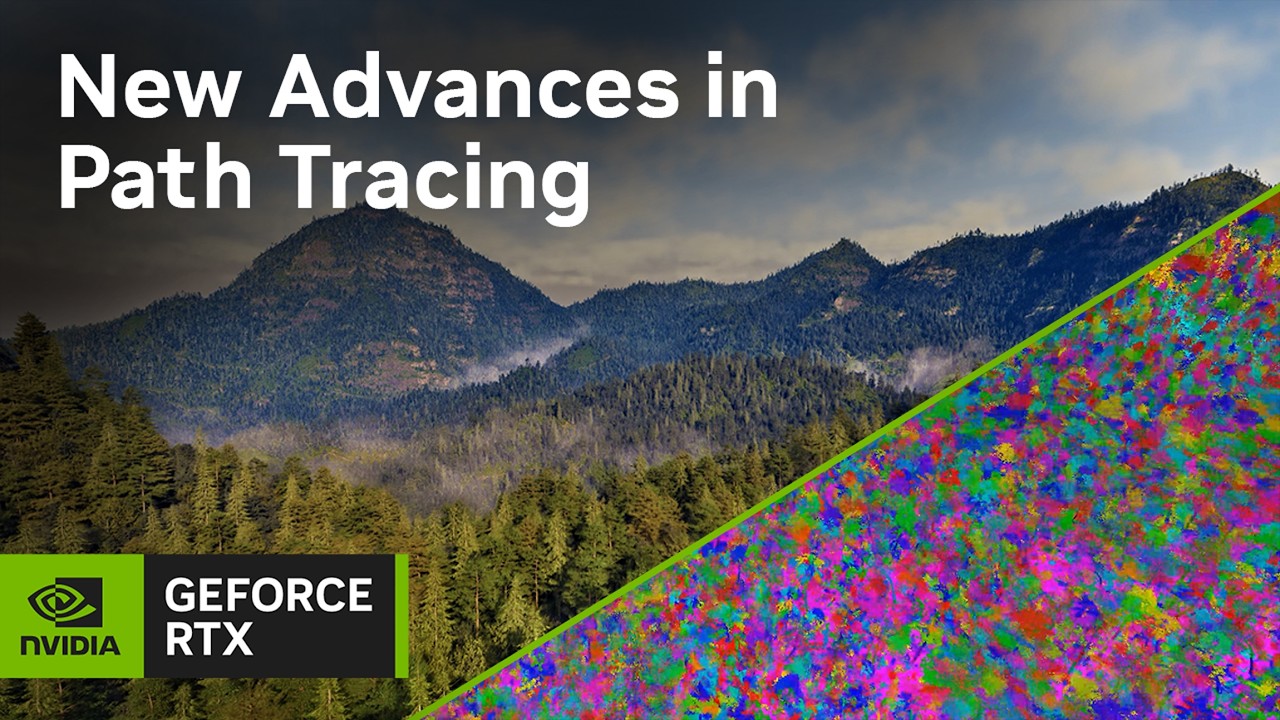
According to the video, RTX Mega Geometry foliage "selectively updates scenes, reducing memory usage and accelerating performance in a visually-seamless manner". This allows dense forests with ‘millions’ of trees and plants to have “unique animation, and accurate real-time lighting and shadows.”
Improving detail and graphical effects whilst lowering hardware requirements sounds a bit too good to be true, but I’ve been impressed with Nvidia’s DLSS and Frame Generation features in the past. These have leveraged AI to lower the hardware burden of graphically-intensive games, while keeping image quality close to the same, or sometimes even improved. So I have high hopes for this tech.
Toss A Coin To Your Witcher (and Nvidia)
Despite still being early days, the examples shown in the video are impressive. Plus, the announcement that Nvidia is making the tech open-source later this year should hopefully mean we’ll get a decent amount of new games coming out that support the technology.
One of those games will be (as announced at GDC) The Witcher 4 – one of the games I am most excited about playing in the future. Cezary Bella, Rendering Engineer, CD Projekt Red, mentions that the developers are working with Nvidia to bring path tracing to The Witcher 4, and by using RTX Mega Geometry foliage technology, fully path-traced forests will also be in the game.
The Witcher series of games are set in a world loosely based on eastern Europe, and that means lots of lush forests. The Witcher 3 wasn’t just one of my favorite games of all time, it was a graphical showcase, so I’m ridiculously excited to see what the next game looks like.
It also means that PC will easily be the platform to play The Witcher 4. While Nvidia will be making the RTX Mega Geometry foliage tech open-source, it’s very likely that you’ll need an Nvidia GPU to take advantage of it, and both the Xbox and PS5 use AMD hardware.
Of course, the fact that the PC version will likely be a (bit) cheaper, hopefully support mods, and will be playable on my gaming handheld as well as my desktop PC (plus the small matter of me not owning any current consoles), means that I was always going to be playing The Witcher 4 on my PC anyway. I just hope RAM and GPU prices drop even a little bit before it releases sometime next year.

➡️ Read our full guide to the best laptops
1. Best overall:
Apple MacBook Air 13-inch M4
2. Best budget:
Asus Chromebook CM14
3. Best Windows 11 laptop
Microsoft Surface Laptop 13-inch
4. Best gaming:
Razer Blade 16
5. Best for pros
MacBook Pro 16-inch (M4 Pro)
Follow TechRadar on Google News and add us as a preferred source to get our expert news, reviews, and opinion in your feeds. Make sure to click the Follow button!
And of course, you can also follow TechRadar on YouTube and TikTok for news, reviews, unboxings in video form, and get regular updates from us on WhatsApp too.
