Updated 10 hours ago

12814 products + 13861 members

Why isn't Digital Britain disability-friendly?

Broadcasters and the web still have a long way to go

October 23rd | Tell us what you think [ 5 comments ]

england

Why shouldn't websites and broadcasters have to think about accessibility?

<>

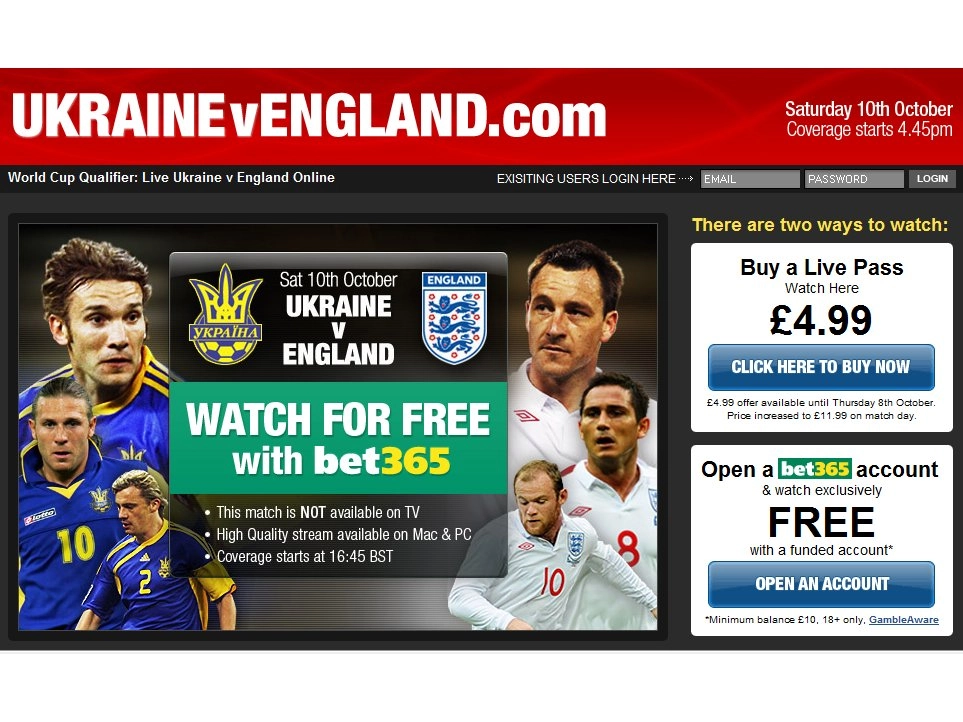
When England played Ukraine earlier this month it was an historic moment - not because it was web-only, but because it excluded deaf and disabled footie fans. As Alison Smith blogged a few days before the game, the match wouldn't be subtitled or audio described.

It's not a deliberate exclusion, of course. It's just that FIFA, UEFA and the broadcasters simply didn't think about accessibility at all. And they don't have to.

The EU Audio Media Services Directive, which comes into force this year, brings video on demand under the umbrella of existing broadcasting regulation - and that means that the government must "encourage media service providers… to ensure that their services are gradually made accessible to people with a visual or hearing difficulty."

Time to get a grip

Encourage? Gradually? It's hardly a demand for VOD providers to get a grip, is it? According to Ofcom in this PDF, "over the next few months we will be discussing with VOD providers what plans they have in this area. If you reckon Ofcom should be doing more, you'll need to contact them quickly: their consultations on Television Access Services and VOD end on 12 November and 26 October respectively.

It's not just video, though. The European Commission has floated the possibility of legislation to force websites to cater for disabled users, and while accessibility is a hot topic among clued-up web designers the Disability Discrimination Act doesn't really say what companies should or shouldn't do.

As the RNIB points out, "Service providers are only expected to make "reasonable" adjustments. Note that "reasonable" is not defined in the Act".

If Alison Smith's experiences at Birmingham's Hello Digital event - that's the Hello Digital event that's supposedly about the possibilities of digital technology to make the world a better place - are anything to go by, Digital Britain has a long way to go in the accessibility stakes.

"The event started at 8am," Smith writes. "They called Birmingham Institute for the Deaf at 10am and the SLI (Sign Language Interpreter) finally arrived at 1.30pm" - more than halfway through the event.

"What will it take take for Deaf and Disabled people to be a real part of so called Digital Britain?" Smith says. "Why do we have to fight for our access needs so much? Where are there no live subtitles streaming online at conferences? Where's the audio description? Why aren't websites compatible with screen readers? Why can't conferences get the access right?"

They're good questions. Does anybody have the answers?

-------------------------------------------------------------------------------------------------------

Liked this? Then check out Digital Britain: 7 things you need to know

Sign up for TechRadar's free Weird Week in Tech newsletter
Get the oddest tech stories of the week, plus the most popular news and reviews delivered straight to your inbox. Sign up at http://www.techradar.com/register

Follow TechRadar on Twitter

Comment on this article
 

Your comments (5) Click to add a new comment

kasino72


October 25th

5. Hi Cyberdoyle. Fair point about Hello Digital: I wrote this before the debate started in the comments on Alison's post, and the conversation there puts a different slant on the background to it all. But I do think Alison's post is a pretty vivid example of how easy it is for people to be excluded.

Alert a moderator

kasino72


October 25th

4. Hi Anteus (I'm Gary, btw). I agree about the cowboys and the vagueness of the legislation, but there's more to this than PC.

Here's a pretty good example: I do a radio thing, and one of the questions last week was about TV. A caller (emailer, really) had a problem: they can't receive digital TV in any form due to trees, and when the analogue signal goes they're snookered. Do they have rights to get a TV signal? The answer, it seems, is no: going through Hansard transcripts, the govt's response was THE INTERNETS WILL SAVE YOU!

OK, it was a bit more sensible than that. But the gist was: yes, it's terrible that some people can't get digital TV, but come 2012 everybody will have broadband - and therefore they'll be able to get their programmes via that.

Which is fine, assuming that the digitally delivered stuff is accessible. If it isn't, and as the law stands just now it doesn't have to be, then you've got a situation where going digital breaks existing accessibility. So it's not a case of disabled people asking for the moon on a stick; it's "Woo! Tech!" taking something away from them.

The other issue is that increasingly, firms want to operate online. It's their own problem if, say, a shop selling expensive coats misses out on a few sales, but what about utility firms and all the other organisations people *have* to interact with, and are often financially disadvantaged if they don't use the websites?

Alert a moderator

peskypeople


October 24th

3. Thank you to Gary Marshall for posting this article. I welcome the open discussion and debate around this issue and appreciate the comments made by both cyberdoyle and anteaus.

I won't comment on Hello Digital event as this has been covered both in the Pesky People blog, comments from the digital community to the blog and via twitter. 4iP,

Screen WM and creative industries sector in the WM now plans to address the issues around disabled access and I welcome their offer to work with them.

The issue of web accessibility at times is a complex one and as technology advances faster than the speed of light it seems we will never catch up or get our heads around it.

Myself and others who are Deaf or Disabled are excluded from accessing the world in a major way not just in terms of physical access to buildings, education, jobs, social and cultural activities but also digitally to information on the web, Knowledge and information is power and we shouldn't be excluded.

If it is a political campaign that is needed that is no bad thing. If the Suffragette movement hadn't fought to enable women to vote I and million other women in the UK wouldn't be able to vote in our democratic society or stand for Parliament.

If Lord Ashley hadn't of become Deaf Plantype a speech to text system wouldn't have been developed to enable him to fully participate in Parliament.

The W3C guidelines can stifle creativity - that shouldn't stop web developers, programmers, Apple, Dell etc. from finding creative ways to ensure their equipment, software and digital content is accessible to everyone young, old, Disabled, Deaf, elderly, people with dyslexia or reading disabilities etc. why should we be excluded?

If we had a law that all politicians were to provide their speeches in Braille, BSL, Large Print (don't forget easy print, use of wigits and visuals), film content with Audio description, subtitles and BSL et all. It wouldn't be a bad thing. That way the 15% of our population who could be defined as Disabled under the Disability Discrimination Act will know what politicians are saying and take part in the political debates that makes our society democratic.

Currently only 1% of websites are considered accessible to W3C 'AAA' guidelines. The UN in 2006 declared digital access a human right issue. An OxIS Survey in 2009 found 'Disability is a major cause of digital exclusion'.

The debate around digital exclusion shows there is an economic disadvantage if you can't get online.

Martha Lane Fox, Digital Exclusion Taskforce's report found that digitally excluded households could save between £270 and £560 a year, depending on their economic circumstances, by going online.

Being online can help the unemployed increase their lifetime earnings by £12,000, while internet-savvy workers can increase their earnings by £8,000.

The study also found that the government could save at least £900m a year if all digitally excluded adults got online and made just one electronic contact per month.

Source: http://news.bbc.co.uk/1/hi/technology/8302598.stm

So there is sound economic, social, political and moral reasons for Digital Britain to be fully accessible to everyone not just Disabled and Deaf people.

Alert a moderator

cyberdoyle


October 23rd

2. I have no info on the streaming of football matches other than it wouldn't work in britain because of the limited bandwidth available. I do know a bit about the Hello Digital conference because I attended it remotely and was very impressed by the organisation and effort that had gone into it. I saw Alison's tweet and retweeted it to raise awareness of the problem. I fully support Alison in her campaign to get more help for disabled people but I don't think the signer not being present was anything more than a mistake. If one had been requested in advance and one didn't turn up it could have been for a multitude of reasons. If the conference had been run by a professional conf arranging business it would have been too expensive to put on, and Alison probably couldn't have afforded to go, but no doubt a signer would have been there. As a digital community was doing all the arranging I have to say they did a superb job, the livestream was excellent and all the other elements worked. I am sure they apologised and will learn from this, and make the next conf even more spectacular than this one. Nobody is perfect, and everyone is doing their best, and it isn't really fair to flag up a brilliant effort in this way as an event which didn't support the disabled sector. Just my opinion for what it is worth. I have no vested interest in the event, I just enjoyed attending remotely and joining in on twitter.

Alert a moderator

anteaus


October 23rd

1. Much as I sympathize with disabled people -to the extent that I volunteered to maintain a wheelchair-sport site for 'nowt- I see this as being more in the nature of a political bandwagon than any genuine concern for their wellbeing.

We already have a situation where corporate webdesigners are being straitjacketed into using standardized formats (such as the big-name CMS backends) in order to to ensure that 'accessibility' rules are met. This is stifling creativity and stunting technological development. It is also, quite unreasonably, criminalizing the average site-maintainer for actions which are not in themselves a crime.

Because the actual requirements of 'accessibility' are open to very wide interpretation, this kind of legislation is also a breeding ground for racketeers, swindlers and corrupt lawyers. Witness the number of Stateside operations claiming to 'Check your website's accessibility compliance' -and finding all kinds of nit-picking reasons to charge you money for (completely unnecessary) remedial work.

People's abilities vary, and no-one is, strictly speaking, without some disability or other. As for me, I'm very poor at theoretical math, which prevented me from following the career in research that I really wanted. But, should I be able to sue CERN for putting math on their website without a plaintext explanation which I, as a mathematically-challenged individual, can follow? No, I dont think so. That would not only be unreasonable, it would be verging on tyranny.

Maybe if we introduced a rule that no politician may speak in public unless he/she also writes the same information in Braille and also delivers it as sign-language at the same time as speaking it?

Oh, the sweet poetic justice that would be.

Alert a moderator

Tell us what you think

You need to Log in or register to post comments

By submitting this form you agree to our Terms of Use and so are legally responsible for anything you submit. DO NOT submit anything which may violate the Terms of Use or another person's rights including copyrighted or offensive materials.