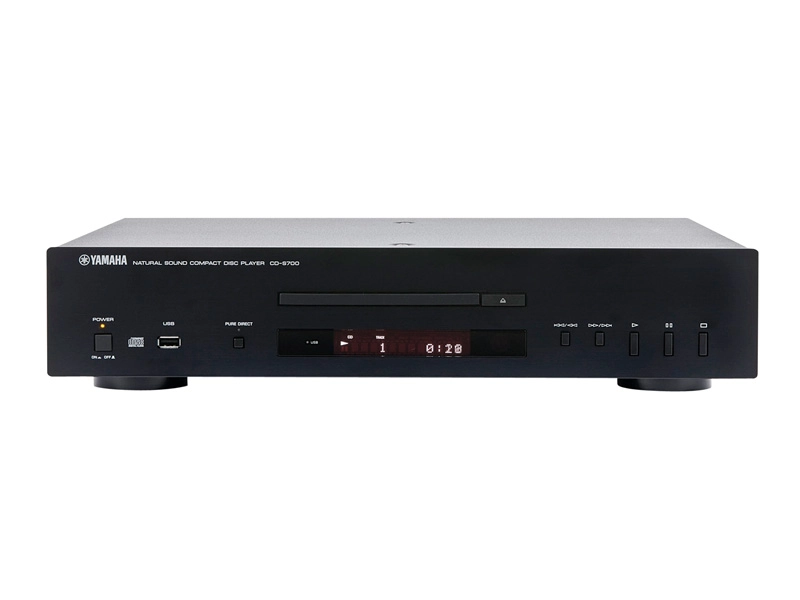
The Yamaha CD-S700 is a good, no-frills CD player, without any of the SACD gubbins found in its bigger brothers.
It's not without concessions to hi-fi sensibilities – it has a Pure Direct button that disables the digital output and front panel display – and even features a USB port for connecting up an MP3 player or a PC.
Beneath the minimalist exterior, it features a 24-bit/192kHz Burr Brown DAC run in differential mode, plus a triple-wired power transformer feeding separate power supplies for the transport, digital and analogue stages.
It also features the Silent Loader transport mechanism found in its bigger brothers. The silent treatment from the disc transport is remarkably silent. As in, put your ear to the player and nothing happens. In fact, if you turn the display off and leave a disc spinning, you could spend days 'running in' the player without noticing it.
Purer sound
Moving over to the Yamaha A-S700 amp, this 90- watt model includes both MM phono and CD inputs, as well as two extra line inputs and two recording line inputs/outputs.
The CD input is picked out for special treatment; the other inputs can bypass tone and loudness controls via the Pure Direct button, but CD has an additional CD Direct option that bypasses the input selector too.
Once again there are features found in the bigger models, like the ToP-ART (Total Purity Audio Reproduction Technology) symmetrical layout of the complete amplifier circuit, which Yamaha suggests gives a more pure sound.
Confusingly, Yamaha reuses the 'ART' acronym within the ToP-ART package to describe its 'Anti-Resonance and Tough' chassis base.
Unappealing style
If the CD player is minimalist in its approach, the same does not apply to the A-S700, at least by British hi-fi standards.
It includes a tape-monitor, two sets of speaker terminals tone and loudness controls and the aforementioned Pure Direct and CD Direct buttons. However, this does not come at the expense of lots of blinking lights and a garish styling exercise; in black or silver, the amp has a classic appeal and those flat tone/loudness controls hark back to Yamaha products of the 1970s and 1980s.
Loudness and tone controls got a (somewhat justified) bad press in the past, but Yamaha has made the contour of the controls adjust with volume, to prevent that 'all-bass, all-treble, nothing in between' problem that beset tone shaping in the past.
Just right hi-fi
Both products in the 700 series treat any piece of music with equal respect, serving up a dark and dignified representation of what was put on the disc. The closer you get to the Pure Direct performance (on both products), the nearer you get to a supremely detailed, sophisticated musical replay chain.
In other words, you get a distinctly 'right' sound. It's a Goldilocks sound; not too exaggerated, not too dull… just right. And you can apply the same Goldilocks attributes to almost any part of the performance. Stereo? Not too big, not too small… just right. Detail? Not too much, or too little. Vocal articulation? Rhythmic properties? Porridge temperature? You get the message.
This freedom from grace or favour toward a specific musical type is the inverse of the initially impressive school of hi-fi.
It rewards a lengthy listen and does wonders for those whose tastes have matured beyond the plebeian. Although, if you do just happen to spend your entire musical life listening to X-Factor runners up through the USB port of the CD-S700, the A-S700 has a small bonus for you; those tone controls seem designed specifically to tame the hardness and trebly thin sound of MP3. These are some of the best in the business and only tone-shaping in the digital domain can do better.
Limited scale
Between them, the Yamaha 700 duo pass the Layla test; this overplayed track is the last one on an otherwise excellent, if monotonous album.
If the system exaggerates the treble and if it over-exaggerates the rhythm, you'll stop tapping along after about eight or nine tracks.
The limits of the price become apparent only when really punishing the amplifier. Play large-scale orchestral madness (Mahler's Eighth, for example) through relatively demanding speakers and the amplifier tends to smooth things over too much.
Level-headed pair
That said, few similarly priced competitors will do a better job with that particular musical onslaught.
What's the bad side, then? Well, it's fair to say that there are more dynamic sounding products out there (especially amplifiers), and this helps produce a sound that's less exciting than some.
On the other hand, most of these more dynamic products make a more exciting sound at the expense of some other aspect of the musical presentation, usually the coherence of the sound. Many will look to the Yamaha 700 series as the more level-headed sound.
Coupled to the right speakers, the Yamaha CD-S700 and A-S700 may not be the Dynamic Duo, but do represent a call for honest reproduction of music that few others can provide at the price. If you are fed up with overly warm, overly bright or overly 'exciting' products, this is the remarkably grown up choice.


Your comments (1) Click to add a new comment
16bit
December 28th 2011
1. I have to agree with Alan Sircom here. His assessment is pretty accurate.
All too often a few brands get pushed to the top of the WhatHiFi leader boards, but they have the same sound that we don't like. It's the immediate obvious detail, brightness and punch. That stuff gets damned annoying after a little while, and makes the units fatiguing.
Yamaha's sound isn't like that, and that is one reason why it gets less than fantastic reviews amongst those magazines. Just because the detail isn't delivered like a dagger, doesn't mean it isn't there. It's very much there with these units, just at a place where you can listen to the music as a whole as well.
Part of a good sound reproduction is to portray things they way they are, no emphasising. That's the Yamaha sound.
All of the function on the amplifier work well. The "loudness" contour, if needed, drops the perceived volume without destroying the tone, all the way to about 70%. "Pure Direct" cleans up and tightens the sound just a little, compared with just the knobs at flat zero position. "CD Direct" improves clarity and body a small amount more than with "Pure Direct". The "Mute" remote function drops the volume to a low level, rather than cutting it off, and this is well thought out - you know it's still playing but can have a phone conversation etc.
The CD players functions are, by nearly all ways great. The draw movement is just fantastic. Smooth moving, and dampened when returned. The screen display is easily legible, but not garishly bright. Default setting is 1 under maximum. Pure direct switches the screen off completely, lighting only one small LED. When a button is pressed the screen fades back up to normal (previous set) brightness, then fades back to pure direct again - very neat. The settings stay when the unit is switched off, so if you prefer to have the time count down, it will remember that for next time it is switched on.
With CD playback, the unit is fantastic, however the USB side has been a bit neglected. It does not support lossless file types, no matter what you may read on the internet, I have tried. So now WAV of FLAC support. It will take MP3 or WMA files up to 320Kbs (including variable rate). Unfortunatelyl, the order in which files play from USB stick is a bit scattered. No playlist appears to be supportd, the tracks play in order of file creation on the USB stick. So to create a track order each track must be compied one at at a time, or software which can copy sequentially (eg. TeraCopy) must be used.
I conducted a few tests with the lossy formats which the units supports, comparing to the same source track on a CD. The result was that the closest to CD sound was WMA v9 320kbs CBR, with a very small amount less clarity in the lossy file. Others like WMA v9 98 VBR, MP3 320Kbs CBR, MP3 VBR all sounded gradually worse. I attempted a couple of lower bitrates, and the degradation became more obvious. With the price of flash memory or CD-R's there's no reason to use less than WMA v9 320kbs CBR or the full lossless file burnt as an audio CD.
It is a shame that Yamaha didn't employ a better processor and/or implement better software for the USB side. Supporting lossless WAV should be a minimum, and FLAC should be a close second. Playlist recognition couldn't have been too hard to design either. A cover or plug for the USB socket would have beena nice touch, to cover the little whole in the front, but it's not a big problem. I'd also have liked an S/PDIF input on the back, to utilise the player's DAC for other sources (such as a PC). In this modern world, those things are good selling points.
In all, other than the lack of well implemented USB support on the CD player, the pair are Well built, have nice styling and some cleaver thinking. But hey, they are just for playing music - and they do that very well indeed.
Alert a moderator
Tell us what you think
You need to Log in or register to post comments