


- The AVEN thrust-vectoring nozzle has been added to the X-BAT AI-piloted fighter with vertical take-off capabilities
- Thrust-vectoring allows a plane’s exhaust to be redirected, instead of relying purely on manipulating airflow across the wings for movement
- The engine was first trialed on an F-16 fighter in the 1990s
Shield AI has revealed the X-BAT AI-piloted fighter jet relies on a jet engine variation first developed over 35 years ago and tested on a General Dynamics F-16 in the 1990s.
The AVEN – Axisymmetric Vectoring Exhaust Nozzle – essentially replicates the actions of a wing, but instead of manipulating airflow across the airfoil, it directs the exhaust, in a process labeled “thrust-vectoring.”
Developed for the F-16 as part of a dedicated GE Aerospace program investigating Multi-Axis Thrust Vectoring (MATV), the nozzle was proved to work. The technology has recently been revived thanks to GE Aerospace and Shield AI, with the AVEN paired with an F110-GE-129E engine.
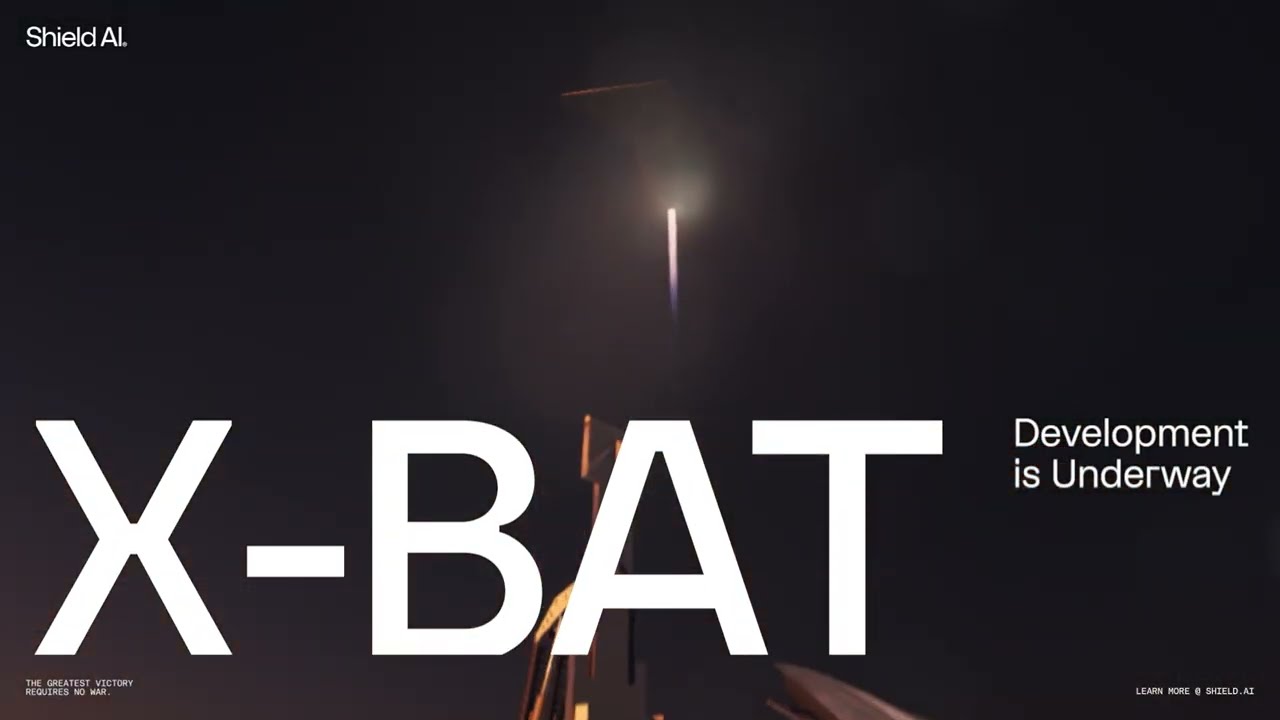
The VTOL X-BAT needs AVEN
Using the Axisymmetric Vectoring Exhaust Nozzle, the X-BAT is given flight capabilities that would prove demanding for humans to repeatedly endure. It enables hovering, but also superhuman reaction speeds, and removes the risk of G-force induced blackouts. Without pilot fatigue, the X-BAT can commit to extreme maneuvers in aerial combat.
Designed as a Vertical Take-off and Landing (VTOL) aircraft, the X-BAT can be deployed in areas with little or no runway. The Axisymmetric Vectoring Exhaust Nozzle is a key part of this, providing the necessary thrust for the X-BAT to take off. As the craft launches more like a rocket than a standard jet fighter, the AVEN and the F110-GE-129E engine appear to ensure a steady detachment from the launch dock as the X-BAT heads skyward.
It’s a setup that might resemble something out of a 1950s sci-fi comic, but in reality can only work successfully without a human pilot.
AVEN isn’t unique to the X-BAT. While the GE Aerospace project with the F-16 proved the technology worked, it was pursued elsewhere, most notably with the Russian Sukhoi Su-27SM revision of 2002. Earlier craft, like the Harrier variants, use “2D thrust vectoring” where thrust is directed horizontally or vertically via exhausts on either side of the aircraft. Indeed, the notion of thrust vectoring dates back to the V-2 rocket, the long-rang rocket used by Nazi Germany in the final months of World War Two.
Modernising the AVEN
Shield AI and GE Aerospace haven’t simply stuck to the original AVEN hardware and attached it to the F110-GE-129E engine. The nozzle has been re-engineered, with modern materials and production techniques. Inevitably, it has also been adapted to work with 21st century guidance systems, and the AI piloting and control systems are also accommodated.
First test flights of the X-BAT are expected to take place in Kansas by late 2026, ahead of a planned 2028 operational validation and full production.

Follow TechRadar on Google News and add us as a preferred source to get our expert news, reviews, and opinion in your feeds.
