





TechRadar Verdict
The Oukitel WP61 Plus is a bold proposition in the rugged smartphone market, combining a 20,000mAh battery with a built-in 2W DMR walkie-talkie and a 1200 lumen camping light into a single device. It offers great battery life, even if it’s built on an older SoC design.
Pros
- +
Impressive 108MP primary camera
- +
Android 16
- +
DMR walkie-talkie
- +
Excellent battery life
Cons
- -
Dimensity 7025 is a mid-range chip with a poor GPU
- -
Scale and weight make it impractical as a daily pocket phone
- -
DMR in some locations needs special dispensation
- -
No 4K video
Why you can trust TechRadar We spend hours testing every product or service we review, so you can be sure you're buying the best. Find out more about how we test.
Oukitel WP61 Plus: 30-second review
Unveiled at IFA 2025 in Berlin, the Oukitel WP61 Plus is the brand's flagship all-in-one rugged smartphone, featuring a 20,000 mAh battery, an integrated 2W DMR walkie-talkie, and a high-powered camping flashlight.
But what is likely to confuse people is that the WP60 and WP62 have been available for some time, but Oukitel held the WP61 Plus back.
Built for outdoor professionals, search-and-rescue workers, or those who routinely find themselves in the great outdoors, the WP61 Plus is entering a highly competitive market.
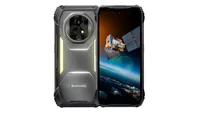
There are four versions of the WP61 that all share the same SoC, memory, and storage model but differ in the special features included. There is a base model, the Plus model reviewed here, that has a 2W DMR walkie-talkie, the WP61 Ultra with thermal imaging, and the WP61 Ti with NTN Skylo Satellite communications.
All of them use the Dimensity 7025 processor, have 12GB of RAM, 512GB of storage and the same 108MP primary camera.
The large 6.8-inch FHD+ display runs at 120Hz, which is a welcome touch for a rugged device, and Android 16 puts it on the cutting edge for that platform
Where the WP61 Plus truly distinguishes itself, however, is in its extended utility features. The built-in DMR (Digital Mobile Radio) walkie-talkie operates at 2W and is designed to maintain group communications in areas where cellular coverage fails.
Oukitel quotes a range of 5.5km (3.4 miles) for DMR communications, but this will work without any cell service.
Combined with the camping light and the ability to act as a power bank for smaller devices, this phone is positioned less as a smartphone and more as a portable field communications and survival tool.
The only significant downside of this design is its physical scale; at over 650g, this isn’t a small or lightweight design, and with the walkie-talkie antenna attached, it becomes even more unwieldy.
The WP61 Plus might not break into our best rugged smartphone selection, but if you are looking for a general-purpose rugged phone for an adventure trek, then it could be an option.

Oukitel WP61 Plus: price and availability
- How much does it cost? $370/£280/€323
- When is it out? Available soon
- Where can you get it? You can get it directly from Oukitel or via online retailers such as Amazon.
Direct from Oukitel, the asking price for the WP61 Plus is $369.99/£279.99/€322.68, which is a good deal if you accept the view that this is a discount from $499.99/£378.37/€436.06, a price at which this product has never been sold.
You read that correctly. At the time of writing, while Oukitel are promoting this product, it remains out of stock. Also, it’s not available via online retailers, but that’s probably right around the corner.
The Plus model is $50 more than the base model, but $60 less than the Ultra option. There is no price yet for the Satellite model.
There are lots of phones that use the same or similar SoCs, like the Blackview Oscal Tank 1, RugOne Xever 7 Pro, Doogee S200 and Oukitel WP300. All these are cheaper, but lack the DMR walkie-talkie technology.
Blackview has the Xplore 1 Walkie Talkie that sells for €383.95 direct from the makers, a good amount more than the WP61 Plus.
The Unihertz Atom XL is a much smaller phone with the same DMR technology, priced at $289.99 at the official Unihertz outlet. However, I’d avoid this phone because there are no US or Global models.
A better choice is the Armour 26 Ultra Walkie-Talkie, but its base price is $649.99, making it substantially more expensive.
For a DMR-capable phone, the WP61 Plus is reasonably priced, though it might seem a little expensive for the platform specification.

- Value score: 4/5
Oukitel WP61 Plus: Specs
Item
|
Spec
|
|---|---|
CPU: |
MediaTek Dimensity 7025 (6nm)
|
GPU:
|
IMG BXM-8-256
|
NPU:
|
MediaTek's APU 780
|
RAM:
|
12GB
|
Storage:
|
512GB
|
Screen:
|
6.8-inch FHD+ LCD
|
Resolution:
|
1080 x 2460 pixels 650nits
|
SIM:
|
2x Nano SIM + TF (one shared position)
|
Weight:
|
651.6 grams
|
Dimensions:
|
179.5 x 85 x 27.5 mm
|
Rugged Spec:
|
IP68 IP69K dust/water resistant (up to 1.5m for 30 minutes), MIL-STD-810H Certification
|
Rear cameras:
|
108MP Camera + 8MP Night vision +2MP macro
|
Front camera:
|
32MP Sony IMX616
|
Networking:
|
5G bands, WiFi 5, Bluetooth 5.2
|
Audio:
|
130 dB 5W speaker
|
OS:
|
Android 16
|
Battery:
|
20000 mAh (45W wired, 5W reverse charge)
|
Colours:
|
Black
|
Oukitel WP61 Plus: design
- Built for the field, not the pocket
- DMR Antenna
- Standard layout
The WP61 Plus makes no apologies for its bulk. At 179.5 x 85 x 27.5 mm, it is a substantial device, and one that is clearly engineered to accommodate its enormous 20,000mAh battery alongside the walkie-talkie antenna hardware and camping light module. The extra 27.5 mm of depth alone sets it apart as a very different prospect from a standard smartphone, and not one you can easily fit in a pocket.
What can make this design even more challenging to store is that in the box is a 92mm antenna for the DMR walkie-talkie that screws into the top right of the phone. You can choose not to attach that, but I presume that will impact the ability to communicate using that functionality.
The Oukitel WP series devices have traditionally used a combination of reinforced polycarbonate and aluminium alloy framing, and the WP61 doesn’t deviate from that, making it a device that can withstand heavy abuse.
The device supports a 'seat charger', a docking cradle that allows the phone to be mounted and charged in a fixed location, such as a vehicle dashboard or on a desk. This is a thoughtful addition for fleet operators or those who need their device always charged and ready. The dock isn’t included as standard, and its arrival date and price haven't been released yet.

In terms of the general aesthetics and layout, there isn’t anything especially surprising about the WP61 Plus. The button arrangement is the one most rugged phones use, with the power (doubling as a fingerprint reader) and volume buttons on the right, the custom button on the left, where the SIM tray is also placed.
The buttons are all metal, and the sides of the chassis are all machined aluminium, making this phone feel both comfortable to hold and seemingly indestructible.
Both the top and bottom edges feature a waterproof plug: one for the antenna on the top and another covering the USB port on the bottom. Both of these are held in place with screws, suggesting they could be replaced when they wear out if Oukitel makes replacements available.
To avoid wearing out the USB-C cover, the dock has four metal contact points on its bottom face, allowing it to be charged without inserting a cable.
The rear has three noticeable features: a camping light, a 5W speaker, and the camera cluster. The 1200-lumen camping light is obscured by a reference sticker that contains important information you don’t want to misplace by peeling it off and throwing it away, annoyingly.
According to Oukitel, the speaker is rated at 130 dB, which would undoubtedly damage your hearing if you held it against your ear while it was making noise. The top-centre placement of that speaker also pushes the three rear camera lenses to the phone's outer edge, which isn’t ideal.
While I’ve seen worse, the WP61 Plus seems to try to be many things at once and has slightly compromised some of its features in the process.

Design score: 3.5/5
Oukitel WP61 Plus: hardware
- MediaTek Dimensity 7025
- 20000 mAh battery
- Walkie-talkie
This is the third phone I’ve covered that uses the MediaTek Dimensity 7025, and I haven’t changed my opinion of it.
Instead of this being a new and exciting SoC, it’s a renaming of the older Dimensity 930, a chip from May 2022. If you research this silicon, you will find that the Dimensity 7025 was launched in 2024, but the underlying chip is at least two years older.
That explains why all the 70XX SoCs are made using a 6nm process, whereas all the 73XX and 74XX chips use the new and superior 4nm process.
Ironically, that’s not the biggest issue with this platform, since, as SoCs go, the Dimensity 7025 is an effective power-efficient system that delivers a good user experience for the most part.
A bigger problem is that the CPU is coupled with the IMG BXM-8-256 GPU, one of those PowerVR IMG designs that is poor by modern standards. It drives the Android 16 interface reasonably, but it's not a game-friendly GPU. Critically, it lacks some of the OpenGL and Vulkan functionality that interactive graphics apps often use.
For the WP61 Plus's intended use cases, it is a sensible and efficient choice, but more modern MediaTek designs, such as the Dimensity 7300 and 7400, offer far more potential.
In large, rugged phones, a 20000 mAh battery isn’t exceptional, but this device helps because it supports a 45W charger, which is included. That enables the phone to charge from zero to full capacity in about four hours, and get more than half of a charge in ninety minutes.
This is dramatically better than the WP60 offered with the same battery capacity, as that phone could only charge at 33W. Though, as I recall, the WP60 did reverse charge at 7W, where the WP61 Plus only puts out 5W.

You can get a similar platform and battery in a wide range of rugged phones, but the final feature I’ll talk about here is something that is in relatively few: a DMR (Digital Mobile Radio) walkie-talkie.
The radio in the WP61 Plus transmits at 2W, which is a meaningful output for direct device-to-device communication. DMR is a professional-grade digital radio standard, typically used in construction, security, and emergency services, making this a genuine productivity tool rather than a novelty. And, the hardware here can also work with Analogue technologies, alongside DMR-capable handsets.
As I only have one WP61 Plus, I wasn’t able to test the assertion that communication of over 5.5km was possible, but the technology is capable of that, so I don’t doubt it could work at that range in theory. The beauty of this technology is that it doesn't rely on any other infrastructure to operate, though the practical range may be limited by terrain.
For those working together off the grid or at a building site, the range seems enough to be practical, even if it won’t work if you travel beyond the potential range, or put a mountain between those talking.
The custom button opens the DMR app to initiate a call, and you can select a channel to communicate over. While you can add custom channels, the app includes the standard DMR-approved channels for a range of countries, including Europe, the USA, Australia, and Taiwan. Iran, Korea, Malaysia, Russia, Japan and China.
As a matter of interest, I researched the DMR frequencies for various countries, and discovered that for some, like India, for higher power transmitters like this one, using 5W and with better range, a WPC license is required. So if you are not in any of the countries I previously listed, it might be worth researching which DMR channels you can use and any other clearances required before purchasing.
Even with those potential caveats, the DMR part of this device is undoubtedly the best aspect, should you have more than one of these or other DMR handsets to hand.
- Hardware score: 4/5
Oukitel WP61 Plus: cameras
- 108MP, 8MP night vision and 2MP Macro on the rear
- 32MP on the front
- Four cameras in total

The Oukitel WP61 Plus has four cameras:
Rear camera: 108MP Samsung ISOCELL HM6 (S5KHM6), 8MP SK Hynix Hi-846 night vision IR sensor, 2MP BYD BF2257CS Macro
Front camera: 32MP Sony IMX616 Sensor
Oddly, this camera arrangement is remarkably similar to a range of phones I’ve recently reviewed, except that many of them use a GalaxyCore sensor for the 2MP macro function, whereas the WP61 Plus uses the BYD BF2257CS for the same job.
The combination of the 108MP Samsung ISOCELL HM6 (S5KHM6) and the 8MP SK Hynix Hi-846 night-vision IR sensor was seen on the Oukitel WP60 Pro. But that phone didn’t use the Sony IMX616 front-facing sensor, and it used a GalaxyCore GC02M1 for the Macro.
The Sony IMX616 is better than the 32MP GalaxyCore GC32E1, but the 2MP Macro sensors don’t make a huge difference to the close-up shooting you can do.
The weakness of this layout is that the 108MP Samsung ISOCELL HM6 (S5KHM6) is used to avoid the need for zoom optics by providing a high-resolution sensor that can be cropped or pixel-binned. It offers a range of zoom settings from 1.0x to 4.0x. But it’s still not as good as having actual zoom optics, as the zoom jumps between settings, and the results for some digital zoom factors are better than for others.
The SK Hynix Hi-846 night vision sensor delivers impressive results in complete darkness, although it captures only in monochrome. And the Macro sensor is exceptionally grainy and requires excessive amounts of light to produce passable results.
Probably the biggest disappointment of this camera is that the primary Samsung ISOCELL has a resolution of 108MP, and you can shoot at that full resolution, but incredibly, the best video resolution available is only 1440p. That this phone, with a 108MP sensor, can’t offer 4K video is embarrassing.
The hardware is rated for 8K at 24 frames per second (fps) and 4K at 120fps, so the video resolution is down to the choices Oukitel made about the SoC and the Android camera application.
This camera can take some excellent still images, but if I were to drag a phone this big and heavy about the wilderness, I would at least expect it to shoot 4K video.

Oukitel WP61 Plus Camera samples


- Camera score: 3/5
Oukitel WP61 Plus: performance
- Older 6nm SoC
- GPU issues with OpenGL 3.1 and Vulkan 1.3
- Great battery life
Phone
|
|
Oukitel WP61 Plus
|
Blackview Oscal Tank 1
|
|---|---|---|---|
SoC
|
|
MediaTek Dimensity 7025
|
MediaTek Dimensity 7050
|
GPU
|
|
IMG BXM-8-256
|
Mali‑G68 MC4
|
NPU
|
|
MediaTek's APU 780
|
MediaTek NPU 550
|
Memory
|
|
12GB/512GB
|
12GB/256GB
|
Weight
|
|
656g
|
640g
|
Battery
|
|
20000
|
20000
|
Geekbench
|
Single
|
959
|
920
|
|
Multi
|
2362
|
2466
|
|
OpenCL
|
failed
|
2471
|
|
Vulkan
|
failed
|
3036
|
PCMark
|
3.0 Score
|
13080
|
11684
|
|
Battery
|
40h 9m Est.
|
33h 57m Est.
|
Charge 30
|
%
|
28
|
13
|
Passmark
|
Score
|
6620
|
6861
|
|
CPU
|
5284
|
5285
|
3DMark
|
Slingshot OGL
|
3741
|
5293
|
|
Slingshot Ex. OGL
|
3738
|
4150
|
|
Slingshot Ex. Vulkan
|
2614
|
3940
|
|
Wildlife
|
Failed
|
2232
|
| Row 19 - Cell 0 | Nomad Lite
|
Failed
|
266
|
Rather than putting the WP61 Plus against another phone with the same SoC, I thought it might be appropriate to compare it with a marginally better chip, so I chose the Blackview Oscal Tank 1. It uses the MediaTek Dimensity 7050, slightly better than the 7025.
Both of these phones have the same battery capacity and RAM, which makes them closer to each other than many other rugged phones. size
What these results show is that the Dimensity 7025 is modestly slower than the 7050 used in the Tank 1, until you test it with a graphics benchmark. The IMG BXM-8-256 GPU can’t run the OpenGL and Vulkan APIs used by GeekBench and is required for 3DMark Wildlife and Nomad Lite.
But the upside of poor GPU performance is that the battery lasts much longer, with the WP61 Plus running for more than 40 hours. However, that result is a predicted endpoint because, like the Oscal Tank 1, the WP61 Plus crashed PCMark before exhausting the battery. Not sure if this is an issue with the benchmark or how both these phone makers are managing their batteries.
The overall performance of the WP61 Plus is fine for most uses, but it's not a phone that gamers or anyone who uses VR will embrace. However, with curation, the battery could easily last six days or more, which could be useful off-grid.
- Performance score: 4/5

Oukitel WP61 Plus: Final verdict
The Oukitel WP61 Plus is a device that sets out to do something genuinely different in a crowded market. Rather than competing solely on processing power or camera resolution, it bundles a professional-grade walkie-talkie, an enormous battery, and a camping light into a package that could plausibly replace multiple pieces of equipment for an outdoor professional or expedition team.
The Dimensity 7025 is not the most exciting chipset, and the physical dimensions mean this is not a device you will comfortably carry in a trouser pocket. But if your priorities are extended endurance, off-grid communications, and resilience in harsh environments, the WP61 Plus presents a compelling case at the asking price.
How useful DMR technology is to you will depend on whether you already use it or intend to buy multiple phones for walkie-talkie use. If it’s not something you'll use immediately, you could save yourself $50 by buying the base model, since it has everything else I’ve mentioned here.
Should I buy a Oukitel WP61 Plus?
Attributes |
Notes |
Rating |
|---|---|---|
Value |
Reasonable cost for a well-made device |
4/5 |
Design |
Substantial but purpose-built for outdoor use |
3.5/5 |
Hardware |
Unique walkie-talkie, 20,000mAh battery and mid-range SoC |
4/5 |
Camera |
Good for still images, but the lack of 4K video is poor |
3/5 |
Performance |
Great battery life, but sub-par GPU performance |
4/5 |
Overall |
Good price, excellent battery life and DMR |
4/5 |
Buy it if...
Don't buy it if...
Also Consider

For more ruggedized devices, we've reviewed the best rugged tablets, the best rugged laptops, and the best rugged hard drives
