





TechRadar Verdict
Practicality exited stage left when engineers designed the Doogee V Max Play, because this is too heavy and unwieldy for the majority of humans. It’s packed full of features and has a battery that could run a vehicle, but you need a pack animal just to carry it.
Pros
- +
Robust
- +
Excellent battery life
- +
Onboard LED Projector
- +
Decent camera
Cons
- -
Doubles as a boat anchor
- -
Dire bumper design
Why you can trust TechRadar We spend hours testing every product or service we review, so you can be sure you're buying the best. Find out more about how we test.
Doogee V Max Play: 30-second review
Some rugged phone makers want to put every feature imaginable in their devices, irrespective of how large and heavy it makes them.
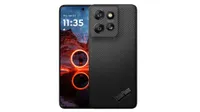
A classic example of this is the Doogee V Max Play, a monstrously large, rugged phone with an onboard LED projector.
It also comes with 16GB of RAM (not 36GB as advertised), 512GB of storage and enough battery to see you through a working week. The downside of an exceptional feature set and a talk time that’s about a third of a month is that this isn’t the most practical phone to carry.
It’s large, it's heavy, and it has a carry case that would be classed as carry-on luggage on an aircraft, if the airline wasn’t funny about you bringing a 20500 mAh battery onboard.
Ideally, this is a phone that’s dropped by helicopter onto a mountain top with all your other equipment, or mounted on a vehicle, because it isn’t anything you'd want to carry long distances.
However, those who bring it along will find that it rarely needs recharging and its features are comprehensive. While some aspects of this design are first-class, like the cameras, others, such as the projector, are more niche, and at this price, I was expecting something more practical for general use.
If you don’t care that it's so unwieldy and not inexpensive, it might provide good service, but there are too many questionable choices for it to be included in our best rugged phone selection.

Doogee V Max Play: price and availability
- How much does it cost? $690/£600/€600
- When is it out? Available now
- Where can you get it? You can get it in most regions directly from Doogee or from many online retailers.
Doogee sells its phones directly and through online retailers such as Amazon and AliExpress.
In the USA, the V Max Play sells for $689.99 directly, or you can get it on Amazon.com for $649.99. This is a reduction from its launch price of $700 on Amazon, but you can get it for only $549.99 via AliExpress for a Global model.
In the UK, it's priced at £599.99 on Amazon.co.uk, and in Europe, it's €799.99 through the various EU Amazon sites.
Overall, those on the European side of the Atlantic are probably better using AliExpress, since the UK price from that outlet is only £532.99, or €601,39 for those in the EU.
As a side note: the review phone is a VIP edition, and as such it comes with a special projection stand and a Bluetooth rechargeable speaker. And, the starting price from Doogee for that package is $744.99.
There aren’t many phones that have a comparable feature set to the V Max Play, but the asking price is close to that of the Ulefone Armor 34 Pro and the 8849 Tank 3 Pro, and both these have inbuilt projectors.
Given how relatively few phones have that one feature, it reveals how niche the V Max Play is and that rugged phone makers are willing to throw almost anything into their devices to differentiate them. This phone isn’t cheap, but it's feature-rich.

- Value score: 3.5/5
Doogee V Max Play: Specs
Item |
Spec |
|---|---|
CPU: |
MediaTek Dimensity 7300 Energy |
GPU: |
Arm Mali-G615 MC2 |
NPU: |
MediaTek APU 655 |
RAM: |
16GB |
Storage: |
512GB |
Screen: |
6.78 inchFHD+IPS Screen |
Resolution: |
1080 x 2460FHD+,120Hz |
SIM: |
2x Nano SIM + TF (all three can be used) |
Weight: |
686 grams alone, 771g with bumper |
Dimensions: |
183.5 x 85.4 x 30.5 mm |
Rugged Spec: |
IP68 IP69K dust/water resistant (up to 2m for 30 min), MIL-STD-810H Certification |
Rear cameras: |
200MP AI Main Camera + 20 MP Night Vision Camera + 8MP Ultra Wide Angle & Macro Camera |
Front camera: |
32MP Samsung |
Projector: |
100-lumen projector with Dynamic 854×480 resolution |
Networking: |
WiFi 6, Bluetooth 5.3 |
Audio: |
130dB loudspeaker with Smart PA |
OS: |
Android 15 |
Battery: |
20500 mAh (Max 45W wired, 10W reverse) |
Colours: |
Black |
Doogee V Max Play: design
- Heavy and thick
- Annoying bumper
I’ll be brutally honest - the packaging for the Doogee V Max Play is so big, I did wonder if I’d need both hands just to hold this behemoth. I can just about hold this in one hand, but at 771g with its pre-attached bumper, this is an excessively heavy phone that nobody would want to take on a hike. Even without the bumper, it's 686g, making it easily one of the thickest and heaviest rugged phones this review has ever encountered.
And some of the phone's special features have affected the button placement, which is unusual for a Doogee design.
The right side has the power button/fingerprint reader and volume rocker, but these are much further down the side than usual, because an air vent on the top right is required to stop the projector from overheating.
The left side has, going from the bottom up, the user-definable button, an activation button for the projector and the SIM tray. The SIM tray is worth mentioning because it supports two Nano SIMs and a TF card, and you can use all three simultaneously.
The top edge is entirely occupied with the projector and another vent, presumably to pull air into the phone, and the bottom edge has the USB-C port that’s covered with a large rubber plug. That plus is held in place with a screw, so it might be replaceable, making it more likely that the V Max Play can be maintained as waterproof in the long term.
To make this hefty chunk of metal, glass, and glass-reinforced plastic easier to handle, the phone's entire underside is angled, almost like a boat.
On the lower section is a slot for a strap, and a flat area with two camping LED clusters, one of which Doogee helpfully covered with an important label. And, the upper section has a camera cluster, which sticks out at least 6mm. As you can see from this topology, there is no suitable location for wireless recharging, and with a battery this big, it probably isn’t much of a loss.
Overall, the phone's design is reasonable, but the hard plastic bumper Doogee includes with it is truly annoying in several critical ways.

What this shell adds, other than additional corner protection, is a metal ring that can be used to support the phone, and might be especially useful when the projector is being used.
It also includes a large rubberised strap that covers the whole left side of the phone, allowing it to be carried like a small handbag.
However, the person who designed the bumper was evidently not told about either the camping lights or the projector button, because the design ignores the existence of these things entirely. With the bumper in place, it's not easy to get on and off, and it entirely obscures the LEDs behind reinforced plastic.
Where the stap has the uncanny ability to transfer any finger press on the left-hand side to the projector button, resulting in the projector control always being on screen when you unlock the phone.
That’s a double fail on my scorecard, and it makes me wonder how, in the development of the bumper, nobody in the Doogee engineering team didn’t notice these glaring mistakes.

Design score: 3/5
Doogee V Max Play: hardware
- Dimensity 7300 Energy
- Big battery capacity
- 480p Projector
I’ve written at some length about the Dimensity 7300 Energy or other versions of this silicon, one of the new MediaTek 4nm SoCs that also appeared in the Ulefone Armour 30 Pro, 33 Pro and 34 Pro, and is in the upcoming AGM G3 Pro, among others.
It features an octa-core CPU (4x Cortex-A78 at 2.5 GHz and 4x Cortex-A55 at 2.0 GHz) and a Mali-G615 MP2 GPU. It supports LPDDR5 RAM, UFS 3.1 storage, Wi-Fi 6E, and Bluetooth 5.4.
But in this context, the critical features of this SoC and the series it belongs to are power efficiency, AI processing (APU 655), and camera capabilities (up to 200MP, 4K HDR video). It’s designed for smooth multitasking, gaming, and advanced imaging in modern smartphones, offering a strong balance of performance and battery life.
While it's not insanely powerful like the Snapdragon 8, it’s a jack-of-all-trades SoC, and offers sufficient performance for the majority of phone apps, including games.
With such an efficient chip, it might seem excessive how much battery this phone has, but the 20500 mAh here is actually less than I saw in the Ulefone Armor 34 Pro, a phone that’s even heavier than the V Max Play.
The issue with having a battery this size, or the 25000 mAh in the Armor 34 Pro, is that it won’t charge rapidly, purely based on the capacity and how much heat the phone can dissipate.
The maximum charge rate is only 45W, which equates to at least five hours on the charger to go from empty to full charge. Therefore, this isn’t a phone where you wake and realise that you didn’t charge the phone, but you can top up while having breakfast.
The upside is that Doogee claims it can run videos for 47 hours, play music for 370 hours, and has a talktime of 165.7 hours. Whatever the reality, the battery capacity here is sufficient to operate for days without a recharge, and if curated, it might last over a week.

The final special feature of the V Max Play is the projector, which is a feature that has appeared in a few phones recently. What I’ll say about this one is that don’t get its capability confused with a home cinema projector, both in terms of brightness, image size and resolution.
For starters, it's only rated at 100 lumens, making it unsuitable for any area that’s fully lit. At a minimum, it needs a dimly lit room, and ideally, complete darkness. In those conditions, it can project a 120-inch display, but that’s highly dependent on the projection surface and any ambient light.
It’s impressive that this projector includes intelligent autofocus and keystone correction, but you can also override them if you wish to manually configure it via the built-in app. The resolution of the projection is a curious resolution of 854 × 480, which is apparently designated as FWVGA. While 480p doesn’t sound great, it's good enough for watching standard-definition TV shows and for gaming.
The V Max Play has enough battery to show full movies on the projector, but when it's finished, you might want to let the phone cool down before putting it in a pocket.
Doogee makes a projection stand accessory that didn’t come with my review can hold the phone up higher than the bumper kick-stand, and provide some stability.

- Hardware score: 4/5
Doogee V Max Play: cameras
- Rear camera: 200MP Samsung S5KHP2 primary camera, 20 MP Sony IMX350 Night Vision Camera, 8MP Ultra Wide Angle & Macro Camera
- Front camera: 32MP Samsung S5GD1

Where Doogee didn’t spare some expense is in the camera department, with at least four sensors spread around this phone. Well, maybe four. These days, phone makers typically hide the actual sensors they use from complete interrogation, so they can swap them out in mid-production for a cheaper option if they wish.
What I’m reasonably certain of is that Samsung provided the 200MP primary camera with an HP2 option that is an excellent choice. It’s backed up with the older, but equally useful, Sony 20MP IMX350 Night Camera. On the back is also another 8MP sensor that does dual duty for ultra-wide angle and Macro. This is either a GalaxyCore GC08A3 or a Samsung S5K48, as the version of Android 15 assembled for the phone had both these 8MP sensors compiled.
On the basis that the 32MP front camera is also a Samsung S5GD1, that manufacturer may have contributed three sensors to this device.
But, and this may be an aberration, some of my investigation software indicated that the 32MP on the front isn’t alone. It might have a 2MP partner sensor, presumably for creating depth effects. If true, then this phone has five sensors, which is remarkable for a rugged smartphone.

For those unfamiliar with the Samsung ISOCELL sensor series, the ISOCELL HP2 is a newer, more advanced sensor than the HP3, offering better low-light performance, faster image capture, and improved colour reproduction.
And here it can take incredibly crisp 12MB images with excellent dynamic range and deliver good results even when there isn’t much light. And, if you want to see the full sensor capture, it will snap 200MP pictures.
It can also capture 4K video on this phone, which isn’t always available when some phone makers use such good sensors.
This camera app is packed with all manner of modes that include panorama, group photos, PRO (still and video), dual video (front and back in one shot), slow-motion and time-lapse. It also includes the seemingly inevitable AI mode, where it puts ears on people. Because that’s ‘hilarious’, isn’t it?
Despite the abuse of technology, the cameras are a strong point of this phone, and it's good to see the camera app deliver so many sensor capabilities without ignoring them as usual.
Doogee V Max Play Camera samples


- Camera score: 4.5/5
Doogee V Max Play: performance
- Decent SoC
- GPU is game-friendly
- Big battery
Phone |
Header Cell - Column 1 | Doogee V Max Play |
Ulefone Armor 34 Pro |
|---|---|---|---|
SoC |
Row 0 - Cell 1 | Mediatek Dimensity 7300 Energy |
Dimensity 7300 |
GPU |
Row 1 - Cell 1 | Mali-G615 MC2 |
Mali-G615 MC3 |
Mem |
Row 2 - Cell 1 | MediaTek NPU 655 |
MediaTek NPU 655 |
NPU |
Row 3 - Cell 1 | 16GB/512GB |
16GB/512GB |
Weight |
Row 4 - Cell 1 | 686g |
825g |
Battery |
Row 5 - Cell 1 | 20500 |
25500 |
Geekbench |
Single |
1009 |
1029 |
| Row 7 - Cell 0 | Multi |
3176 |
3111 |
| Row 8 - Cell 0 | OpenCL |
2478 |
2494 |
| Row 9 - Cell 0 | Vulkan |
2501 |
2500 |
GFX |
Aztec Open Normal |
40 |
40 |
| Row 11 - Cell 0 | Aztec Vulkan Norm. |
42 |
41 |
| Row 12 - Cell 0 | Car Chase |
36 |
36 |
| Row 13 - Cell 0 | Manhattan 3.1 |
60 |
61 |
PCMark |
3.0 Score |
11709 |
11471 |
| Row 15 - Cell 0 | Battery |
43h 28m |
45h 43m |
Charge 30 |
% |
11 |
21 |
Passmark |
Score |
13901 |
14258 |
| Row 18 - Cell 0 | CPU |
6973 |
7204 |
3DMark |
Slingshot OGL |
6977 |
7000 |
| Row 20 - Cell 0 | Slingshot Ex. OGL |
5275 |
5343 |
| Row 21 - Cell 0 | Slingshot Ex. Vulkan |
4862 |
2457 |
| Row 22 - Cell 0 | Wildlife |
3269 |
3249 |
| Row 23 - Cell 0 | Nomad Lite |
360 |
353 |
As both the Doogee V Max Play and the Ulefone Armor 34 Pro I included for perspective use a similar SoC, GPU, NPU and memory model, the majority of these results are a coin-toss as to who will win. These are both decent phone platforms, and for a rugged phone, the chips in these are modern and efficient.
Where these results diverge is that the Ulefone Armor 34 Pro has another 25% more battery capacity, but the running time is only marginally longer, and certainly not 25% longer. That said, the Ulefone device recharged more quickly, and that’s definitely a weakness of the Doogee V May Play.
The running time of more than 43 hours is great, and if you used it constantly for eight hours per day, it would take you from Monday to Friday easily. Those who can resist the urge to look at their phone all day could clock up a week or more before a recharge is necessary.
There are more powerful phones with faster CPUs and GPUs, but for the average user, the platform in this one is decent.
Where it excels is making the most of the battery capacity, and this is demonstrated well by the PCMark battery test results. It might have a 4500 mAh battery capacity less than the Ulefone, but it manages to go nearly as long. The tweaking of the Dimensity 7300 to make it the 7300 Energy certainly works, and a running time of more than five eight-hour days is useful to those away from daily recharges.
Therefore, in most respects, the Doogee V Max Play performs well, but at this asking price, it should.
- Performance score: 4/5

Doogee V Max Play: Final verdict
I think this phone has probably crossed the Rubicon, where on one side is an entirely practical device and on the other is something less useful. It’s like someone made a giant Swiss Army knife with a broadsword as one of its tools.
I’m a large person, but I couldn’t imagine carrying one of these around all day, and certainly not if I’m hiking across a forest or a desert.
This is only practical if it's mounted on a vehicle, and then it's less about its size than how long it can operate on its battery.
The projector works best in complete darkness if you bought a highly reflective surface to project onto, and it doesn’t flatten the battery so quickly that you won’t see the extra scene after the credits.
What it badly needs is a new bumper, one that considers where the camping LEDs are on the phone, and doesn’t have a strap that conflicts with the projector button.
But based solely on the price and the ergonomic compromises made with the V Max Play, be certain you are willing to live with its idiosyncrasies before investing in this option.
Should I buy a Doogee V Max Play?
Attributes |
Notes |
Rating |
|---|---|---|
Value |
Maker price is too high, but online its more affordable |
3.5/5 |
Design |
Terrible bumper and a massive device |
3/5 |
Hardware |
Decent SoC, 480p projector and a 20500 mAH battery |
4/5 |
Camera |
200MP Samsung sensor takes great pictures and video |
4.5/5 |
Performance |
Decent performance and enhanced battery life |
4/5 |
Overall |
Not the most practical phone, even if its feature-rich |
4/5 |
Buy it if...
Don't buy it if...
Also Consider

For more durable devices, we've reviewed the best rugged tablets, the best rugged laptops, and the best rugged hard drives
