





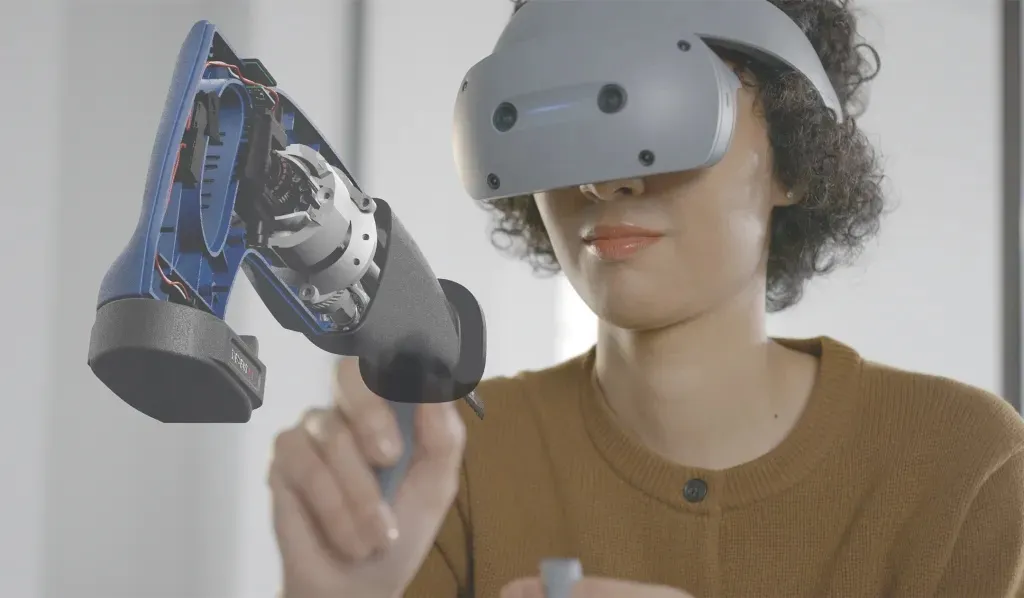
Sony and Siemens have unveiled a mixed reality headset designed for the industrial metaverse at CES 2024.
The two tech giants have teamed up to develop a headset for engineering and design (among other things) set to be released later this year.
The mixed reality headset is designed for professionals looking to expand their productivity and problem solving within the industrial metaverse.
“Solve real world problems”
Siemens CEO Dr. Roland Busch stated that the headset will be used within the industrial metaverse, which he explains as “an immersive space where people and AI can collaborate in real time to solve real world problems.”
The headset will feature 4K OLED microdisplays and is controlled using a pair of unusual controls. One is a more traditional looking VR controller, but the other is worn on one finger.
At CES 2024 a number of the headset’s use cases were demonstrated, with particular attention being drawn to the use of digital twins - a highly detailed virtual recreation of a product or design - which can help companies keep production costs down by prototyping their designs in the metaverse.
The mixed reality headset is designed to use Siemens’ Xcelerator digital transformation software, which combines IOT hardware with an open ecosystem of tech companies and industrial partners allowing enhanced collaboration and expert design feedback.
The capabilities and design of this headset certainly targets a professional demographic, and may be a viable alternative for those with their eye on the Apple Vision Pro.
Sony’s executive deputy president and officer in charge of technology and incubation, Yoshinori Matsumoto, stated, “At Sony, we are passionate about empowering creators with cutting-edge technologies, and in the field of spatial content creation, we have thrived in innovating the way they work by utilizing our proprietary motion and display technologies.”
More from TechRadar Pro
- Appreciating generative AI’s DevOps benefits
- Take a look at our guide to the best graphic design software
- Your next work PC will almost certainly be AI-equipped
