
The best portable power station is essential for keeping devices and appliances powered during outages or when you're off-grid. Whether you're looking for a lightweight unit for camping or stashing in the truck for work, or a heavy-duty power station that will keep the lights on during blackouts, these are the top-performing units based on extensive tests of over 40 power back-up supply units.
The EcoFlow Delta 3 Plus is the best choice for most users - my testing panel found it an excellent all-rounder, packing a fair 1024Wh battery capacity that's ideal for general use at home, in the RV, or on jobsites. It charges quickly, boasts a good selection of ports and outlets for all your devices, and we really like the 10ms UPS switchover for delivering continuous power during outages.
Update: In my latest update, I've reviewed the current picks, explored our newest reviews, and added the Bluetti Pioneer Na as a top option for those in colder climates.
Best portable power station overall


EcoFlow power supplies have long been a favorite of ours, and after extensive tests, the Delta 3 Plus proved an insight into the next generation of off-the-grid power.
Specs-wise, you’re looking at 1024Wh battery capacity, 2400W output, and a great port selection. For charging the device itself, you have the option of using AC, solar, car, or smart generator, making it a versatile device. .
So, what was our experience using it? Well, we tested this device in the home office, garden, in a Jeep, and out on the road, and it proved to be a lot of fun. Operation was quiet, and we liked the rapid charging features and overall robust build quality. But what particularly impressed us is the UPS with a 10ms switchover, which means your core devices shouldn’t lose connection. During review, we simulated several power outages and our router, laptop, even lights stayed on for as long as the portable power station held charge.
Price is admittedly high, and accessories are limited. However, for the cost, we found this unit delivered a solid balance of power, portability, and features, and an ideal solution for most uses.
Read our full EcoFlow Delta 3 Plus review
Best portable power station on a budget


The EcoFlow River 3 is a genuinely portable power station, tipping the scales at 7.8 lb and measuring 10 x 8.3 x 4.4 in.
In other words, this compact unit is perfect for camping, road trips, or emergency back-up if you know power's coming back shortly. We wanted to see just how portable the power station was, so we slipped it on the back tray of a Jeep Cherokee, a standard backpack, a storage cabinet, in a carrier on a four-wheeler, and even in a portable tech cart. And yes, it fitted in nicely, giving this one some real versatility.
Given the size, you can't expect it to have a massive battery capacity - it hits 245Wh - but we tested it out and found it could recharge a dead MacBook Pro three times before needing a recharge, while powering a separate monitor at the same time.
Beyond the small-form design, we were also fans of the fast charging capabilities and UPS support. So, overall, ideal for travel or home use, especially where space is at a premium.
Read our full EcoFlow River 3 review
Best portable power station for RVs and home back-up


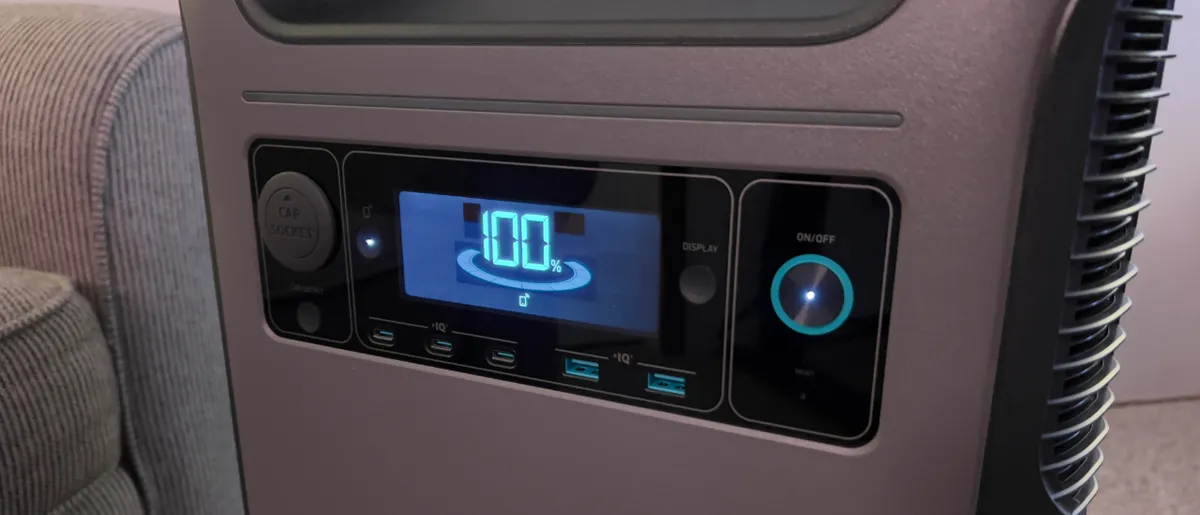


There’s no denying that the Anker Solix F3800 is a big beast - but then, with a 3840Wh battery capacity and 6000W output, it needs to be. You can even expand power supply up to 26.9kWh with additional battery packs. We’re just thankful this 132lb monster comes on wheels for portability.
It’s been one of our favorite portable power stations for some time, and I can’t see that change anytime soon. If you need a lot of power for, say, your whole home or RV, this is one of the best out there. According to Anker, the unit will capably handle running an air conditioner, or even directly charge an electric vehicle. And after extensive testing, we can believe that.
We ran a router, space heaters, and lights, charged laptops and iPads, and it handled everything we threw at it without issue. Port selection is excellent, boasting three UPS AC sockets and three standard AC sockets, a NEMA 14-50 AC port, L14-30R AC port, a DC port, three USB-C and two USB-A ports, home panel and dual solar panel ports, a car input port, and room for battery expansion.
Beyond the sheer size, weight, and cost, the only real downside here is that we couldn’t charge up another portable power station using this device (and we tried - and the unit warned us of potential damage).
Tip: Pair this with Anker's F800 Home Power System (see our review) for even more reliable home connections during blackouts.
Read our full Anker Solix F3800 review
Best portable power station for on-site work


Jackery is a core player in the portable power supply game, and one of those brands you typically can’t go wrong choosing. For on-site and field work, though, I like what’s on offer with the Jackery Explorer 1000 V2, an update on the V1 unit that increases the power output and improves both port selection and overall portability.
The capacity here is 1070Wh with a 1500W output and 3000W surge protection, capable of powering most household devices and appliances. In our own tests, we found it easily kept up charging three computers, a camera, drone, and lighting for the day. When we hooked up a MacBook Pro, it stayed fully charged with almost a continuous 100W power draw for six hours. We were delighted with the number of ports on offer - three AC sockets, one USB-A and two USB-C ports, and a car outlet - letting you power up a full suite of devices and appliances at once. Usefully, for those using this for work (or even at home), there’s also UPS, and when simulating an outage with a 3D printer, we experienced seamless switchover with no downtime when the power was cut.
At 10kg, it might be slightly too heavy for some, and the 1500W output won’t power every household appliance, like irons, but in short, there wasn’t much we didn’t like about the Jackery Explorer 1000 V2 when used for off-site work.
Read our full Jackery Explorer 1000 V2 review
Best portable power station with swappable battery


The Bluetti AC180T is a great all-rounder power station - but it boasts one of the best features I've seen on any unit here: the ability to hot-swap batteries. That's going to be a serious life-saver for anyone who can't (or won't) wait for the unit to recharge once depleted.
Oh, and it's also a mini cooler.
You read that right. The AC180T is part of Bluetti's SwapSolar series, which features changeable batteries and a multi-purpose cooler system and ice-maker all in one. When we reviewed this, we were delighted to find the system let us use the spacious Multi-Cooler anywhere while running on batteries - and when it begins running low, it was simple to pop it and swap it with another battery charging within the unit.
It's aimed at campers, road-trippers, and travelers, and when we took this out on vacation to the cabin, we could see why. Performance proved to be fantastic as both a standard portable power station and as a cooler (it still feels odd even saying that, but there you go - the capability of this unit is great).
Elsewhere, the power station is loaded with essential extras like UPS and a good but not extensive selection of ports. It's not the highest-capacity portable power station around, and it's probably overkill for a lot of users, but in most ways, this is one of the coolest portable power supplies around.
Read our full Bluetti AC180T review
Best portable power station for cold weather

Bluetti's Pioneer Na is essential if you need reliable power supply in extremely cold environments, as it's designed to charge at -15 °C and discharge down to -25 °C.
The Pioneer Na is the world's first sodium-ion powered portable power station ('Na' being the chemical symbol for sodium in the periodic table). And that's gives it the edge over traditional lithium power stations, delivering superior thermal stability and reliability in cold weather.
At 900Wh, battery capacity isn't ultra-high for the price (you're paying for the newer tech, really). However, in the team's tests, it easily handled powering a laptop, small refrigerator, and LED lighting all at once. Switching to the Power Lifting mode, it even powered high-draw appliances (in short bursts, at least).
Design-wise, it's compact but relatively heavy at 35lb (16kg), and Bluetti has hardly innovated here. Beyond the light blue coloring, it stylistically fits in with the company's other offerings. What's especially good here are the tactile buttons, which are intuitively laid out and easily accessed even while wearing gloves.
It also has broad appeal - we praised it as ideal for campers, RV users, and homeowners who want dependable backup in frosty conditions. Ultimately, nothing comes close to the Pioneer Na if you want a portable power station that works even in freezing temperatures.
Read our full Bluetti Pioneer Na review
Best portable power station for drones


If you're a big-time drone operator, then DJI's Power 2000 is going to be the one to opt for over the lower capacity Power 500 and Power 1000 units.
As with previous models from the company, this power station features a port specifically for charging DJI drones, but it does a lot more than that, too. We tested this across a range of high-draw household devices, as well as using it as part of a home office set-up. It all worked perfectly - and pretty much completely silent in use, too.
Specs-wise, it's well-equipped for power back-up, with a 3000W continuous power output, and also includes a Uninterruptable Power Supply features, which is essential for units of this size. There are improvements we'd make here and there, including a not particularly good app and AC port placement to the front. But for operators of drones, it's ideal.
Tip: If you want a smaller power unit for drones, check out my DJI Power 500 review.
Read our full DJI Power 2000 review
Best portable power stations compared
Model | Our rating | Capacity | Output | Solar input | Size & weight | Best for... |
|---|---|---|---|---|---|---|
★★★★★ | 1024Wh | 2400W | 1000W | 15.7 x 8.0 x 11.2 in / 27.6 lb | Home, on-site, camping, travel | |
★★★★⯪ | 245Wh | 300W | 110W | 10 x 8.3 x 4.4 in / 7.8 lb | Home, camping, travel | |
★★★★⯪ | 3840Wh | 6000W | 2400W | 27.6 x 15.3 x 15.6 in / 132 lb | Home, back-up, RV | |
★★★★★ | 1070Wh | 1500W | 400W | 12.87 x 8.82 x 9.72 in / 23.8 lb | Home, on-site, camping, travel | |
★★★★⯪ | 2× 716Wh | 1800W | 500W | 15.4 x 11.0 x 15.6 in / 58.4 lb | Home, on-site, travel | |
★★★★☆ | 2048Wh | 3000W | 1800W | 17.6 x 8.9 x 12.8 in / 48.5 lb | Home, camping, drones |
Best portable power stations: Also tested
My team and I have reviewed more than 40 power units, and while not all of them can be 'the best', these are my favorite top-rated portable power stations deserving of an honorable mention.
Model | Our rating | Capacity |
|---|---|---|
★★★★☆ | 1024Wh | |
★★★★☆ | 2073Wh | |
★★★★⯪ | 1843Wh | |
★★★★☆ | 768Wh | |
★★★★☆ | 512Wh |
Model | Our rating | Capacity |
|---|---|---|
★★★★⯪ | 256Wh | |
★★★★★ | 4096Wh | |
EcoFlow Delta 2 Max | ★★★★★ | 2048Wh |
Model | Our rating | Capacity |
|---|---|---|
★★★★⯪ | 1056Wh | |
Anker 767 PowerHouse | ★★★★★ | 2048Wh |
Model | Our rating | Capacity |
|---|---|---|
★★★★⯪ | 3072Wh | |
★★★★☆ | 2042Wh | |
★★★★☆ | 293Wh |
Model | Our rating | Capacity |
|---|---|---|
★★★★☆ | 620Wh | |
★★★★☆ | 3096Wh | |
★★★★⯪ | 4000Wh | |
★★★★☆ | 3072Wh | |
★★★★⯪ | 1462Wh | |
★★★★☆ | 1024Wh |
Tips for choosing the best portable power station for you
These are the specs I recommend checking to make sure you get the right power supply for your needs.
Specs | General use | Jobsites | RVs | Home back-up |
|---|---|---|---|---|
Capacity (Wh) | 256Wh and above | 1024Wh and above | 2048Wh and above | 2048Wh and above |
Output (W) | 300W and above | 1000W and above | 1500W and above | 2000W and above |
Features | Compact size | Built-in carry handle, rugged design, port covers, high surge wattage | Must have 12V car port, solar charging, UPS | Expandable batteries, UPS |
Battery capacity
Power station battery capacity is measured in Watt Hours (Wh) - or 1 watt of energy used per hour. The higher the number, the more battery capacity the unit has, the longer it lasts without requiring a recharge. To give you an idea of the power a unit has, an iPhone 17 Pro Max has a battery capacity of 20Wh; the cheapest and smallest portable power station in this guide has a capacity of 245Wh.
Output
Output measures the total continuous power supply a unit can deliver, and is measured in Watts (W). Small devices like a laptop and coolers tends to need around 60 to 100W of continuous power whereas appliances like fridges can need up to around 800W. So, a large portable power station with a higher output is best for powering large devices, or more devices at once.
Input
Portable power stations are usually charged via the mains - it's quick and efficient, especially for higher-capacity units. Many also let you charge the device from the car using a 12V cigarette lighter socket - ideal for those living the van life or in the RV. You can recharge some devices using solar panels, too.
Solar
Every portable power station I've selected for this guide have solar charging capabilities for off-grid power supply, but not every unit you can buy does. The solar panels can come bundled with the unit or bought separately. Smaller power stations will have a lower maximum solar input, making them slower to charge.
UPS
Uninterrupted Power Supply (UPS) is essential for ensuring reliable and continuous power even during black-outs. If you're using your unit for devices like routers or fridges, it's. Effectively, a UPS-enabled power station will step in during a power outage to continue charging or powering connected devices. Times vary, and while we're talking a matter of milliseconds, if it's a 'mission-critical' device, then select one with a faster switchover time.
High surge wattage
This is especially important if you're using a portable power station on a job-site, as some tools, like circular saws, draw a huge amount of power at once. So, a unit with a high surge wattage (or high surge rating) prevents the machinery from tripping out the unit.
Size & weight
"Portable" isn't one size fits all. My team and I have reviewed everything from compact and handheld units to massive power stations that have built in wheels or need a trolley to move them. Depending on how and where you'll be using the unit, you'll want check the dimensions. As you'd expect, the higher the battery capacity, the heavier the power station will be.
Ports
Port selection is always worth checking. Portable power stations almost always include USB-C and USB-A ports, as well as mains outlets. However, larger units will usually have a higher number of ports as there's extra space for them, and the unit holds more power to charge more devices. Some go beyond this - for example, DJI's products include an SDC port for charging DJI drones on the go.
Best portable power stations: FAQs
Are portable power stations worth it?
Yes, but it depends on how often you use it and how many devices you're charging. There are a lot of models on the market, and the best portable power stations can handle everything from charging mobile devices and laptops to powering appliances and even EVs. If your needs are simple, you can pick up a good portable power station for around $200.
What is the difference between a portable power station and a generator?
Generally speaking, a portable power station is charged and outputs electricity. Generators tend to refer to units that use fuel like gasoline to generate energy and power.
Both can be used for back-up purposes, and both have different pros and cons.
Power stations are quieter, cleaner and more eco-friendly, and . However, their battery capacity can be low, and if it runs out of charge during a power-cut, you'd best hope it has built-in solar panels to re-charge.
Power generators are ideal for running heavy appliances, as they have a higher capacity, and isn't reliant on electricity, making it perfect for a back-up solution.
How many years do portable power stations last?
It depends on how often you use your power station and the type of battery inside. Like any battery, for example one in a phone or laptop, this will wear down over time until the power station no longer holds charge. General estimates put the lifespan of a portable power station at around ten years. Expect it to last approximately five years minimum with standard use.
What can you run on a portable power station?
So long as your portable power station has the right ports and enough capacity, it can run a massive range of devices, including phones, laptops, and desktops.
Higher capacity units will also let you power large home appliances and charge electric vehicles.
Check which ports your preferred model has, including USB Type-A and Type-C, AC and mains sockets.
How long can you run a portable power station?
It all depends on the power station and the device or devices you're charging. As a general rule of thumb, to figure out how long your portable power station can run, divide battery capacity (Wh) by power drawn by the device (W).
What is UPS and why do I need it?
UPS stands for Uninterrupted Power Supply, and it’s a really important feature if you’re powering devices like routers and household appliances like fridges, or working on-site and need reliability. If you experience a power outage, the portable power station will automatically and seamlessly continue charge your devices without dropping the supply.
How we test the best portable power stations
Our team of expert reviewers have hand-tested a range of outdoor-ready equipment, including the best rugged smartphones, the best rugged laptops, and the best rugged tablets for working out in the field. We've even tested out the best rugged hard drives. So, we know what to look for when it comes to technology for rural locations and hostile environments.
We test the best portable power stations on volume, weight, battery chemistry, and additional feature sets. Before writing any review, we try to fully understand the unit to describe each device's pros and cons best and accurately compare them. Part of this process is through benchmark tests, part is through daily use, and part is through simulated or real scenarios.
As the main function of these devices is to be batteries, we test charge and discharge cycles on every unit. First and foremost, this is the most important feature of the portable power stations we test. If they cannot meet our standard here or do not come near what the other portable power stations in this guide are capable of, we will most likely not include them.
Next, we push the power stations to their limits and beyond. We intentionally exceed the maximum power allowed on each generator, then observe and note the recovery from the over-power protection. This helps us promote safe power stations for you and your family.
To ensure reliability, these tests are designed to learn the features, the downfalls, and the limits of the power stations tested by our subject matter experts.
Get in touch
- Want to find out about commercial or marketing opportunities? Click here
- Out of date info, errors, complaints or broken links? Give us a nudge
- Got a suggestion for a product or service provider? Message us directly
- You've reached the end of the page. Jump back up to the top ^
