





Most people have a wireless network in their home these days. So you might think that Powerline networking (aka HomePlug), which uses your home's electrical wiring as a wired data network, is an outdated and redundant technology.
But you'd be wrong. Yes, Wi-Fi is convenient and fast − 802.11n technology is widespread and the newest 802.11ac-class routers, like the dual band TP-Link Archer C7 AC1750, promise even zippier connection speeds up to 1300Mbps.
However, there's a simplicity and reliability that Powerline offers that wireless technology still can't match. It's not designed to replace a Wi-Fi network. It's supposed to complement one.
What is Powerline networking?
A Powerline network is essentially a wired network with (mostly) hidden wires. Let's say that you have your broadband router in the hallway and a smart Samsung HD TV in the living room. Let's also say that this particular telly isn't wireless-enabled, so the only way that you can enjoy catch-up TV on it is to trail an Ethernet cable from the router, down the hallway, and across the living room floor to the TV. You try to hide the cable with a big rug. It doesn't work.
The Powerline solution is less visible − a 'no new wires' approach. You buy a basic kit, which comes with two Powerline adapters and two short Ethernet cables. You connect one of the Ethernet cables to your router and to the first of the adapters. Then you plug it into the nearest power socket. You click the second Ethernet cable into the back of the HD TV and into the second adapter. You plug the second adapter into the nearest power socket.
And that's it. The adapters auto-detect each other (no drivers, no lengthy configuration process) and auto-connect, enabling data packets to whizz from router to TV, travelling along the Ethernet cable, into the first adapter, across the electrical wiring in the walls, out into the second adapter and into the TV. When the first HomePlug Powerline standard was introduced in 2001, data speeds were limited to a sluggish 14Mbps. But the newest Powerline products now support Gigabit-class networking.
Why use Powerline networking?
If you've already got a wireless hub, you might not see the point of incorporating Powerline adapters into your home network. But the technology has several advantages over Wi-Fi, namely consistent speeds, reliability, security and ease-of-use.
Powerline is a bridging technology, often useful for extending the reach of a home network to places where your wireless coverage is poor, or where you need the fastest connection possible − a games console, perhaps, or an Apple TV. It's also ideal for connecting old devices to the Internet that don't have built-in Wi-Fi connectivity, avoiding cluttering up your living room with a tangle of Ethernet cables. Powerline is a neat and effective networking solution.
Powerline technology is arguably more secure than a wireless network too. As data is sent across the copper wiring in your home, it can't be hacked or misused from the outside. Modern Powerline kit also encourages you to password protect your adapters, adding an extra layer of protection.
How does Powerline networking work?
Sending signals across a home's electrical wiring isn't a 21st century idea. In fact, the power companies have been sending control signals over the mains since the 1920s − it's how electricity meters know when to switch to an off-peak rate. The electrical wiring in the average home can support a variety of frequencies. As electricity uses 50/60Hz signals, extra data can be transported along the same wiring at much higher frequencies, without causing any interference.
The original HomePlug 1.0 standard (IEEE 1901) accelerated out of the blocks at a somewhat pedestrian 14Mbps, although real-world speeds were closer to 5Mbps. A 'Turbo' upgrade boosted the maximum throughput of version 1.0 to 85Mbps (real-world speeds of around 20Mbps). In 2005, a revamped HomePlug AV boosted the rate even higher, claiming 200Mbps on the box (80-90Mbps in tests) − more than enough to cope with audio and video streaming, hence the 'AV' tag.
Most recently, January 2012 saw the release of a newer, faster version of the HomePlug Powerline standard. Enter the HD and 3D video-friendly HomePlug AV2, which incorporates MIMO technology to send data over the fastest two wires in a typical three-wire (live, neutral and ground) home electrical system.
What is HomePlug AV2?
According to homeplug.org, "HomePlug AV2 enables even more powerful performance and coverage for broadband networking over powerline wires, making it faster than ever to handle the most demanding online services and applications."
In practice, the first wave of HomePlug AV2 products was rated at 500Mbps, although as we've seen the real-world speeds are typically a lot less than this. For example, in our Linksys Powerline HomePlug AV2 Kit PLEK500 review, we recorded network speeds of up to 107.28Mbps. Good, but nowhere near the 500Mbps theoretical maximum.
Powerline speeds are about to get faster. At CES 2014, TRENDnet announced a new Powerline 1000 adapter kit (TPL-420E2K), which effectively doubles the theoretical 500Mbps AV2 data rate. TP-LINK also launched a Gigabit Powerline adapter (TP-PA8010). Both feature MIMO technology, handy power-saving standby modes, auto-connectivity and data encryption. They're also both backwards compatible with 500Mbps AV2 and older HomePlug AV hardware.

Who makes the best Powerline kit?
It depends on your definition of 'best'. The adapters themselves are ludicrously simple to install − quite literally 'plug and play'. However, they're not always cheap, as you can see from our Linksys Powerline HomePlug AV2 Kit review that includes two wall adapters for around .
Older, less expensive AV technology is still available − a pair of TP-Link TL-PA211KIT AV200 Nano 200Mbps Powerline adapters can be picked up for a lot less if you shop around.
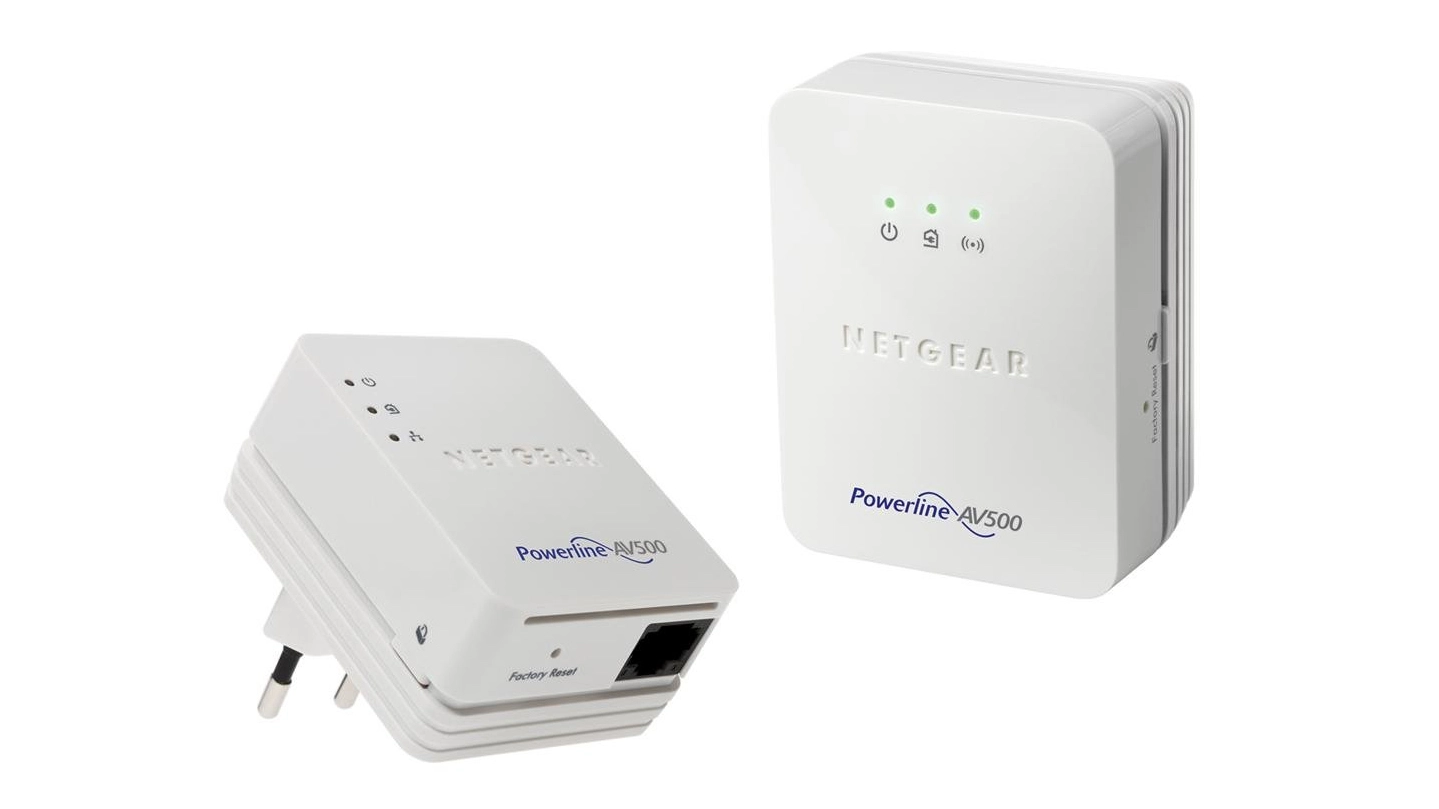
Not all Powerline products offer the same features either. The Netgear Powerline 500 Wi-Fi Access Point uses the technology to route Internet connectivity from your router, through your electrical wiring, and into a wireless access point to boost the range of a Wi-Fi network.
The Netgear Powerline 200 + USB XAU2511 takes a different tack and, as its name suggests, incorporates a USB port alongside the standard Ethernet jack. This allows you to share USB devices over a network, turning a printer into a network printer or a USB drive into a NAS.
The Devolo dLAN 500 AVtriple+, meanwhile, features an adapter with three Ethernet connections, enabling you to hook up multiple devices. Otherwise, it's a case of one Powerline adapter, one Ethernet cable, one device.
Of course, the disadvantage of basic Powerline kit is that you can't use the wall sockets for anything else once you've plugged in an adapter. But take another look at the Netgear Powerline 200 + USB and the Devolo dLAN 500 AVtriple+ and you'll see that the adapters also feature a pass-through connection, enabling you to continue using the plug socket.
In some cases, manufacturers may opt to build HomePlug AV2 technology into consumer electronics products. But ultimately, the best Powerline solution depends on what you want to connect and how much you want to pay for the privilege.
What's next for Powerline networking?
Next up is HomePlug Green PHY (aka HomePlug GP), a subset of the AV2 standard. It's not an evolution of AV2 as such, so don't expect an imminent networking speed boost. In fact, HomePlug Green is actually slower, supporting speeds of around 10Mbps, with up to 75 percent reduced power consumption compared to existing HomePlug hardware.
The point? The new format is being prepped for future 'smart grid' applications and a whole new wave of HVAC devices and other connected appliances. According to the HomePlug Alliance, "[HomePlug Green] can be used in smart energy applications such as demand response, load control, energy efficiency, as well as for home/building automation."
HomePlug Green will also be used with plug-in electric vehicles. Car manufacturers including Audi, BMW, Ford, GM and Volkswagen have all agreed to use HomePlug Green as the common protocol to control how future cars communicate with their charging stations.
Last, but by no means least, HomePlug's IEEE 1901 format is also part of a converged IEEE 1905 standard that embraces 802.11 wireless networking, IEEE 802.3 Ethernet connectivity and Multimedia over Coax. This will further ensure home networking compatibility when you mix wireless and wired technologies together.
The smart home is coming. It's just taking longer than anyone thought.
- Liked this? Then check out How to choose the best home networking option